


Welcome to AI Health Uncut, a brutally honest newsletter on AI, innovation, and the state of the healthcare market. If you’d like to sign up to receive issues over email, you can do so here.
Important Disclosure. This publication is written and distributed by an independent journalist and constitutes journalism, commentary, and opinion protected by the First Amendment to the U.S. Constitution and other applicable principles of freedom of speech and freedom of the press. Those protections do not eliminate the responsibility to report accurately, and I take that responsibility seriously. I endeavor to base factual statements on verifiable information, primary-source documentation, publicly available records, interviews, and other evidentiary materials. Where I express opinions, interpretations, inferences, or conclusions, they should be understood as such and are based on the information available to me at the time of publication.
I have no financial interest, whether long or short, direct or indirect, in any of the companies discussed in this article. I have not received compensation from any person or entity for publishing this article. Nothing in this publication constitutes financial, investment, legal, or other professional advice.
Can you feel it?
That crisp autumn air. The leaves beginning to turn. And wait… do you hear that? Somewhere in healthcare, another upcoding allegation is quietly poking its head above the soil.
Then another.
And another.
Ah, fall. 🍂 My favorite season. Pumpkin spice, shorter days, and fresh reminders of what can happen when AI, reimbursement incentives, and healthcare collide.
Come along with me as we wander through this charming little landscape of AI, upcoding, and alleged criminal conduct.
🚨 But first, a couple of quick personal announcements…
I’m honored to be speaking at the Origin Point healthcare technology conference in beautiful La Jolla, CA, on September 16–18, 2026. If you’re there, please come say hello!

🎙️ Calling all medical professionals, healthtech folks, and fans of our podcast, Digital Health Inside Out. Alex Koshykov and I are looking for a few brave souls willing to join us for in-person conversations that may range from serious healthcare debates to completely inappropriate healthtech dad jokes. 😄 We’ll be recording right from the floor of HLTH in Las Vegas, November 15–18. 🎰🔥 If you’ll be there and think you’d be a good sport, drop a comment or send either of us a DM. One thing we can promise. It won’t be boring. And yes, things may get a little heated from time to time. 😉
And my favorite part: providing students full access to AI Health Uncut. I receive a lot of messages daily, and I always strive to respond promptly to every one of them. Most are incredibly kind and supportive.
I want to highlight one recent message in particular. A student reached out recently asking for full, paywall-free access to my Substack. Of course, I granted it, as I always do.
This brings me to another important message. If you cannot afford this article—perhaps you’re a student or currently between jobs—please reach out. That’s precisely why I created the AI Health Uncut Founding Member Club. Thanks to generous donations and support from these wonderful individuals, I’m able to provide access to anyone who needs it. By the way, students reach out frequently, and I’m always glad to help.

If you’d like to support my mission to uncover the brutal truth in healthtech and healthcare AI, please consider becoming a Founding Member of the AI Health Uncut community. You can join through this link. You’ll be making a real impact, helping me continue to challenge the system and push for better outcomes in healthcare through AI, technology, policy, and beyond.
All right, housekeeping’s done. Now back to AI upcoding…

AI is making medical upcoding easier, faster, and vastly more scalable. At its core, upcoding means billing for diagnoses, conditions, or care that were not actually documented or delivered. That is fraud.
The laws are already on the books. The problem is enforcement. “Maximizing billing and coding” has become one of the fastest-growing businesses in American healthcare, and AI is transforming what was once a manual compliance problem into an industry of its own.
I examine some of the most recent AI-related upcoding cases, then lay out the red flags to watch as a new generation of “autonomous” medical coding companies races into the market.
I also connect this AI upcoding saga to a direct question I recently put to Heidi Health CEO Tom Kelly on “Digital Health Inside Out.”
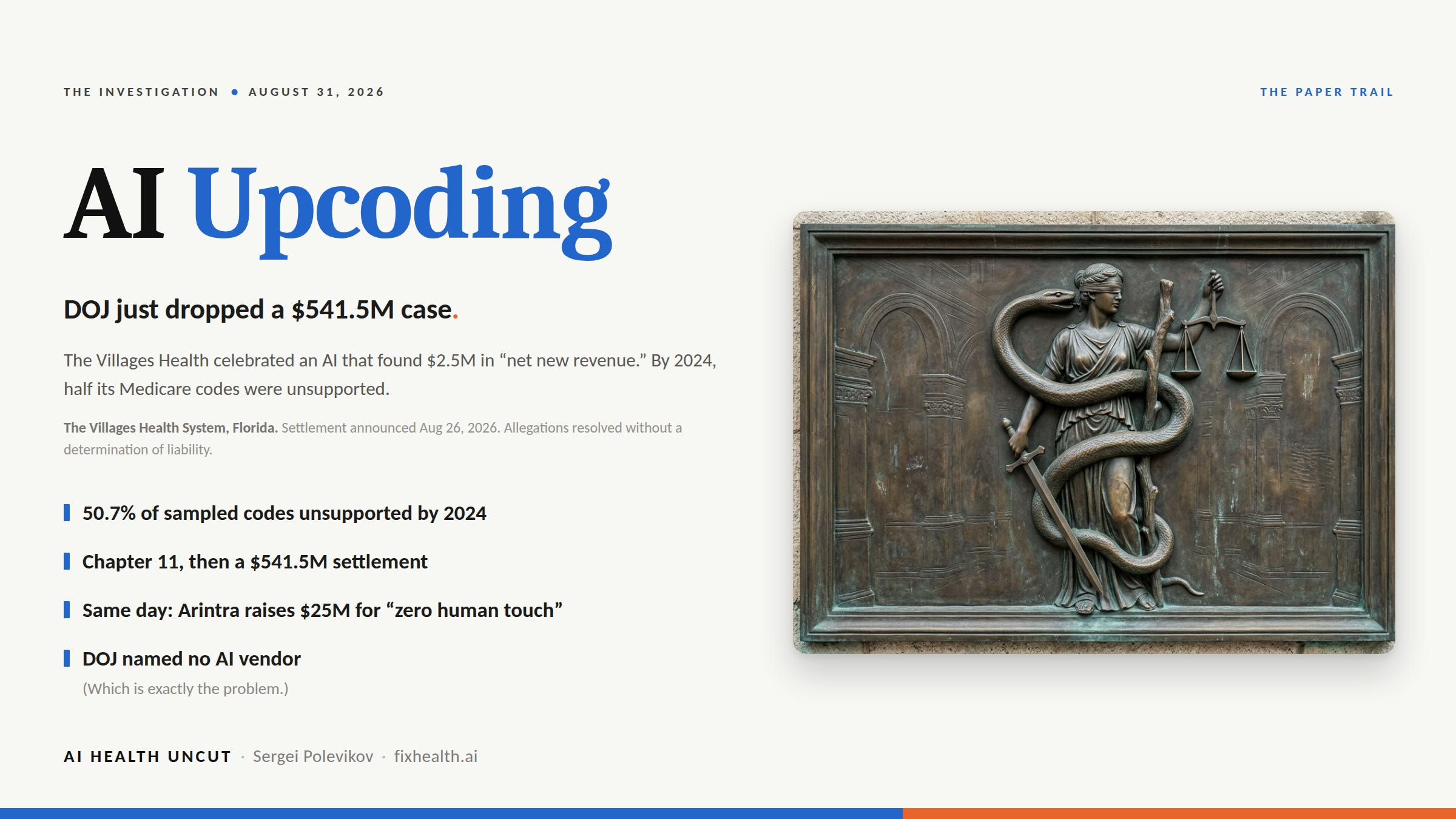
Last Wednesday, August 26, the DOJ announced a $541.5M False Claims Act settlement with The Villages Health System, a Florida primary care group, over invalid Medicare Advantage diagnosis codes submitted to Humana, UnitedHealthcare, and Florida Blue. DOJ dates the conduct “from 2020 through 2024,” and the settlement agreement pins it to January 2020 through December 2024. A bankruptcy judge approved it on August 25. It is the second-largest Medicare Advantage settlement I know of, arriving seven months after Kaiser’s $556M. It’s mind-blowing how healthcare organizations, big and small, can cough up more than half a billion dollars just to make the bad news disappear. 🤯
The mechanics are the story. Per the settlement agreement, employees ran two internal programs called “Retrospective Amendments” and “Sprints,” inserting diagnosis codes into charts “sometimes months to over a year after the patient visit,” not initiated by the rendering provider, and routed for approval to a non-rendering provider such as the chief medical officer when the original doctor had left. The health system’s own consultant sampled 100 beneficiaries a year and found unsupported codes rising from 28.6% in 2020 to 50.7% in 2024.
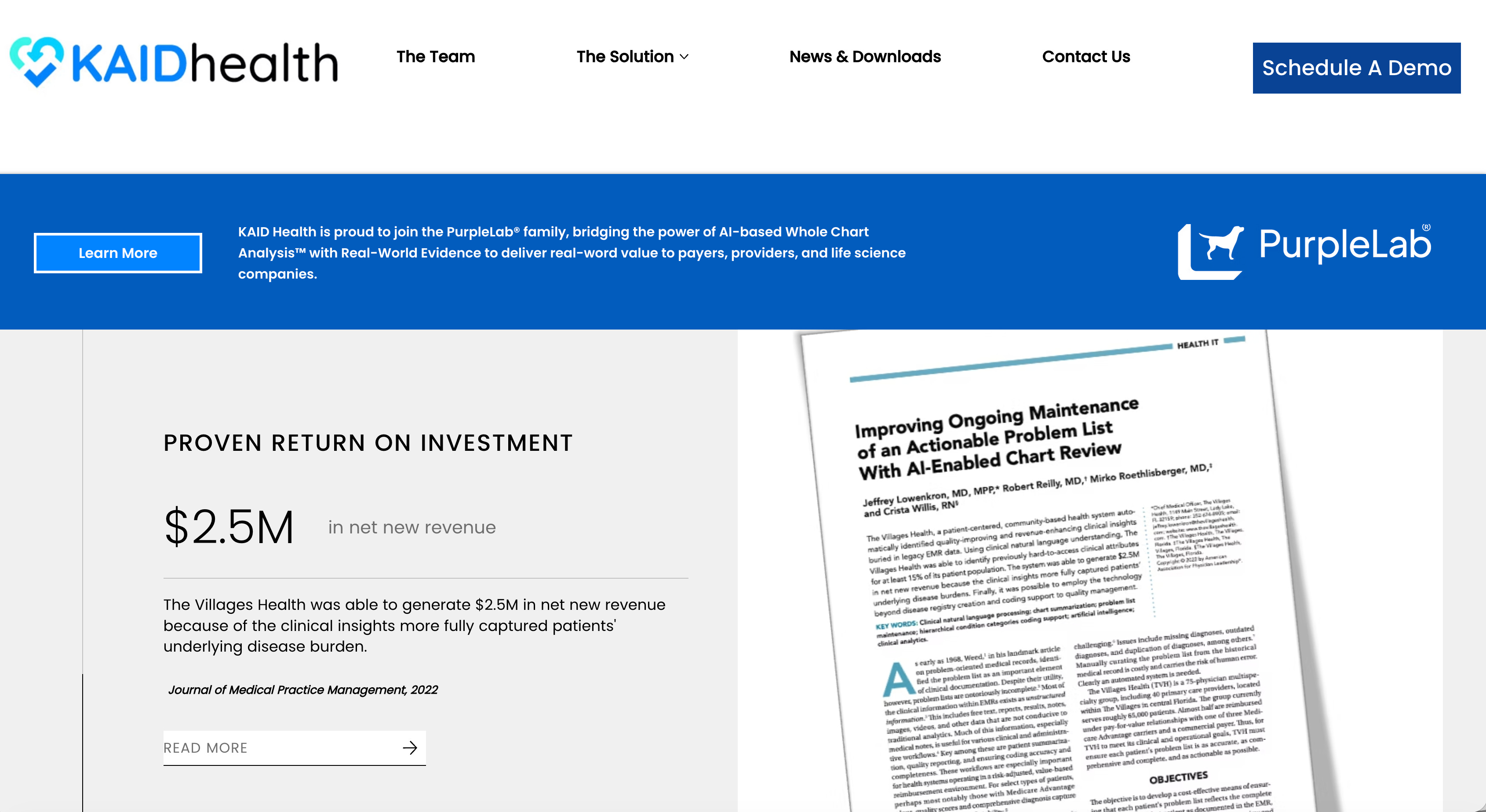
Here is the part every healthcare AI CEO should read twice. During that same window, The Villages Health publicly celebrated an AI platform from KAID Health that mined its records for “care and coding gaps,” and Villages’ own chief medical officer, Dr. Jeffrey Lowenkron, co-authored a case study reporting $2.5M in “net new revenue” and a “10-fold return on investment.” That case study is still on KAID’s homepage today, August 31, 2026:
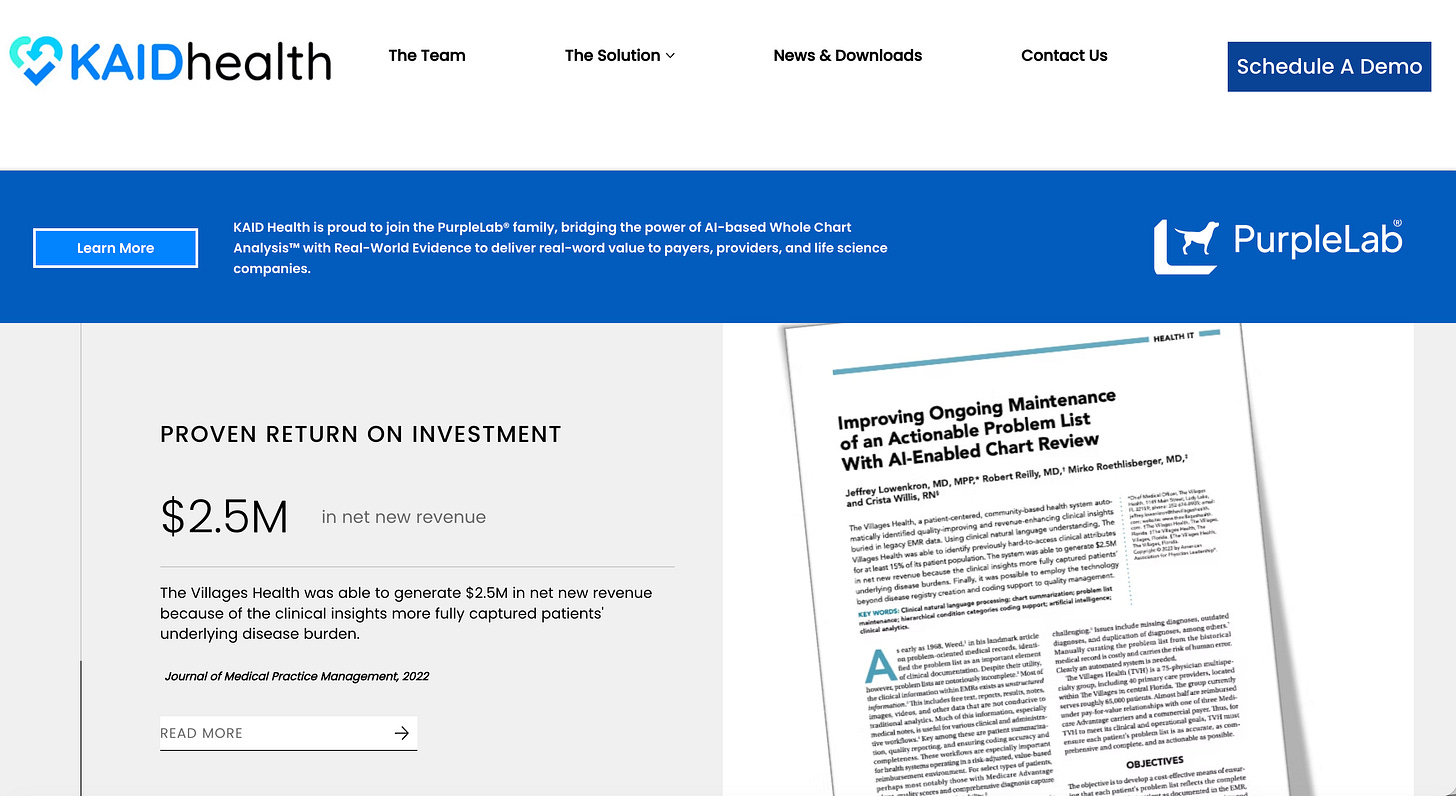
kaidhealth.com. Accessed August 30, 2026. To be clear: DOJ does not name KAID or any technology vendor. The settlement agreement contains no mention of software, algorithms, AI, or a third party. There is no public evidence that KAID generated, selected, or transmitted a single disputed code. I am not accusing KAID of anything. I am pointing at the overlap and saying it demands reporting.
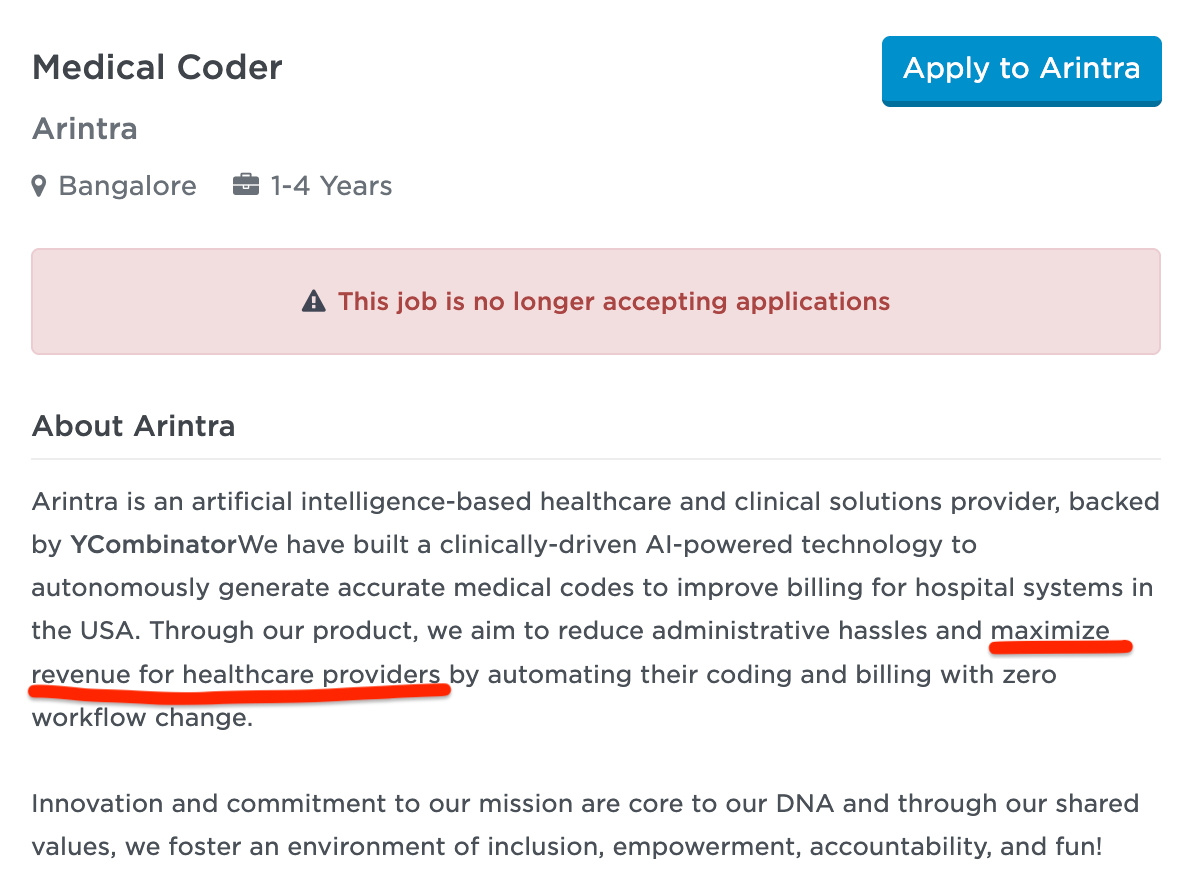
The same day, Arintra raised $25M, claiming $51M total (Dealroom and CB Insights count about $46M), to autonomously code every chart with, per its product page, “Zero human touch” and “Zero coding errors.” Its own blog says 10% to 20% of charts go to a human. Its Bengaluru job ad says the goal is to “maximize revenue for healthcare providers.”
On August 12, I asked Heidi CEO Tom Kelly on our podcast where the line is. His answer, in full below, is the most honest thing a vendor has said on this: never fabricate, and the only real fix is scribes and payers working from one shared record. Otherwise, in his words, “everyone will have to use something like Heidi or Abridge to be claiming and upcoding.”
Also inside: 11 red flags at Arintra, my 12 questions for the company, 5 for KAID, and the prediction I will be held to.
🚨 TL;DR
1. What the DOJ Actually Alleged Last Wednesday
2. The AI Vendor DOJ Did Not Name
3. The Same Day(!), Arintra Raises $25M for Autonomous Medical Coding
4. Arintra’s Potential Red Flags, One by One
5. The Candid Question I Asked Tom Kelly of Heidi Health on Air
6. Every Published Medical Coding Case Study Points in the Same Direction. Guess Which One.
7. Where the Grey Area Ends: the Law Is Already Written
8. The Arms Race Is Not Coming. It’s Already Here.
9. My 12 Questions for Arintra. And 5 for KAID.
10. My Verdict
