


Welcome to AI Health Uncut, a brutally honest newsletter on AI, innovation, and the state of the healthcare market. If you’d like to sign up to receive issues over email, you can do so here.
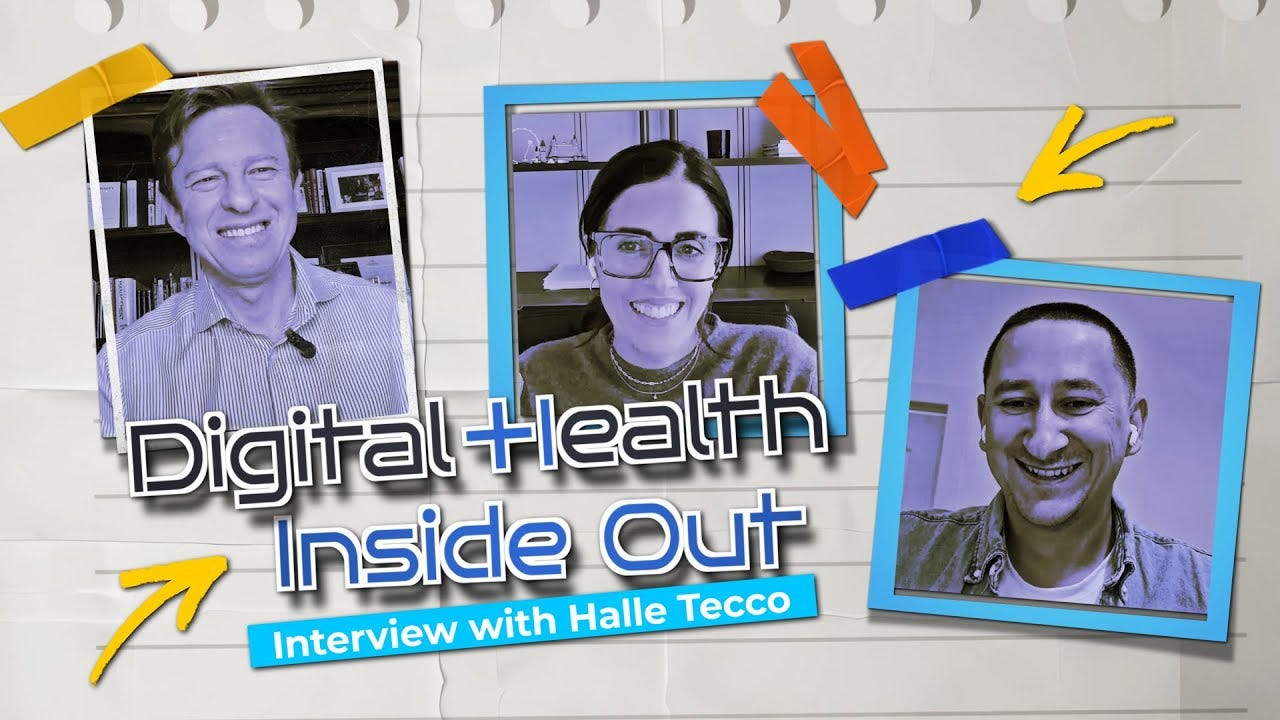
We opened up our podcast season with Alex Koshykov with a bang. We brought on the legendary Halle Tecco, who was also my 2025 Person of the Year in Health Tech.
We talked about Halle’s upcoming book, which you all should absolutely pre-order, plus a whole lot more about what is broken in healthcare and what actually has a shot at fixing it.
Also, I make two cameos in Halle’s book. Honored. 🙏
Preorder Halle’s book

Halle has shared that the book is out February 11th, which is now close enough to feel real. Preorder Halle’s book here.
Subscribe to Digital Health Inside Out
Don’t forget to subscribe to the podcast.
Why this episode matters
Healthcare is full of smart people with dumb incentives. That sentence is not even cynical. It is what it is.
In most industries, outsiders show up, identify inefficiency, build software, and ship. In healthcare, outsiders show up, identify inefficiency, build software, and then get punched in the face by reimbursement, procurement, regulation, incumbents, and workflow physics. Then half of them pivot into “wellness.” The other half write Substack posts about how “healthcare is broken.”
Halle’s edge is that she has lived the lifecycle. Founder. Investor. Operator. Teacher. She has watched waves of hype crash into the same structural rocks. She still believes in change, but not the delusional kind.
That is the tone we wanted for this new interview format. Thoughtful, transparent, grounded, and yes, sometimes uncomfortable and provocative.
What we actually asked Halle
We went in with questions that cut past polite panel talk and into the stuff founders and investors argue about privately.
Here is a taste of the threads you will hear in the episode.
TL;DR:
1. “Cranky Old Guard.” Who exactly is blocking progress
2. What smart outsiders consistently get wrong
3. The ACA. What critique is worth taking seriously
4. Drug prices, NIH, and the uncomfortable “societal investment” argument
5. Interoperability. Is it really “vendors not willing”
6. Screens, anxiety, and the dirty secret of “helpful” tools
7. Transparency. Why everyone whispers and nobody names failure modes
8. Women’s health, women investing, and a message to my daughters
1. “Cranky Old Guard.” Who exactly is blocking progress
In the book, Halle talks about the “Cranky Old Guard” (COG). And the obvious question is. Are we talking about a small group of villains, or basically the whole industry.
Because sometimes it feels like everyone is the “Cranky Old Guard.” From VCs to incumbent lobbyists to vendors protecting their margins.
I asked Halle to define it plainly and explain how innovators deal with it without becoming it.
2. What smart outsiders consistently get wrong
People love to blame insurance and PBMs, and yes, that is part of the crisis. But the deeper issue is incentive alignment.
We pressed on what innovative outsiders misunderstand when they first enter healthcare, and why so many “obvious” fixes die on contact with reality.
If you are building in this space, this part is not philosophy. It is survival.
3. The ACA. What critique is worth taking seriously
The Affordable Care Act moved real needles, including coverage expansion and protections for preexisting conditions. That is not controversial if you can read data.
But it is also under political crossfire from both sides.
So I asked a question that is rare in health tech circles. What is the strongest critique of the ACA that Halle actually takes seriously.
You do not improve systems by treating them like sacred objects. You improve systems by being honest about where they fail.
4. Drug prices, NIH, and the uncomfortable “societal investment” argument
Halle’s book cites the reality that U.S. drug prices are dramatically higher than elsewhere, and that taxpayers often support upstream science through NIH-funded research.
We also brought up biotech investor Peter Kolchinsky’s argument that expensive branded drugs should be viewed as a societal investment rather than an expense, and asked whether Halle buys it.
This is one of those debates where smart people can disagree in good faith, and still be forced to confront a nasty truth. Our current structure makes it too easy to extract value without creating proportional public benefit.
5. Interoperability. Is it really “vendors not willing”
I pushed back here as someone who actually works with providers and lives inside the constraints.
If you have spent more than 20 minutes trying to integrate into a health system, you already know the fairy tale version of interoperability. “If everyone would just cooperate, data would flow.”
But the hard version is economics. Incumbent EHRs sit on a wildly profitable status quo. Breaking that status quo is not a technical problem. It is a business model problem.
So I challenged the framing directly.
6. Screens, anxiety, and the dirty secret of “helpful” tools
Halle has talked publicly about minimizing exposure to social media and doing a “mobile device detox.”
I connected that to a broader, uncomfortable question in digital health. What if some tools make people more anxious rather than healthier.
I referenced a point raised by Dr. Ezekiel Emanuel about gadgets like the Oura ring. If you wake up refreshed, you already have signal. If the device adds anxiety and does not add therapy, what are we really selling?
Then I asked the question all founders hate: Does minimizing screen time also mean minimizing screen time for digital health tools?
7. Transparency. Why everyone whispers and nobody names failure modes
Healthcare is political. Digital health is small. People network. People fund each other. People want future deals.
Which means almost nobody calls out bad actors or even names real failure modes, because nobody wants to burn bridges.
So I asked. How do we change that?
If you care about credibility in this industry, this is not optional. It is the whole game.
8. Women’s health, women investing, and a message to my daughters
This one is personal.
I brought up my daughters, the reality of inequality in women’s health and in the workplace, and the need for role models who do not just win. Role models who do the right thing with their voice.
I asked Halle what message she would give to them, and whether there is hope.
Your turn
Drop a comment with three things.
What resonated most.
What you disagreed with.
Who you want us to interview next.
And yes. Preorder Halle’s book. This is one of those rare cases where the preorder is not just marketing. It is a signal that the market wants substance.
More interviews coming soon. Next up: Shiv Rao, founder and CEO of Abridge, and Christina Farr, CEO of Second Opinion and GP at Scrub Capital.
Bonus. If you missed it, here is our prediction episode of Digital Health Vitals:
👉👉👉👉👉 Hi! My name is Sergei Polevikov. I’m an AI researcher and a healthcare AI startup founder. In my newsletter ‘AI Health Uncut,’ I combine my knowledge of AI models with my unique skills in analyzing the financial health of digital health companies. Why “Uncut”? Because I never sugarcoat or filter the hard truth. I don’t play games, I don’t work for anyone, and therefore, with your support, I produce the most original, the most unbiased, the most unapologetic research in AI, innovation, and healthcare. Thank you for your support of my work. You’re part of a vibrant community of healthcare AI enthusiasts! Your engagement matters. 🙏🙏🙏🙏🙏
1) Lisa Bari
2) Jung Hoon Son
3) John Joshua
Looking forward to the book. I have a five-week series on healthcare I will be launching on Substack about the time of your book that dives into nearly all the same issues you address by applying my Tension Transformation Framework, and it describes why the things you are seeing occur and what we should do about them.