


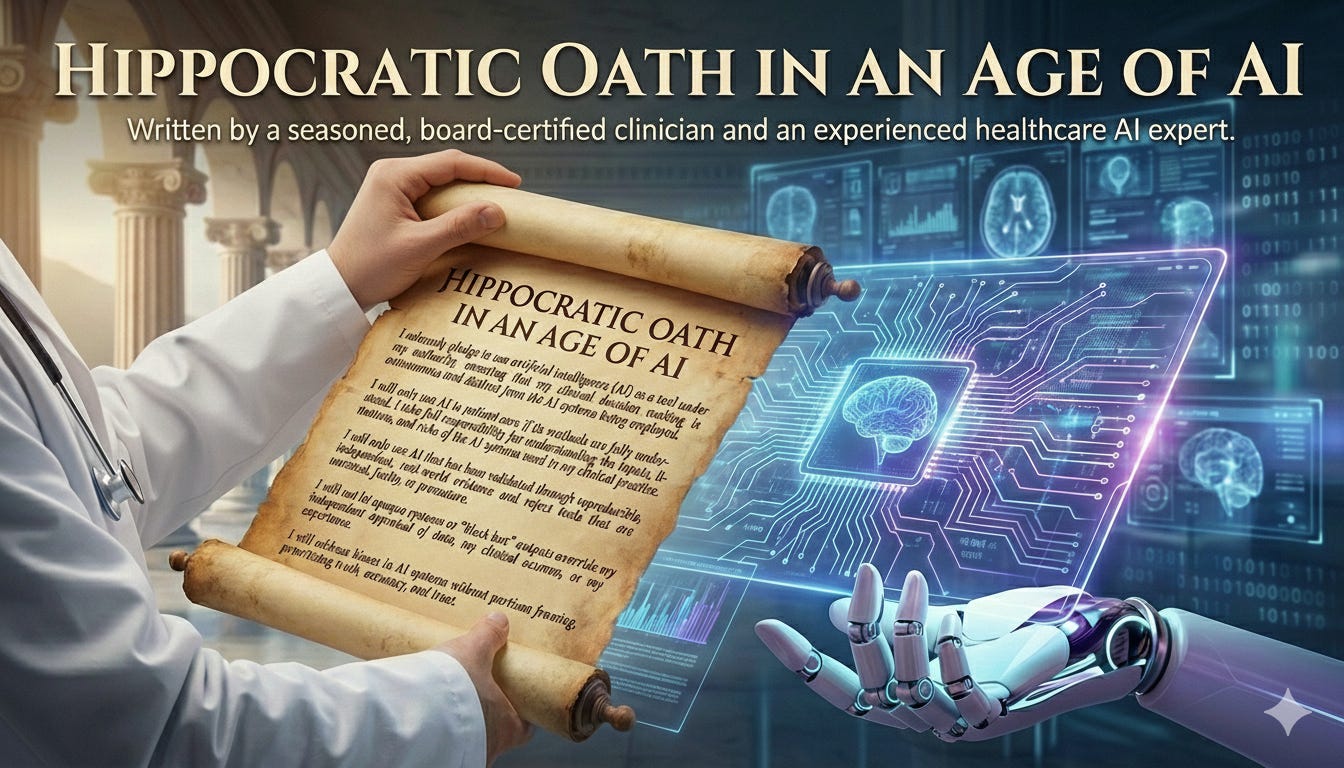
Believe it or not, Dr. Eduardo Vadia and I have been working on this modern version of the Hippocratic Oath for months, tediously debating every statement and every word, because we felt it was important to get it right and to offer something the medical community could use as a real standard. We wanted to keep it true to the original Oath, keep politics out of it, and bring it into the new reality of AI and other technological innovations in medicine.
Whether this proposed Oath becomes the new standard for doctors is up to the medical community to decide. But we tried our absolute best.
Here are some brief bio facts about us.

Eduardo Vadia
Dr. Eduardo Vadia is a physician who is, or has been, board certified in Internal Medicine, Pulmonary Medicine, and Critical Care Medicine. He completed his residency, chief residency, and pulmonary and critical care fellowship at UT Southwestern Medical Center in Dallas Tx, where he later served as a faculty physician with a focus on medical education in the Parkland Hospital ICU. He is the co-founder of Access Physicians, a multi-specialty inpatient telemedicine physician group that scaled to over 200 hospital deployments across 30 states before being acquired by SOC Telemed in 2021. Dr. Vadia is also the co-founder of ArithmoAI, a healthcare AI company that secured seed funding in January 2026. He also serves as Vice Chairman of the Industry Advisory Board for the University of Miami Institute of Data Science and Computing.

Sergei Polevikov
Sergei Polevikov is a Ph.D.-trained data scientist, AI entrepreneur, economist, and quant investor with 30+ academic manuscripts. As the author of the popular Substack newsletter AI Health Uncut, with nearly 10,000 subscribers, he delivers brutally honest insights drawn from his experience as a healthcare AI startup founder at WellAI and Chart2Chart, and as a private equity investor. His work is driven by a relentless pursuit of brutal truth in healthcare. That mission has pushed him beyond building products and into investigating healthcare fraud. Today, Sergei focuses on health AI education and truth-telling. He also co-hosts the podcast Digital Health Inside Out with Alex Koshykov, Ben Schwartz, and Rik Renard.
Keeping AI Human. A Modern Hippocratic Oath.
As physicians and scientists, we stand at a transformative moment in healthcare. Artificial intelligence promises to enhance diagnosis, personalize treatment, and improve clinical outcomes. We should embrace this opportunity for our patients. However, adoption must come with rigorous caution, explicit responsibility, and an unwavering commitment to patient welfare. This is our moment to shape the future of medicine or risk ceding it to external forces.
The oath that follows sets forth a framework to ensure AI is safe, effective, and worthy of clinical trust. AI is not a panacea. As systems evolve toward greater autonomy, they must be governed with the same scientific rigor required of any medical intervention. There is no hall pass for AI. It must earn its place in clinical practice through transparent methods, reproducible evidence, and independent real-world validation. Physicians must lead this process of scrutiny. To reject AI outright risks obsolescence. To embrace it blindly risks patient harm. The responsible path is to integrate AI carefully, critically, and always under clear human authority.
The digitization of healthcare has already strained the patient-physician relationship. AI could fracture this sacred bond if it sterilizes our encounters or reduces patients to data points. Used wisely, it can do the opposite. It can return time to the bedside, deepen trust, and reinforce the compassionate ethos at the heart of medicine.
This moment offers an opportunity to reset the institutional compass, ensuring that clinical excellence, not administrative priorities, is the guiding principle of healthcare leadership. Administrative forces have sidelined physicians in decisions that shape care delivery. The result has been systems optimized for higher fee-for-service volume and institutional protection, not for outcomes and quality. The emergence of AI allows us to re-center care around the standards and judgment that define our profession. By participating directly in the development and validation of healthcare AI, we can build systems that reflect clinical expertise, patient-centered values, and ethical integrity. This will ensure that technology serves medicine, not the other way around. To remain passive is to surrender to actors who do not carry our duty to care.
We must resist two errors. The first is rejecting AI entirely and forfeiting its potential. The second is adopting it uncritically. Both abdicate responsibility and risk permanent erosion of the physician’s role to the detriment of patients. Patient care demands accountability, and our legal and ethical codes place that accountability on physicians. If we cede it, we invite external control over the delivery of care. By embracing responsibility and the accountability that comes with it, we keep AI a tool under human control and in the service of patients.
We must also guard against de-skilling. Over-reliance on AI can dull clinical judgment and reasoning. Physicians must keep their skills sharp so that AI augments rather than substitutes expertise. Medicine demands lifelong learning. So does the safe and ethical use of AI.
Let this oath be a rallying call. Govern AI with wisdom. Lead its development with purpose. Uphold our sacred duty to patients with unflinching responsibility. The future of medicine is ours to shape. Let us seize it.
The Modern Hippocratic Oath for Artificial Intelligence in Medicine
AS A CLINICIAN USING AI IN PATIENT CARE:
I solemnly pledge to use artificial intelligence (AI) as a tool under my authority, ensuring that my clinical decision making is autonomous and distinct from the AI systems being employed.
I will only use AI in patient care if its methods are fully understood. I take full responsibility for understanding the inputs, limitations, and risks of the AI systems used in my clinical practice.
I will only use AI that has been validated through reproducible, independent, real-world evidence and reject tools that are untested, faulty, or premature.
I will not let opaque systems or “black box” outputs override my independent appraisal of data, my clinical acumen, or my experience.
I will address biases in AI systems without partisan framing, prioritizing truth, accuracy, and trust.
I will respect my patients’ autonomy, privacy, and dignity, in all my uses of AI.
I will safeguard personal health information in the development and use of AI, including sensitive genetic or genomic data.
I will ensure appropriate transparency and informed consent for AI use when indicated.
I will actively contribute to improving AI systems used in the delivery of patient care.
I will demand transparency and accountability from those who build AI.
I will work with AI developers while insisting their work aligns with my duty to patients and does not obscure how outputs are generated.
I will share clinical expertise to design, test, and validate AI tools for safety and effectiveness.
I will seek and incorporate diverse input from engineers, ethicists, patients, and other stakeholders, to help shape AI systems that prioritize patient needs and values.
I will report failures and near-misses to improve AI safety, just as I do for other clinical technologies.
I will openly disclose and manage conflicts of interest in my use of AI.
I will oppose commercial, financial, political, or other external influences that compromise the integrity of AI systems, even under pressure.
I will reject AI tools that risk harm, erode dignity, or shift care away from being patient-centered.
I will not use AI in ways that violate human rights, civil liberties, or basic ethical principles.
I will ensure that AI enhances and does not degrade the patient-physician relationship.
I will not rely on AI blindly or adopt it uncritically.
I will maintain and grow my clinical skills so that AI augments rather than substitutes my expertise.
I will not let the existence of AI excuse any decline in my preparedness for patient care.
I MAKE THESE PROMISES AS A CLINICIAN WHO HOLDS ULTIMATE AUTHORITY OVER AI.
I DO SO FREELY, SOLEMNLY, AND UPON MY HONOR.
© 2026. All rights reserved. This document contains proprietary and confidential information that is the intellectual property of Sergei Polevikov and Eduardo Vadia. Unauthorized copying, disclosure, or distribution of any portion of this document, in any form or by any means, without the prior written consent of the owners is strictly prohibited.
Direct and necessary critique Sergei. Where are you seeing the healthiest dose of realism in early-stage health AI right now?
This is a thoughtful and necessary reflection on responsibility in the age of AI. I appreciate the emphasis on keeping AI under human authority, maintaining clinical judgment, and protecting patient dignity.
But I think there is a critical layer missing.
We can formulate a thousand new oaths for medicine —
yet if the healthcare system itself is primarily optimized for economic throughput, efficiency, and scalability, it will inevitably produce exactly that.
AI will not correct this. It will amplify it.
The question is therefore not only how clinicians should use AI, but:
What is the system actually designed to optimize?
Because as long as the underlying incentives are misaligned with biological reality, no ethical framework alone will be sufficient to produce health.
It will produce output — not necessarily care.