


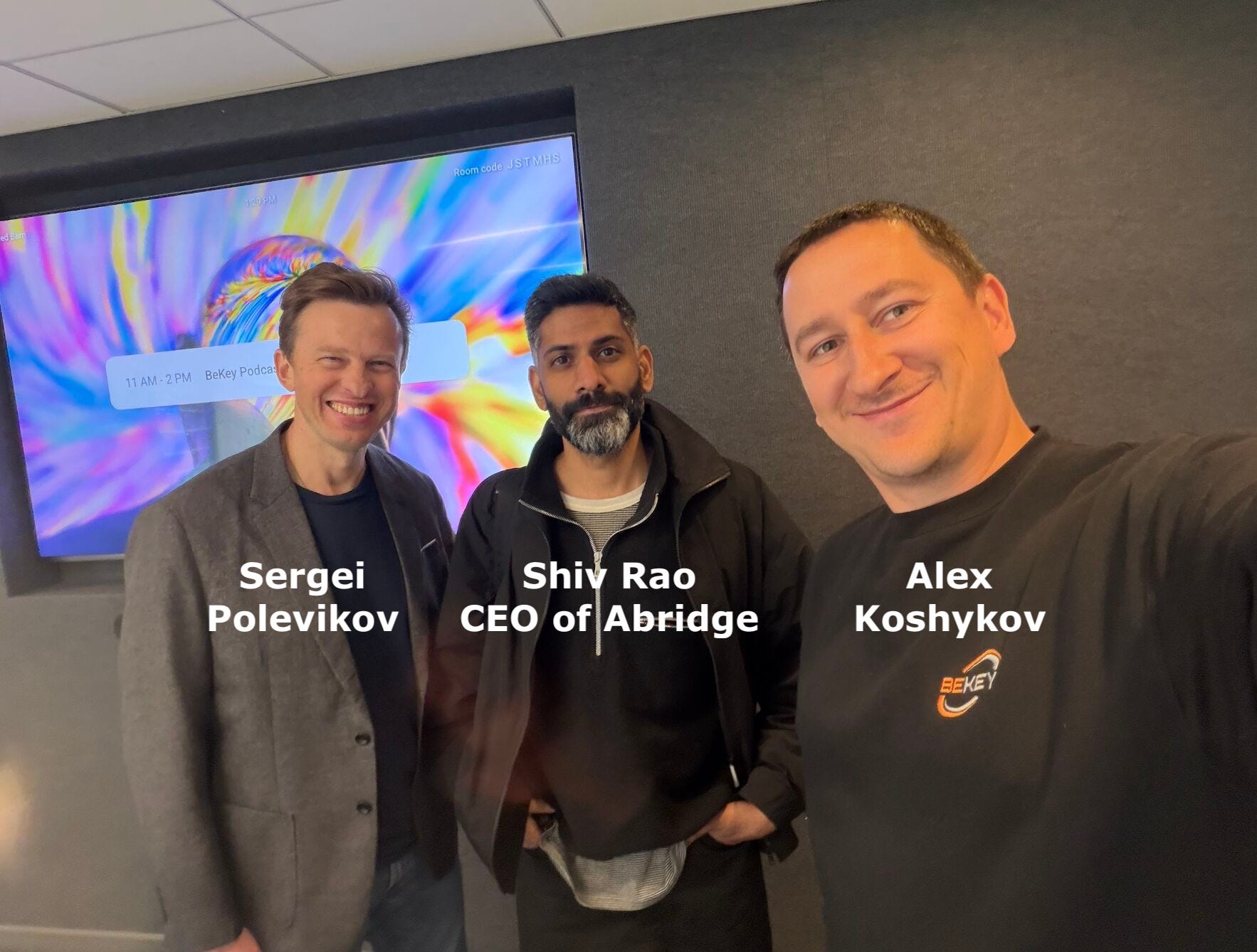
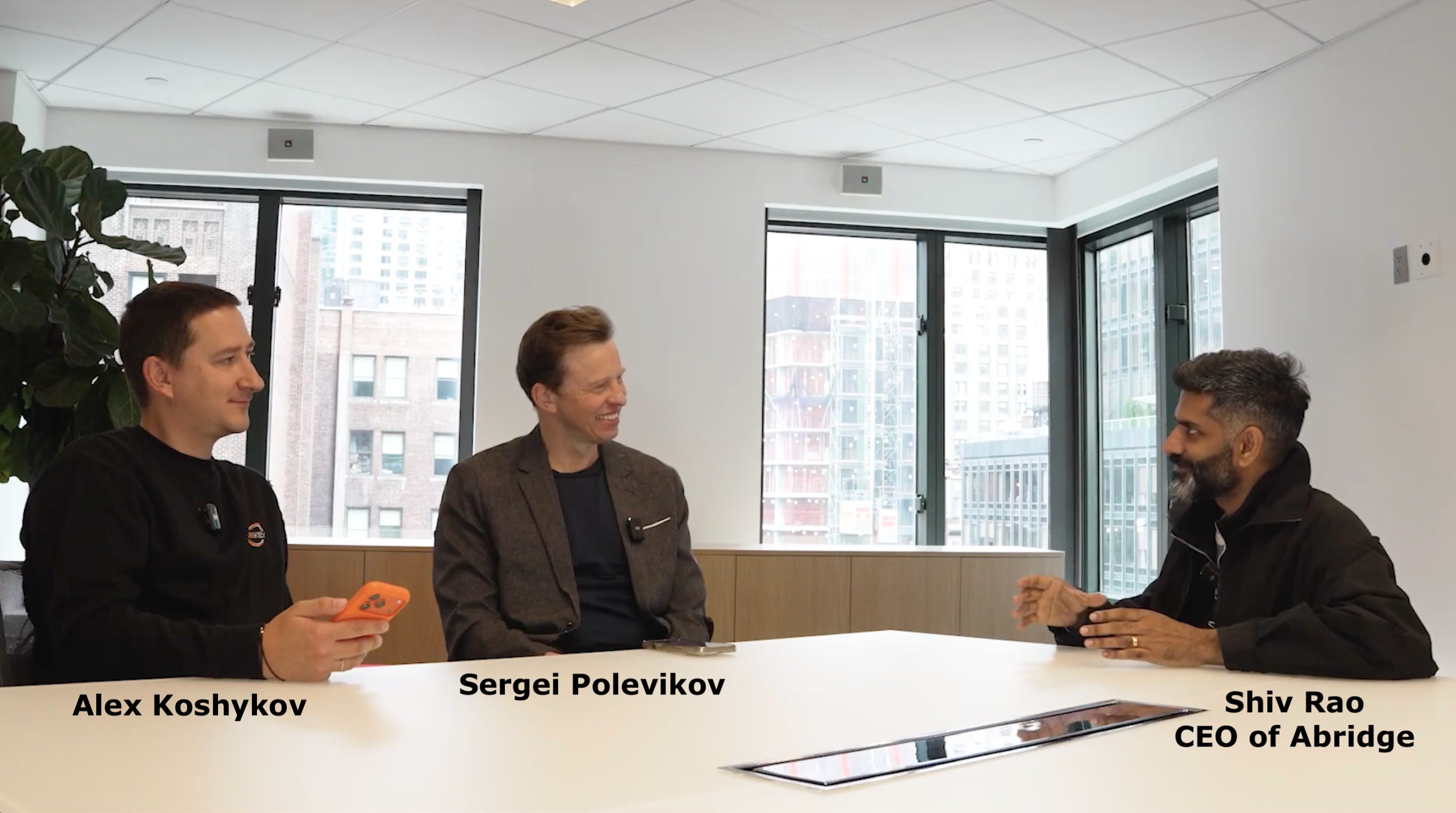
The Digital Health Inside Out podcast offers a rare look inside the world’s largest AI scribe company, as Alex Koshykov and I had the chance to sit down with Shiv Rao, CEO of Abridge, for a brutally honest interview.
Here’s the link to the full interview:
Shiv Rao is not your typical tech CEO. He’s a practicing cardiologist who still sees patients one week a month, a Carnegie Mellon history major who studied minority studies and film theory, a former corporate investor at UPMC, and a dad who spends weekends building Pokémon websites with his twin nine-year-old boys using Claude Code. He co-founded Abridge in 2018 in Pittsburgh — the city of bridges (clever, huh? 😉) — alongside Zach Lipton, a Carnegie Mellon professor he once funded through UPMC’s machine learning and health program. The company has since grown into the largest pure-play AI scribe in healthcare, valued at $5.3B, live in over 250 of the country’s largest health systems, and on track to touch over 80 million patient lives this year.
We wanted to understand how Rao thinks: about his product, his competitors, his investors, and the future of AI in healthcare. He didn’t disappoint.
TL;DR:
1. “It Was Never About the Note”
2. The Tech Stack: 70-80% In-House Models
3. $800M Raised, 100% Control Retained
4. The Customer-Investor Trap
5. 126 AI Scribes: “Party Tricks vs. Enterprise-Grade Platforms”
6. The Prior Auth Breakthrough
7. Liability: “Doctors Go to Jail, Engineers Don’t”
8. FDA Regulation: “The Moment We Need It, We’ll Jump In”
9. The Epic Elephant in the Room
10. The Future: “AI Is Underhyped”
1. “It Was Never About the Note”
The very first thing Rao wanted to clear up: Abridge is not an AI scribe. Or at least, it doesn’t want to be known as one.
For years, Rao said, the company has tried to avoid the phrase entirely. The real thesis is about conversations, the clinical interaction between a doctor and a patient, which Rao sees as the most important moment in healthcare and the upstream source of virtually every downstream workflow.
Documentation was the wedge, not the destination. As Rao put it, conversations are upstream of not just notes, but order entry, diagnosis codes, claim creation, risk adjustment, revenue cycle, clinical trial recruitment, and patient education. The note is just one artifact that flows from that conversation.
And the note, Rao emphasized, is inseparable from revenue. In the U.S., doctors aren’t compensated for the care they deliver. They’re compensated for the care they documented delivering. Whether in a value-based care contract capturing HCCs, or in fee-for-service where notes must be concordant with claims, what’s in the note determines what gets paid.
This framing — documentation as a billing event, not just a clinical one — is central to how Abridge thinks about expanding beyond scribing.
2. The Tech Stack: 70-80% In-House Models
We pushed Rao on the technology question: with billions being poured into foundation models, is Abridge still building its own models, or riding on top of OpenAI, Google, and Anthropic?
The answer: it’s all about model orchestration, and roughly 70% to 80% of what Abridge does is driven by in-house models, with about 30% involving a frontier model.
Rao described a strategic framework for deciding what to build versus what to partner on. If there’s a part of the product where you know you’ll never be perfect and will always aspire to be less than perfect, he said, you might be better served partnering with frontier models — but building the harness around them: the tools, the memory, the guardrails, the context engineering. That harness, he argued, is your differentiation. But where you can see a clear path to “ringing the bell” on quality quickly, you should own the model yourself.
Speech recognition, for example, moves slowly enough that it made strategic sense for Abridge to own it entirely. Doctors mispronounce drug names constantly. Rao joked there are 25 different ways to say “metoprolol,” and new medications come out all the time. Abridge runs multiple in-house speech recognition models, orchestrated together to produce the best possible transcript.
On the orchestration side, yes — Abridge uses sub-agents doing different tasks in parallel. A QA agent checks the work. A judge agent audits it. Another unbundles tasks and coordinates software engineering agents. The company can swap in a new frontier model in days, not weeks or months, and they measure that swap velocity internally as a reflection of agility.
3. $800M Raised, 100% Control Retained
Abridge has raised close to $800M and is valued at roughly $5.3B. When we asked whether investors like Andreessen Horowitz are seeing something the public isn’t, Rao pointed to scale: Abridge is live in over 250 of the largest health systems, serving clinicians across all specialties and settings, and expects to touch over 80 million lives in the next 12 months, with a goal of reaching one million encounters per day this year.
But we pressed harder. With that much capital raised, who actually has leverage — the founders or the investors?
Rao was emphatic: “We have 100% full control, and that’s super important to me.“ He described a governance model where Abridge sets its own scorecard — defining what “winning” looks like for each feature launch, including thresholds for LLM judges and human judges — and the board’s job is simply to hold the team accountable to the report card they created for themselves.
He credited a philosophy he got from Henry Kravis, who is also on Abridge’s cap table. When Rao first sat down with Kravis, the legendary investor asked about exit strategy. When Rao mentioned an IPO as a future possibility, Kravis pushed back: “You should just be focused on your mission. If you need capital from private markets, take it. If you need to go public to achieve your mission, go public. But otherwise, don’t think about it.”
Rao said an IPO is not on his radar, not in his head, and not how the company is recruiting or building its team. For now, Abridge has more than enough capital to sustain R&D over many years.
4. The Customer-Investor Trap
I asked a pointed question about conflicts of interest — what happens when a company’s biggest customers are also investors, and the incentives to inflate valuations or book premature revenue start to pull in strange directions.
Rao didn’t dodge it. He agreed the incentive problem is real when strategic investors lead funding rounds and set prices. His rule: strategics should always be minority investors, never directors who can influence the company’s trajectory, because it’s too difficult for them to decouple their own business interests from Abridge’s.
The value of strategic investors, in Rao’s view, is the feedback loop — compressing cycle time and giving the company access to deep innovation partnerships. Abridge’s cap table includes Kaiser Permanente Ventures, among others, and Rao said the company will bring in more strategics over time, but the criteria for who gets on the cap table is “very rigorous, and we won’t violate that.”
He added a personal note: “I speak as someone who used to be a corporate VC at UPMC. I’ve certainly seen what can go really right, and also where sometimes it can go off the rails.”
5. 126 AI Scribes: “Party Tricks vs. Enterprise-Grade Platforms”
Our very first podcast episode was called “Why the Hell Do We Need 126 AI Scribes?“ — so naturally, I put the question to Rao directly:
What differentiates Abridge from the other 125 AI scribes?
Rao started graciously — he wants more innovation in healthcare, not less. But he drew a sharp line between party tricks and enterprise-grade platforms. To illustrate, he described building his own version of Pocket (the article-saving app Mozilla killed) in a single Saturday using Claude Code, complete with a Chrome extension, a mobile app, a web app, and a semantic search backend. Seven or eight hours of work.
That’s the moment we live in, he said. Anyone can build a demo. But the gap between a demo and something that can truly scale in a regulated, high-stakes industry is enormous. In healthcare, trust means everything. Credibility and transparency mean everything. And once you’ve seen a cardiologist’s preferences, you haven’t seen an oncologist’s — the long tail of specialties, settings, and languages is a treadmill that most startups can’t sustain.
6. The Prior Auth Breakthrough
The most concrete example of Abridge moving beyond scribing came from Rao’s description of a partnership with Highmark, a regional Blue Cross plan in Pennsylvania, for real-time prior authorization at the point of care.
Here’s how the old process works: doctor talks to patient, realizes they need a sleep study, places the order, then days later a staff member calls the insurance company, fills out paperwork, faxes it, waits for approval — weeks or months later, the patient finally gets the study.
Here’s how it works with Abridge: the doctor talks to the patient, the technology hears “sleep study,” and in the background pulls the patient’s medical records, identifies their insurance plan and geography, retrieves the specific prior authorization guidelines, and when the doctor hits stop, Abridge tells them: “This patient has this plan in this geography. You decided to order a sleep study. There are two more questions you should ask based on the chart and the conversation. If you ask them, we’ll give you the approval right now.”
Rao called this “shifting everything left” to the actual moment of care — the sacrosanct moment where the clinician and patient interact. Everything else, he argued, is abstraction. Everything else is bloat.
7. Liability: “Doctors Go to Jail, Engineers Don’t”
I brought up my earlier Substack study, “Doctors Go to Jail, Engineers Don’t,” about the liability gap in healthcare AI. Some clinicians we’ve spoken with worry that the more comprehensive they are — letting patients talk freely, capturing more text — the more errors an AI scribe might make, especially with unrelated “patient side comments” getting coded as clinically relevant.
Rao reframed the risk discussion using a 2×2 matrix: frequency on one axis, stakes on the other. High-frequency, high-stakes use cases — like diagnosing a pneumothorax on a CT scan or sepsis in an ICU — require significant regulatory hoops. But on the other side, there are high-frequency, lower-stakes workflows: revenue cycle, clerical work, the “scut work” of hospital life. The stakes there are financial, not life-and-death. That’s where Abridge chose to start.
On guarding against errors, Rao pointed to features like linked evidence — which maps every claim in an AI-generated note back to the specific passage in the original transcript. The company publishes academic-grade benchmarks, deploys agents that programmatically detect and remove false positives, and tries to make its white papers “as unsalesy as possible” (he admitted they’re not always successful).
He also shared an internal culture detail: Abridge has a Slack channel called “Love Stories” where positive clinician feedback is routed every day, so every engineer in the company — the ones who might otherwise have gone to OpenAI or Anthropic — gets reminded of the mission’s impact.
8. FDA Regulation: “The Moment We Need It, We’ll Jump In”
We asked Rao the same question we asked Alex Lebrun of Nabla: ambient listening solutions are still not FDA-regulated. Should they be?
Rao didn’t reject the idea, but he raised a practical objection: current regulatory frameworks were built for hardware, where a product stays the same after it’s built. AI products change weekly. An issue from last week might already be fixed by a new fine-tuning run. He expressed interest in adaptive trial design, a research methodology that can account for continuous product improvement, as potentially the right framework for assessing AI safety in a world that moves this fast.
He also floated a striking metaphor for what an AI “safety label” might look like: a “fresh until” date, like on a milk carton. Because the technology changes so quickly, the date you bottled it matters as much as how long it will last. The winning vertical AI companies, he predicted, will be the ones who “rebottle” (update their metrics) really quickly. “These are our metrics on February 1st, and this will last until February 14th, and then here’s February 14th, new metrics.”
9. The Epic Elephant in the Room
We brought up the big one: Epic’s exclusive partnership with Microsoft and DAX Copilot, announced in August 2025, and whether the elephant in the room was about to sit on Abridge.
Rao said he held a town hall with Abridge’s health system customers shortly after the announcement. The core message: there is no risk to Abridge’s ability to integrate with Epic, pull data, push data, or partner with health systems. That hasn’t changed and isn’t going to change.
He acknowledged that Epic is building AI of its own, and he’s impressed by the speed. But he framed it as positive-sum pressure, not zero-sum competition: “All boats can rise here. This is a moment where the mission has to be serving health systems, clinicians, and patients.“
When we pushed on the bundling threat — Epic could offer its ambient solution for free as part of its existing package — Rao didn’t flinch. That kind of pressure, he said, forces Abridge to make clear that what it does isn’t “just” an AI scribe. The company goes deep across specialties, settings, and spoken languages, and it’s building capabilities — value-based care contracts, HEDIS measures, clinical trial matching — that are differentiated enough to stand on their own.
“Pressure makes diamonds,” he said. “We want that.”
10. The Future: “AI Is Underhyped”
When we asked Rao for his vision of healthcare in an AGI future, he didn’t hedge.
“I actually think AI is underhyped. I think valuations are underhyped — for the companies who’ve got real fundamentals right now.”
He predicted that over the next one to two years, more and more low-stakes, high-frequency workflows will get fully automated. Then, gradually, automation will start touching clinical work — like the medication refill automation already deployed in Utah by Doctronic. Healthcare will transform stepwise: “Sometimes change is slow, and then it’s sudden.“
But he drew a clear line between automating a doctor’s tasks and automating the doctor’s role. An often-cited study found doctors need 27 to 30 hours in a day to complete all their work.
The opportunity isn’t to replace doctors. It’s to give them superpowers so they can live out the values that took them to medical school in the first place.
And for companies building in this space, the test is simple: when a new frontier AI capability arrives, does it help you or threaten you? If every advance makes your product better, you’re riding the right side of the wave. If it makes you obsolete, you’re positioned wrong.
Rao clearly believes Abridge is on the right side.
This interview was conducted by Alex Koshykov and Sergei Polevikov for the Digital Health Inside Out podcast.
Like what you’re reading in this newsletter? Want more in-depth investigations and research? Alright then, go tell your friends!
👉👉👉👉👉 Hi! My name is Sergei Polevikov. I’m an AI researcher and a healthcare AI startup founder. In my newsletter ‘AI Health Uncut,’ I combine my knowledge of AI models with my unique skills in analyzing the financial health of digital health companies. Why “Uncut”? Because I never sugarcoat or filter the hard truth. I don’t play games, I don’t work for anyone, and therefore, with your support, I produce the most original, the most unbiased, the most unapologetic research in AI, innovation, and healthcare. Thank you for your support of my work. You’re part of a vibrant community of healthcare AI enthusiasts! Your engagement matters. 🙏🙏🙏🙏🙏
Abridge is one of the most important proof points in clinical AI — Shiv's obsession with accuracy over speed is exactly right. The compliance layer underneath these ambient AI tools is what makes or breaks enterprise deals though. The "is this HIPAA-compliant?" question comes up before any procurement conversation can even start. Really enjoyed this interview — the nuance on ambient AI vs. documentation AI is important.
Sergei. Incredible piece. If you are truly building in AI, there is sooo much info here. An important note that I learned from your piece is that Shiv Rao is a physician. As you have taught us, we need to be skeptics… but, the fact that Rao is a doc is reassuring to me. He is human and not perfect- for sure, but he is one of us. This space needs physician founders badly. Like really really badly. So I am officially an Abridge and Dr Rao supporter… until you give me reason not to be 😂. Hold them accountable Sergei- I know you will! Great job on this piece!