


Welcome to AI Health Uncut, a brutally honest newsletter on AI, innovation, and the state of the healthcare market. If you’d like to sign up to receive issues over email, you can do so here.
McKinsey’s new “The state of AI in 2025: Agents, innovation, and transformation” report is out, and everyone seems to be clinging to the “92% AI adoption” number. Again. 🙄
Of course, the devil is in the details. Unfortunately, as always, McKinsey does not give us many.
But first, I want to take a moment to thank all of my supporters. I’m often very critical of certain things happening in AI and healthcare. But I promise you, it’s only because I genuinely care and want to make things better for all of us. So, thank you for your understanding.
I receive a lot of messages daily, and I always respond promptly to every one of them. Most are incredibly kind and supportive.

I want to highlight one recent message in particular. A student reached out asking for full, paywall-free access to my Substack. Of course, I granted it—as I always do.
This brings me to another important message. If you cannot afford this article—perhaps you’re a student or currently between jobs—please reach out. That’s precisely why I created the AI Health Uncut Founding Member Club, currently at 19 and counting. Thanks to generous donations and support from these wonderful individuals, I’m able to provide access to anyone who needs it. By the way, students reach out frequently, and I’m always glad to help.
If you’d like to become a Founding Member of the AI Health Uncut community, you can join through this link. You’ll be making a real impact, helping me continue to challenge the system and push for better outcomes in healthcare through AI, technology, policy, and beyond.

🚨 Also, if you’re in New York City today and tomorrow, come for the Rockefeller Center tree lighting. 🎄 But even more importantly, come see me moderate a Health2Tech panel with a distinguished group of guests tomorrow, Thursday, December 4 at 5:30pm called “Clinically Useful, Not Just Cool: Tech Doctors and Nurses Will Actually Use.” You will not regret it. The event is free, but you still need to register here to get in.
Alright. Let’s get back to AI adoption in healthcare…

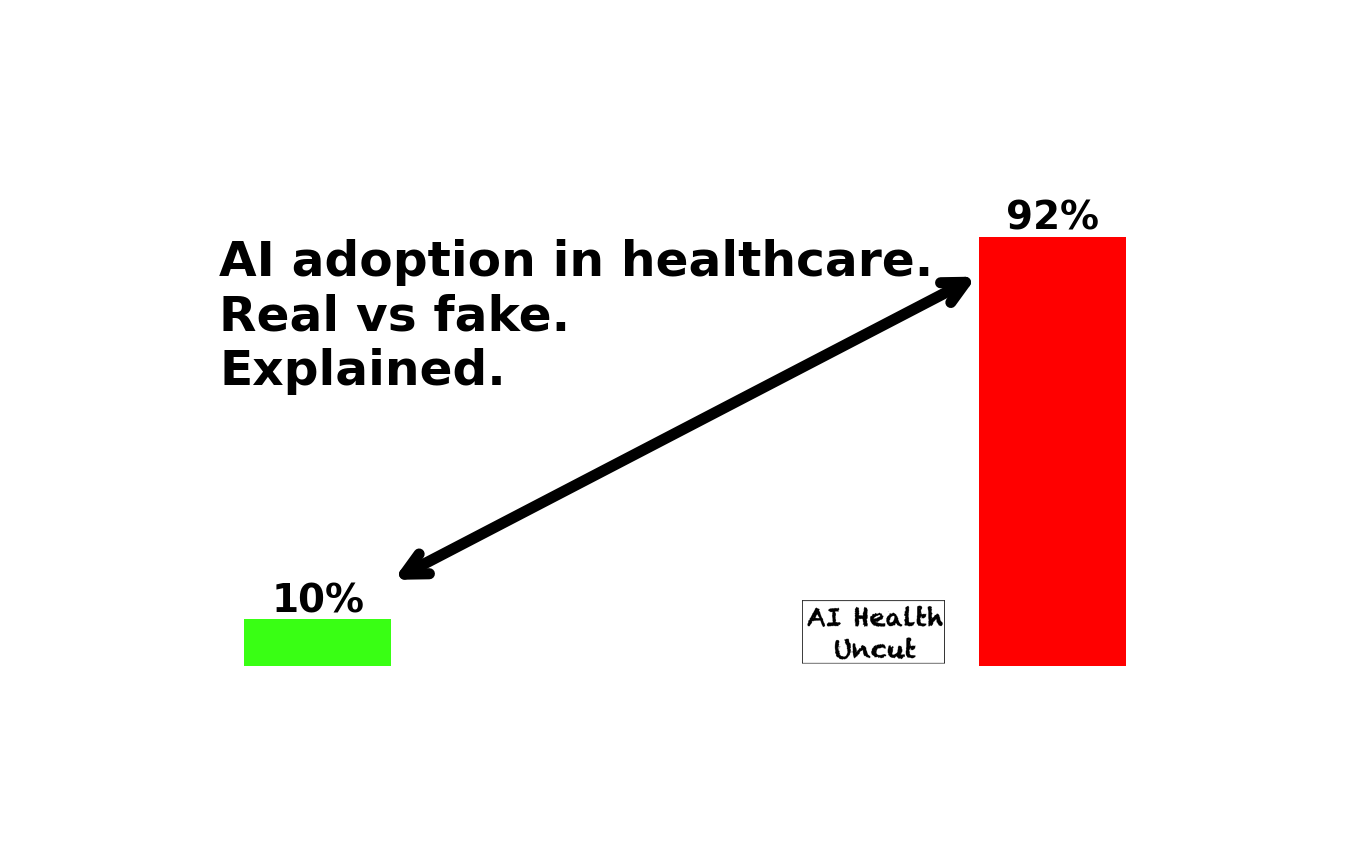
So here is my quick take on why I think the real number is closer to 10%. That lines up with the U.S. Census, based on a much, much larger sample of healthcare organizations. I also said 25% in my previous piece. I overestimated. I am correcting myself.

In March 2024, the U.S. Census Business Trends and Outlook Survey, or BTOS, found that about 5% of U.S. healthcare organizations were using AI, with about 7% expecting to use AI within six months. If that expectation translated into real deployments, and if adoption then climbed from about 7% by late 2024 to about 10% now, that is how I get to current AI usage in healthcare today. By the way, in BTOS terms, “healthcare organizations” are defined by the NAICS sector “Health Care and Social Assistance” (NAICS 62).
So let’s winnow the wheat from the chaff…
Reason #1 Why AI Adoption in Healthcare is ~10%, Not 92%: Definition
Let’s look at the footnotes.
Here is McKinsey’s definition, versus the U.S. Census definition:
McKinsey asks survey respondents whether they are regularly using AI in at least one business function: knowledge management, marketing and sales, HR, risk, legal, compliance, and so on.
The U.S. Census asks survey respondents whether the business is using AI to produce goods or services.
I hope everyone understands this is a massive difference in definition. It is the difference between a company where someone in HR uses ChatGPT to do their job, versus a company that actually uses AI to manufacture, deliver, and service what it sells.
It is night and day. That is why you get a gap like 10% versus 92%.
Reason #2 Why AI Adoption in Healthcare is ~10%, Not 92%: Sample Size
Sample size. That damn sample size is always “on the way.” Why can’t we just ask a couple of our most trusted clients a few questions over beers, confirm what we already know, and call it a day. 😂
I’ve spent a big part of my academic career working on effective sample size estimation. That is the “true” sample size your stats actually need when the i.i.d. assumption does not hold.
I’ll cover this in a separate post, because I genuinely believe it is a topic every clinical researcher should know as well as the palm of their hand. I’ve also written and published a full paper on this called “Advancing AI in healthcare: A comprehensive review of best practices.” Check it out.
This is where it gets really interesting. And I hope everyone who reads this will exclaim “Wow” by the end of this section.
