

Theranos 2.0
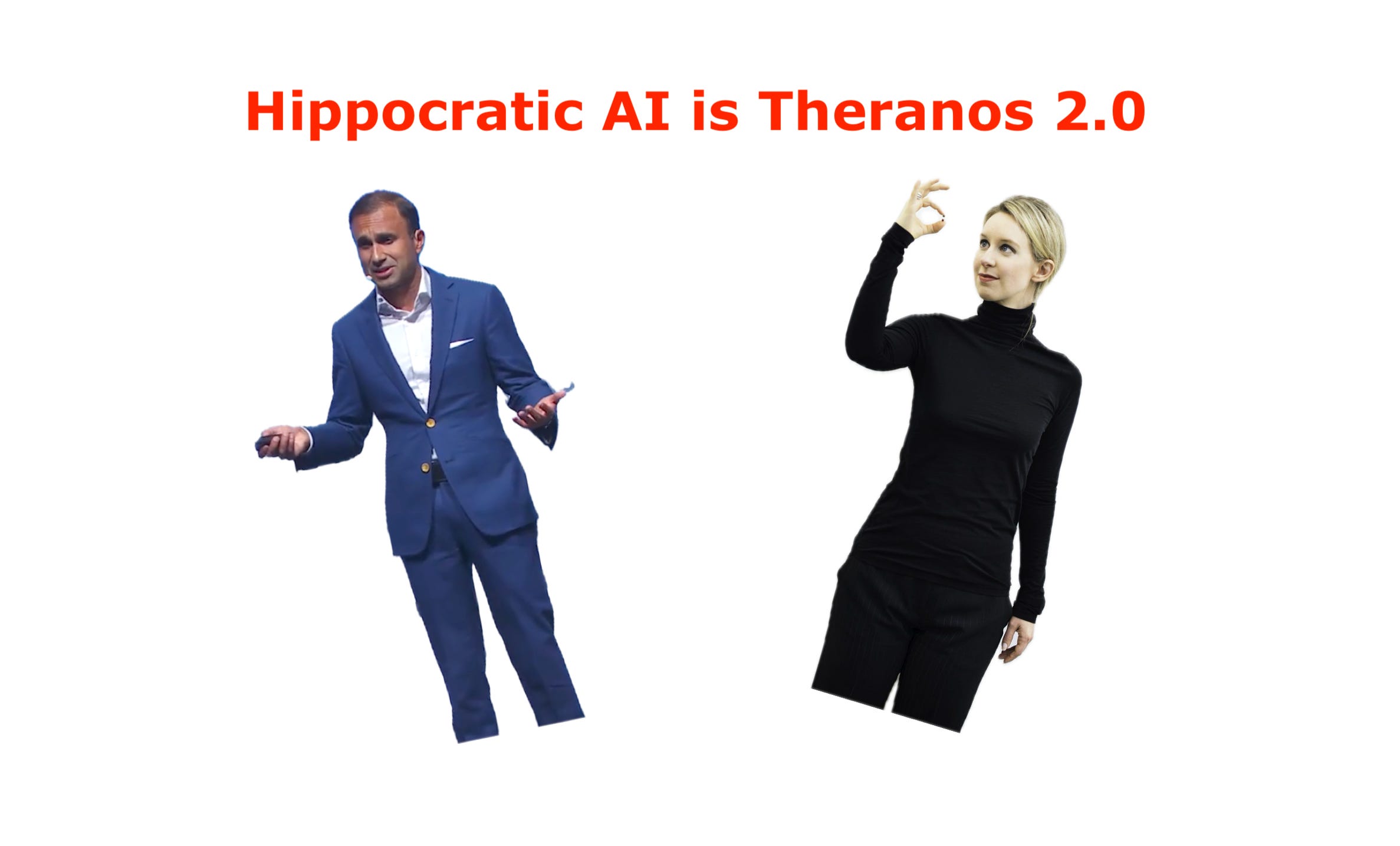
Hippocratic AI is now the most expensive AI company in the world. No revenue. Just a mountain of promises and lies. A chilling reminder of Theranos’s 90,000x valuation peak before it imploded.

Welcome to AI Health Uncut, a brutally honest newsletter on AI, innovation, and the state of the healthcare market. If you’d like to sign up to receive issues over email, you can do so here.
As you are well aware, these research and investigations are time- and labor-intensive. I’m a one-man operation. My Founding Members Club of (currently) 20 is what I heavily rely on for resources to conduct these kinds of thorough investigations. If you’d like to become a Founding Member of the AI Health Uncut community, you can join through this link. (Substack may ask you to enter your email first before taking you to the payment page.) You’ll be making a real impact, helping me continue to challenge the system and push for better outcomes in healthcare through AI, technology, policy, and beyond.
On Monday, Hippocratic AI announced yet another round of financing (what’s the next letter of the alphabet—who the hell knows anymore?), valuing the company at $3.5B with absolutely no fundamentals. Revenue is virtually zero—an estimated ARR of $17–20M—and profit is nowhere in sight. But who’s even talking about profits when the money is burned on supposedly training AI agents?
What’s worse, more than 80% of AI-guided calls, Hippocratic’s main product, come from a single client—likely another one of Munjal’s or Hemant’s buddies. The company’s burn rate now stands at $404M.

But first — if you enjoy my Substack and investigations like this one, you’ll love my podcast, “Digital Health Inside Out” (DHIO), co-hosted with my friend Alex Koshykov. We recently had incredible guests on our women’s health and investing episode, and this week we’re releasing dozens of interviews from the floor of HLTH — conversations with both seasoned industry leaders and bold, up-and-coming entrepreneurs. Check out the DHIO YouTube channel and hit subscribe.
Now, let’s dive into my investigation…
How can you burn $404M and only make $30M? That’s a skill in itself.
Congrats, Munjal Shah. 👏
As a reminder, it took Babylon Health ten years and $1.5B in investor cash to burn the company to the ground. Hippocratic AI is moving at a much faster pace, burning nearly a third of Babylon’s total in just two years.
People have short memories, unfortunately. Just look at the parade of healthcare startups at HLTH this year, claiming to “know everything about you” from “a finger prick.”
It’s been less than a decade, and we’ve already forgotten. Forgotten that Elizabeth Holmes and Sunny Balwani didn’t just lie about their product—they lied about their financials. The SEC (U.S. Securities and Exchange Commission) later found that Theranos’s 2014 revenue was “a little over $100,000,” not the $100M(!) Holmes and Balwani claimed. That fake $100M number fueled an already absurd $9B valuation, which meant Theranos was valued at roughly 90,000x revenue.
The funny thing is, Forbes did its own analysis and pegged Theranos at $800M, a fraction of the $9B valuation, and that was before anyone knew about the lies the SEC would later uncover.

Look, whether it’s Theranos or Hippocratic AI, any fake valuation divided by near-zero revenue gives you the same number: infinity. 😉
The three real questions I’ve been asking for the past two years are:
Why are VCs inflating valuations when they know there’s nothing “under the hood”?
Why is Munjal Shah, a computer scientist by training, (allegedly) lying to investors and the public about Hippocratic’s technology? In my investigation, I found that the technology is nowhere near what Mr. Shah and other executives claim it to be.
Where are the SEC and the DOJ? And why are they always late?
I think I know the answers. And I believe they help explain how we got to this bizarre point in healthcare where real innovation is mocked, while pretenders like Munjal Shah and Hemant Taneja parade around as saviors of healthcare. I’ll address these and other uncomfortable questions—not just to expose the mediocrity running through this industry, but to understand where we went wrong and how we can finally start rewarding real innovators instead of schemers.
In this deep dive, powered by courageous voices from inside the company, I also uncover how Hippocratic AI (allegedly) siphons money from its own clients — a pattern the SEC should take a hard look at.
And, as always, I’m naming names — the biggest clients who, conveniently, happen to be Hippocratic AI’s largest investors. It’s illegal to invest in a company, then turn around and become its customer, overpay 5(!) times for the product just to inflate revenue, and use that fabricated growth to justify a $3.5B valuation. This is a textbook conflict of interest and reeks of Madoff-level manipulation.
TL;DR:
1. Hippocratic AI is Now the Most Expensive AI Company in the World
2. “Sell Me This Pen” — How VC Bros Are Inflating the Price of a Lemon Like Hippocratic AI
3. Founders Are Cashing Out at an Alarming Pace
4. Reasons Hippocratic AI’s Business Model Is Unsustainable
5. How Hippocratic AI (Allegedly) Steals From Its Clients — The SEC Should Pay Attention!
6. Why Is Munjal Shah (Allegedly) Lying?
7. The “Munjal Problem”
8. Digital Health Mafia, and the U.S. Government’s Political Connections
9. Where the Hell Are the SEC and DOJ in All This?
10. Where Do We Go From Here — And How Do We Bring Back Real Innovation in Healthcare?
Earlier this year, I published an extensive two-part investigation into Hippocratic AI: Part 1 and Part 2. I strongly encourage readers (especially policymakers and regulators) to review those pieces, as they provide a solid foundation on Hippocratic AI, the product, and its toxic culture.
Finally, I want to acknowledge the brave individuals who spoke with me, anonymously, about what’s happening inside Hippocratic AI. We need more people like them. Silence isn’t neutrality—it’s complicity.
Alright, let’s unravel this mess…
