


Welcome to AI Health Uncut, a brutally honest newsletter on AI, innovation, and the state of the healthcare market. If you’d like to sign up to receive issues over email, you can do so here.
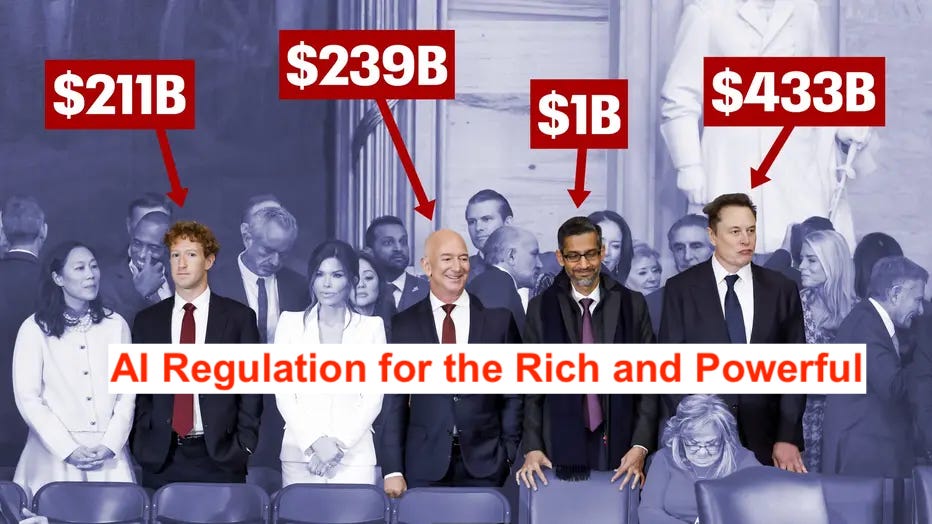
This may be an unpopular opinion. But hear me out. I think federal AI laws come with real dangers. Especially if they end up serving a small club of trillion-dollar companies that have been lobbying in D.C. like there is no tomorrow.
But first, this. In over two years of running this Substack, I have never done any promotions. I hate marketing, to be honest. But Christmas is my weak spot. 🎄 I am running a limited 20% off sale on my already discounted annual plan, with a hard stop on January 7. No ifs. No buts. Click here to get the holiday special. (Substack might make you sign up first.)
TL;DR:
1. Trump’s “One Rule” AI EO Is a Big Tech Coup Disguised as Reform
2. The Great AI Power Grab. Kill the States, Keep the Profits.
3. Remember the HITECH Act. It’s Déjà Vu All Over Again.
4. The Unelected Czar and the Executive Order for Sale
5. Healthcare’s Floor vs. Ceiling: We Regulate the Floor. We Ignore the Cure.
6. China Is Laughing All the Way to the AI Bank
7. Conclusion: Trump’s “One Rule” Is a Power Grab Disguised as Reform
1. Trump’s “One Rule” AI EO Is a Big Tech Coup Disguised as Reform
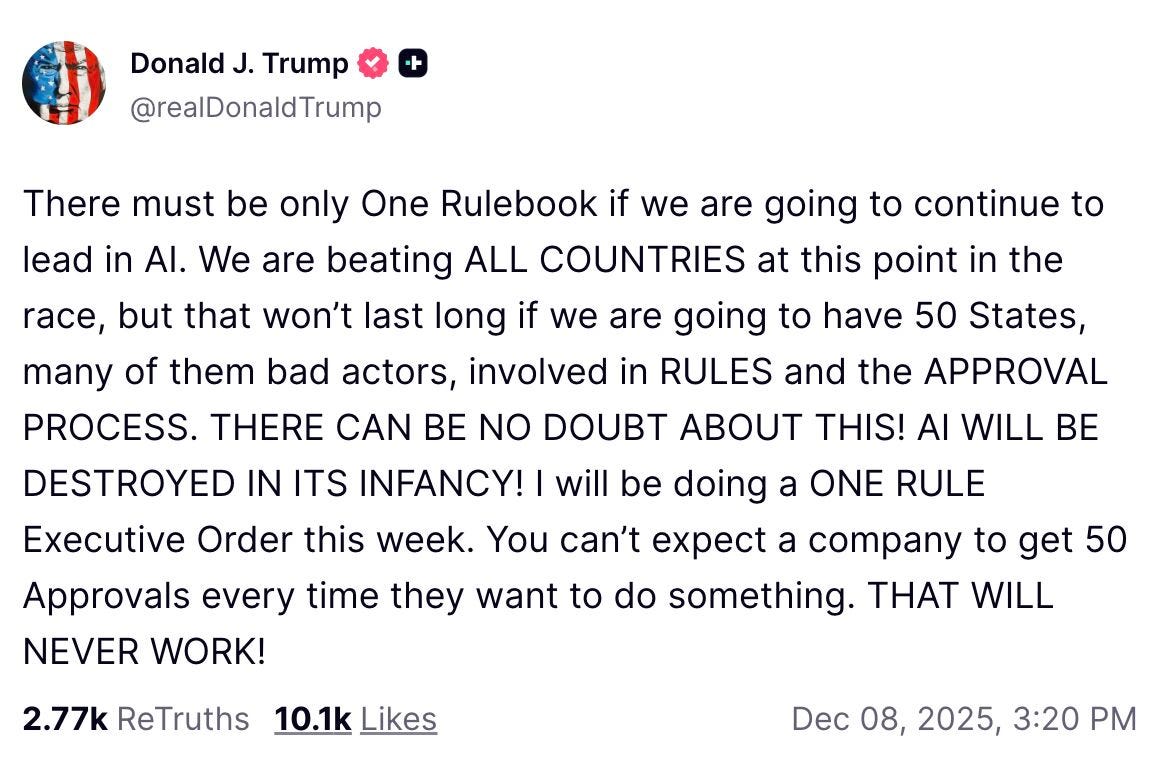
In a Truth Social message yesterday, President Trump reminded everyone that he is serious about regulating AI at the federal level. At least until it stops fitting his agenda. Of course, not through Congress, but through his favorite tool, an Executive Order. Most people will take that as a positive sign. I have deep reservations.
According to draft language of the EO, Trump plans to unleash a federal “AI Litigation Task Force” (helmed by Attorney General Pam Bondi) to sue states over any AI rule that federal agencies find “objectionable,” even threatening to cut off broadband funding to recalcitrant states. (Source: Reuters.) In plain English, this is a one-sided power play: more than a thousand local and state AI laws would be nullified in favor of a single (currently extremely vague) federal standard.
2. The Great AI Power Grab. Kill the States, Keep the Profits.
Industry insiders like Nvidia, OpenAI, Google and others have been clamoring to “reign in” the roughly 38 states that have introduced nearly 100 AI bills this year. They term the patchwork of privacy, bias and content laws “unnecessary” – but of course it is inconvenient to Silicon Valley’s unipolar world.
Big Tech’s eagerness to preempt local rules makes it clear who benefits. Billionaires and venture capitalists have openly lobbied for Washington to stomp out state regulations. Nvidia CEO Jensen Huang, who met with Trump last week on chip controls, bluntly warned that state-by-state AI rules “would drag this industry into a halt” and pose a “national security concern.” (Source: The Tech Buzz.) In one ear of the White House, Trump hears that each of 50 states can’t have its own board of AI law arbitrators. In the other ear he hears his donors: a Chamber of Progress backed by Andreessen Horowitz, Google, OpenAI and others has pitched one “light-touch” federal rulebook. (Source: Wired.) This axis of the “AI oligarchs” means Washington’s “one rule” will likely mirror Big Tech’s wishlist, not protect ordinary Americans. After all, these companies argue flatly that without a unified rule the U.S. will “fall behind China” in the AI race – a threat conveniently wielded to justify handing them a blank check. (Source: The News.)
The proposed EO doesn’t even bother proposing a substantive alternative standard. The measure will focus more on why those state laws are bad rather than one great rule for everyone. Indeed, Wired’s draft analysis shows the order merely directs aides (and its new AI “czar” David Sacks) to draft some federal framework. The only promise of real policy is the vow of “a minimally burdensome national standard” for industry – a phrase echoed in Trump’s own Truth Social bluster (“One Rulebook…you can’t expect 50 approvals”).
This EO is a giveaway to incumbents: no new guardrails, just a federal waiver of state innovation. As Public Citizen’s Bob Weissman observes, Trump’s crusade has “nothing but the industry’s well-paid waterboy” written all over it. (Source: Reuters.)
Big Tech gets a moat. The rest of us get the bill.
3. Remember the HITECH Act. It’s Déjà Vu All Over Again.
Why on Earth Would the Biggest Players in AI Want to Be Regulated? Hint: It’s not for the sake of making the future of AI safer. They are following Epic’s playbook to make them richer.
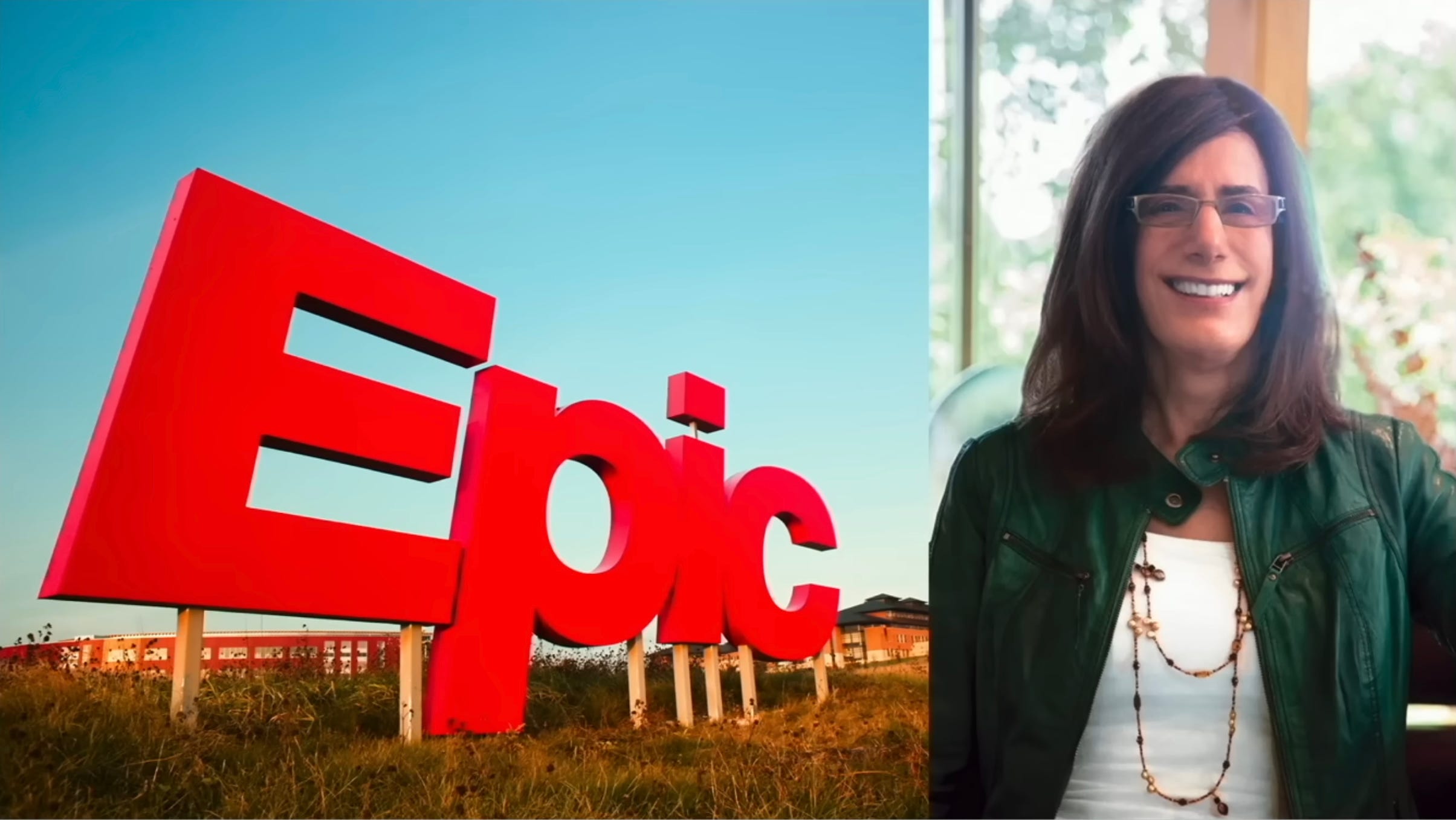
This playbook feels eerily familiar to healthcare veterans.
