


Welcome to AI Health Uncut, a brutally honest newsletter on AI, innovation, and the state of the healthcare market. If you’d like to sign up to receive issues over email, you can do so here.
Important Disclosure. This publication is written and distributed by an independent journalist. It is protected by the First Amendment to the U.S. Constitution and related principles of free expression. Those protections do not relieve me of the obligation to report accurately, and I take that obligation seriously.
I have no financial interest, whether long or short, in any of the companies mentioned in this article. This article is for informational and opinion purposes only and should not be construed as financial or investment advice. I have held every company mentioned here to the same test: published data, evidence of benefit, a real regulatory and reimbursement path, and independent proof rather than a press release.
Also, this is not the product of my research alone. On the ultrasound therapy side especially, I have been consulting with experts in the field.
Midjourney did not start the whole-body scan conversation, but it definitely made a dent in the past few weeks. Unfortunately, the economics have not been kind to companies built around that idea, and the history of failures is impressive. No one knows for sure what will work, and any innovation in healthcare is welcome. But there is a second half of the story that almost everyone is forgetting: potentially economically viable, focused ultrasound therapy. In the piece, I overview the market and explain why this just might be the next big thing in medical imaging.
This piece is a natural continuation of our recent Digital Health Vitals podcast episode, where Stephanie Davis, Alex Koshykov, Amit Phull, and I discussed Midjourney’s “Spa MRI” and other exciting healthtech topics.
But first, I want to take a moment to thank all of my supporters. I’m often very critical of certain things happening in AI and healthcare. But I promise you, it’s only because I genuinely care and want to make things better for all of us. So, thank you for your understanding.
I receive a lot of messages daily, and I always strive to respond promptly to every one of them. Most are incredibly kind and supportive.
I want to highlight one recent message in particular. A student reached out recently asking for full, paywall-free access to my Substack. Of course, I granted it, as I always do.

This brings me to another important message. If you cannot afford this article—perhaps you’re a student or currently between jobs—please reach out. That’s precisely why I created the AI Health Uncut Founding Member Club, currently at 17 and counting. Thanks to generous donations and support from these wonderful individuals, I’m able to provide access to anyone who needs it. By the way, students reach out frequently, and I’m always glad to help.
If you’d like to support my mission to uncover the brutal truth in healthtech and healthcare AI, please consider becoming a Founding Member of the AI Health Uncut community. You can join through this link. You’ll be making a real impact, helping me continue to challenge the system and push for better outcomes in healthcare through AI, technology, policy, and beyond.
OK, now let’s get back to our exciting ultrasound discussion.
Two things worth watching. Dr. Brian Walcott’s reel making the rounds on the Midjourney scan-spa: instagram.com/reels/DZyBwSly_Zo. And the half this piece is about, a 60 Minutes segment on focused ultrasound used to treat, not image.
The neurosurgeon taking the Midjourney scan-spa apart on Instagram is Dr. Brian Walcott, a Harvard-trained cerebrovascular and stroke specialist, and he is not swinging at a straw man. He is right that sound cannot cross bone or air, which means the heart, the lungs, and the brain, the organs a person would most want checked, are exactly the ones ultrasound sees worst, and no software update repeals that. He is right that Midjourney’s own founder admits the AI is labeling outputs, not doing the imaging. And he is right that “cost approaching zero” describes the sound waves and nothing else, not the hardware, the years of FDA review, the facilities, the reads, or the liability. The critique lands the same blow from the money side, and lands it harder than he does: screen millions of healthy people across a dozen organ systems and you will light something up in almost everyone, and most of it is not an early catch. It is a harmless finding that drags a well person into biopsies, specialists, and fear.


And Walcott is not the only physician making this case. From the other side of medicine, dermatologist Dr. Matthew Zirwas ran the same numbers and landed in the same place: roughly 90% of asymptomatic full-body-MRI patients show an abnormality, about two-thirds of it incidental, and finding the rest does not move overall mortality. He reaches for the same Korean thyroid and German melanoma cases we walk through below. His sharpest line named the business underneath the medicine, that a patient talked into a repeat “scam (sorry, meant scan)” every three months is training Midjourney’s model for free, and he asked who is really coming out ahead. Hold onto Zirwas. He does not stay in this chair, and where he moves later is the most interesting turn in the whole debate.
The oldest joke in medicine is that the way to stay healthy is to stay out of hospitals. Underneath the joke is a real finding: look hard enough at a well person and you will find a shadow, and chasing that shadow costs time, money, and fear for something that would have come and gone on its own. On consumer whole-body screening, the argument is won. We are not going to relitigate it.
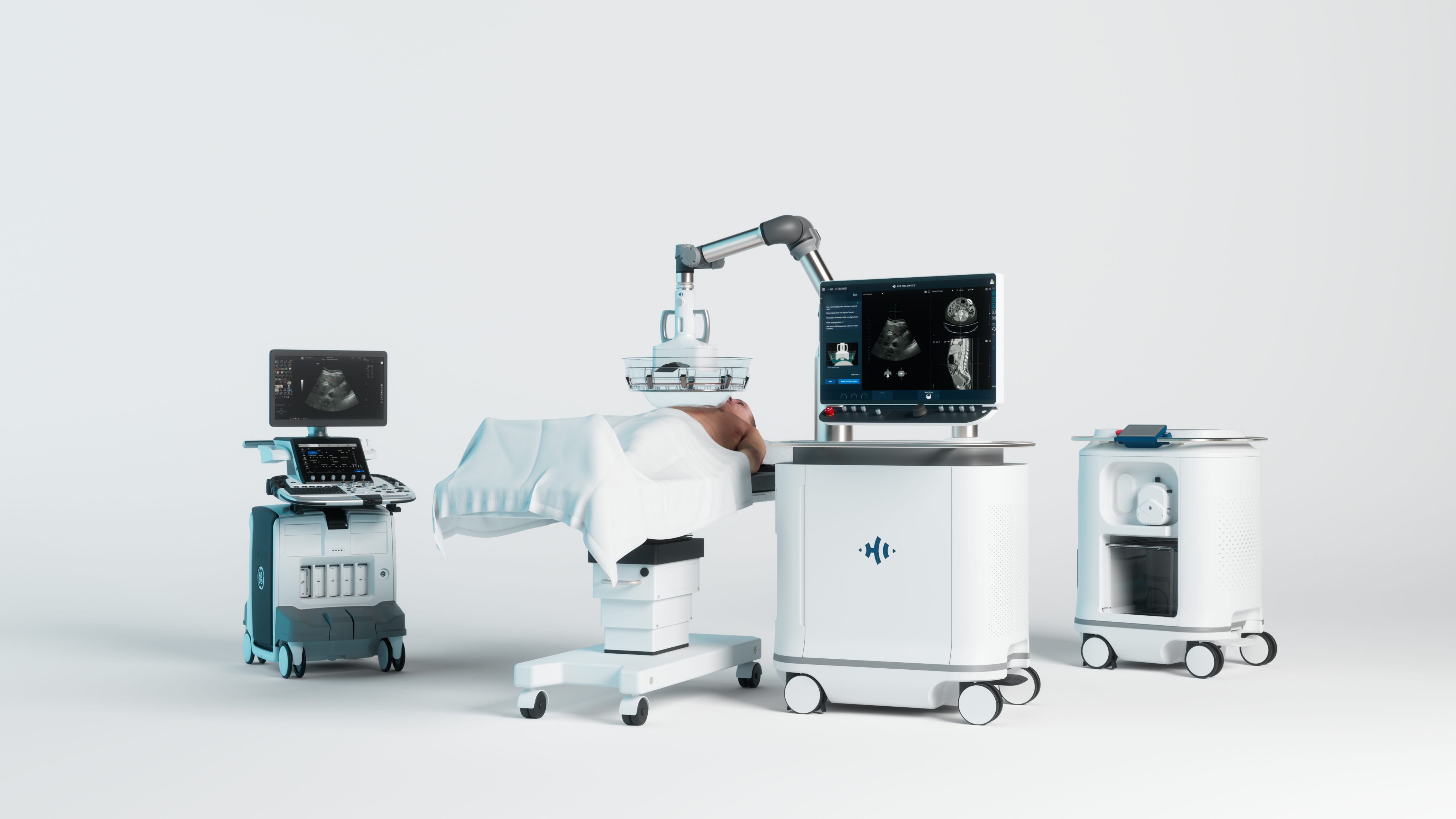
A Histotripsy System is a medical device that destroys targeted tissue using focused ultrasound, but unlike many ablation systems, it does not primarily use heat, radiation, needles, or incisions. The best-known commercial version is HistoSonics’ Edison® System.
Here is the half of the conversation that keeps getting skipped. The problem is not believing too much in screening. It is assuming screening is the whole point of taking ultrasound out of the hospital.
The part that matters is not a machine that scans a healthy body and guesses. It is a machine that treats a sick one. Imaging and therapy on the same device, in the same second.
Aimed at someone with no symptoms, every objection above still holds. Aimed at a patient with a diagnosed clot in the leg or the brain, those objections start to fall away.
TL;DR:
1. The shift is real, and this is the legitimate half
2. The screening critique holds. The bad and the ugly.
3. Midjourney’s scan-spa, and why it is worse than it looks
4. The fight underneath the fight: this is not gatekeeping
5. The honest counterargument: the one thing that could change the math
6. The half the conversation skips: the machine that looks and treats
7. The scorecard
8. Bottom line: The screening story is oversold. The therapy story is undersold.
