


Welcome to AI Health Uncut, a brutally honest newsletter on AI, innovation, and the state of the healthcare market. If you’d like to sign up to receive issues over email, you can do so here.
Disclosure: I am an independent journalist. I have no financial position in OpenEvidence, Doximity, RELX (Elsevier), Apple, Veeva Systems, News Corp, Microsoft, OpenAI, Alphabet (Google), Anthropic, Nvidia, Epic, Sequoia Capital, Springer Nature (Nature Medicine), AKH Inc., HLTH, Business Insider, STAT, Fierce Healthcare, Healthcare Dive, Quadrivia AI, Forbes, Wolters Kluwer, Wiley, Hippocratic AI, Commure, Heidi Health, Ada Health, JP Morgan Chase, Nasdaq, or any other company mentioned in this article or its charts. I have reached out to OpenEvidence and Daniel Nadler for comment multiple times, including with regard to the Wall Street Journal column claims, and have received no response. This article is my opinion, based on the sources cited. It is not investment, legal or medical advice, and nothing in it alleges that anyone broke the law.
I owe you, my loyal readers, an apology: this is yet another piece about OpenEvidence and Daniel Nadler. Believe me, I am tired of covering them. But they insert themselves into the news so often, and no one else seems to set the record straight. And this time, Nadler went too far.
But first, I want to wish all my loyal readers and supporters, many of whom I had the pleasure of meeting at HLTH last week, a Happy Thanksgiving! 🦃
I hope you get to spend it with your family and loved ones.
And if you’re spending holidays alone, please don’t hesitate to reach out to me.
I know how tough the holidays can be when you’re alone. I have to admit that, due to life circumstances, I’ve had to spend a few holidays by myself. And it wasn’t easy.
So if you’re feeling lonely, even if you just want to have a short, warm conversation, please reach out. I’d be happy to chat.
And please think about your neighbors, especially elderly neighbors who may be spending the holidays alone. Sometimes, a simple phone call, a knock on the door, or a few kind words can make someone’s day.
A very warm message from someone I barely knew likely saved my life when I was at my lowest point.
Let’s look out for one another. Let’s be there for each other.
Happy Thanksgiving, everyone! ❤️
Also, I just got back from HLTH in Las Vegas, where I had the pleasure of attending as an official HLTH content creator!
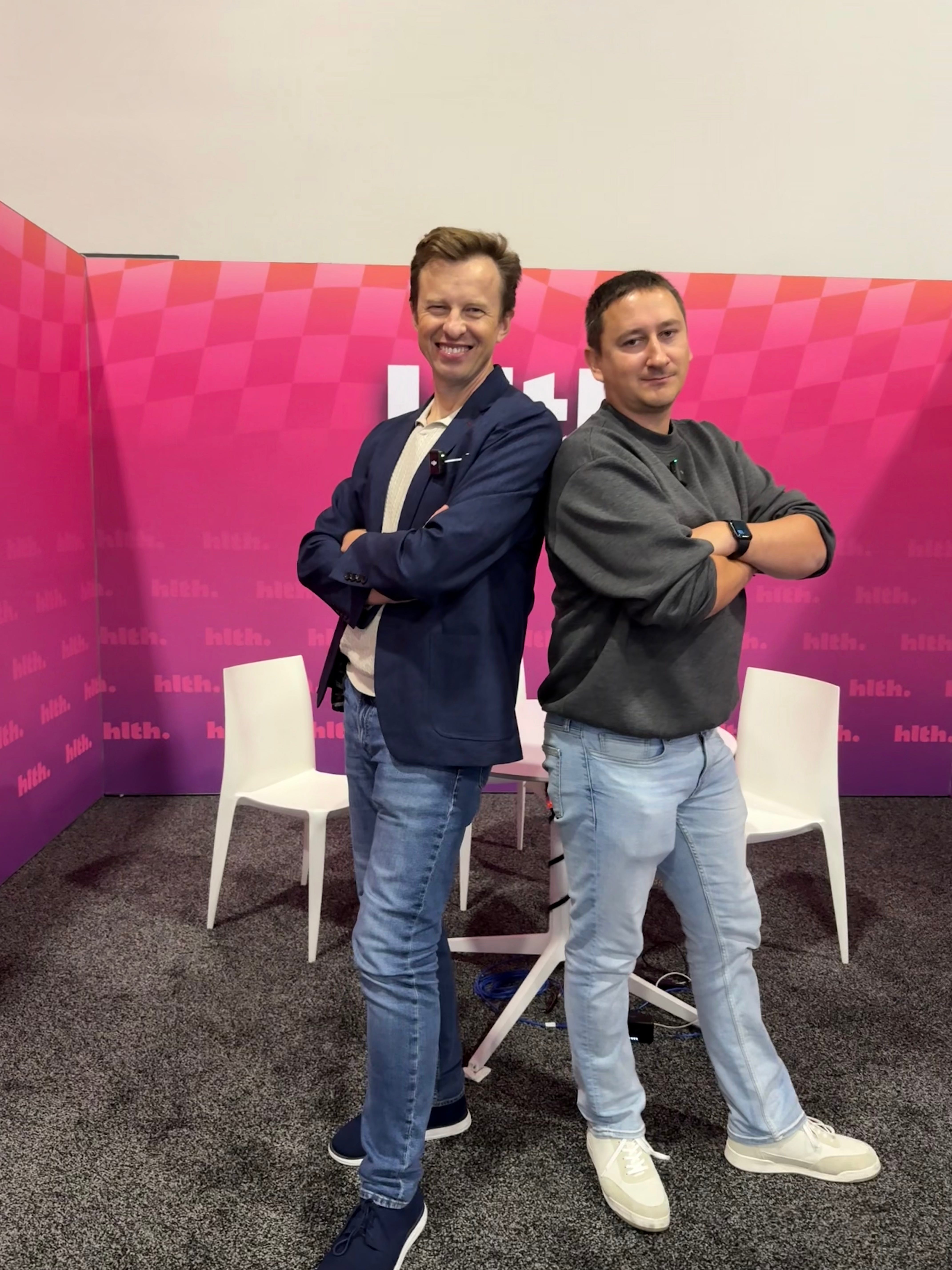
And, of course, together with my friend and Digital Health Inside Out co-host, Alex Koshykov (confidently pictured here with me 😉), we recorded a massive amount of content featuring some amazing healthcare industry leaders, including:
Graham Walker, MD, Head of AI and Co-founder of MDCalc
Carlos Nunez, MD, Chief Medical Officer at ResMed
Joe DeVivo, CEO of Butterfly Network
John Dayton, MD, MBA, Managing Partner at Wildfire Partners
Rebecca Love, MSN, RN, FIEL, CEO of NurseApproved
Varsha Chandramouli, MD, FAAFP, Chief Medical Officer at Avalon Healthcare Solutions
Peter Micca, Managing Partner at Caduceus Capital Partners
And, of course, our fellow co-host, the well-known healthcare industry analyst Stephanie Davis!
We had some fascinating, candid, and occasionally provocative conversations about the future of healthcare, AI, and digital health. And we can’t wait to share them with you!
🎙️ Stay tuned to Digital Health Inside Out! Subscribe on your favorite podcast app or watch us on YouTube. We have a LOT of great content coming your way!
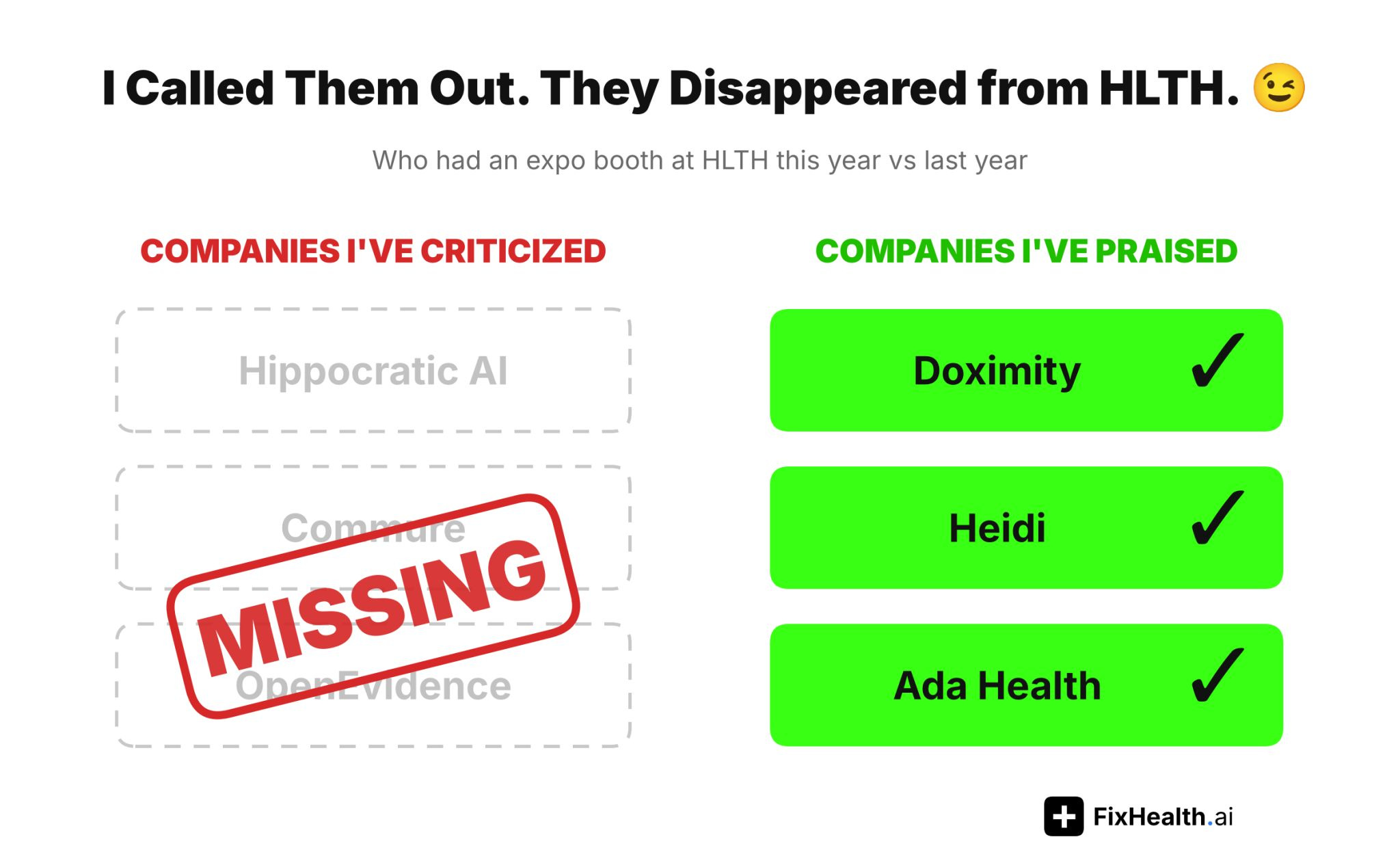
I also have a funny observation from HLTH. 😉 At HLTH this year, unlike last year, I didn’t see expo booths from Hippocratic AI, Commure, or OpenEvidence - all companies I’ve criticized on this Substack.
Meanwhile, companies I’ve praised, including Doximity, Heidi, and Ada Health, were all there.
Just saying. 😉
A word about how this work gets paid for. Independent investigative journalism comes at a significant cost, both in time and legal risk. That’s why I have launched the AI Health Uncut Sponsorship Program. AI Health Uncut’s subscribers include prominent leaders in healthcare, technology and investment, including household names you would undoubtedly recognize. Sponsorship puts your work in front of all these people, who help shape the industry’s direction, its funding and its adoption of new technologies. Sponsorship does not buy favorable editorial coverage. But I welcome like-minded sponsors who respect my editorial independence and don’t interfere with what I write.
I also encourage my readers to become Founding Members. I need your support. By joining, you’re not only supporting my continued investigations and research into healthcare AI. You’re also helping me make this work accessible to people who may not be able to afford a subscription, whether they’re students, between jobs, or simply going through a difficult financial period. (If that’s you, please reach out.) Thanks to the generosity of Founding Members, I’m able to provide access to anyone who needs it. Your support is what keeps the lights on.
Back to OpenEvidence’s claims of saving lives... On November 15, while half of healthtech, including yours truly, was at HLTH in Las Vegas, The Wall Street Journal ran an opinion column by Andy Kessler about OpenEvidence. Its sub-headline credits the company with saving lives. Asked for proof, CEO Daniel Nadler offered an “internal analysis”: all-cause mortality among men under 30 recently declined in countries where doctors have OpenEvidence, compared with similar countries where they don’t. No paper. No data. No method. And a result for one group only. Nothing about women, the middle-aged or the elderly. The same day, Apple announced a study built on OpenEvidence. 4 days later, Elsevier said its OpenEvidence partnership was over.
In my opinion, the life-saving claim is misleading and dangerous, and, if history is any guide, its goal is to prop up a $15B+ price tag. I’ll explain in detail in Section 7 below.
Nadler reminds me of Jensen Huang lately: brilliant, and somehow always in the news for the wrong reason.
A note on how this works. Most of my investigations start with a tip from someone like you. I verify it with other witnesses, then add my own “mosaic theory” research on top. Everything stays confidential, always. I have been doing this for more than 3 years. What follows is a standing public service announcement that I run in every investigation. It is not directed at any company discussed in this piece, and nothing in this article alleges that OpenEvidence or any of its employees or representatives has broken the law.
If you see something unethical, or even just weird, anywhere in healthtech, do not stay silent. Tell a newspaper, tell me (DMs, Signal, WhatsApp, whatever you prefer), or, if you believe a law has been broken, tell a law enforcement agency (tips.fbi.gov).
Here is what’s inside:
1. Nadler’s Proof: An “Internal Analysis” Nobody Can Check
2. The Biggest Problem: Only Men Under 30. Where the Hell Is Everyone Else?
3. Nadler Claims OpenEvidence Saves Young Men. No. They Die of Overdoses, Crashes, Suicide and Homicide, Not Misdiagnosis
4. Fewer Young Americans Are Dying. Thank Fewer Overdoses, Not OpenEvidence
5. OpenEvidence’s Alleged “Life-Saving” AI Scores Only 24% on Real Clinical Questions
6. OpenEvidence “Won” an ACR Study 2 Days After Its ACR Deal. The Numbers Don’t Add Up
7. Proof of Window Dressing: OpenEvidence’s Big Announcements Land Right Before the Money. Every Fcking Time
8. Nadler Stood in the Front Row as Anthropic Rang the Nasdaq Bell. WTF? Is Anthropic the Buyer?
9. My Prediction Came True: Elsevier Ends Its Relationship with OpenEvidence. What Took It So Long? 🤷
10. Learn: OpenEvidence Wants to Train the Doctors It Advertises To
11. The Babylon Parallel Is Striking: Ali Parsa Made Extraordinary Unproven Claims Too. Then Babylon Went Bankrupt
12. Follow the Money: The Lawsuit Is Gone, the Pharma Ads Remain
