


Welcome to AI Health Uncut, a brutally honest newsletter on AI, innovation, and the state of the healthcare market. If you’d like to sign up to receive issues over email, you can do so here.
Important Disclosure. I am an independent journalist with no financial interest, long or short, in any company mentioned here. I did not contact Oura for comment. Facts come from SEC filings and press coverage, hyperlinked at the point of reference. Opinions are my own. Not investment advice.
It’s almost as if Tom Hale, Oura’s CEO, read my September 5 piece, “Oura IPO: Slick Gadget, Shaky Business,” and decided not to test my thesis in public markets just yet. 😉
🚨 But first, an announcement.
🎙️ Calling all medical professionals, healthtech folks, and fans of our podcast, Digital Health Inside Out. Alex Koshykov and I are looking for a few brave souls willing to join us for in-person conversations that may range from serious healthcare debates to completely inappropriate healthtech dad jokes. 😄 We’ll be recording right from the floor of HLTH in Las Vegas, November 15–18. 🎰🔥 If you’ll be there and think you’d be a good sport, drop a comment or send either of us a DM. One thing we can promise. It won’t be boring. And yes, things may get a little heated from time to time. 😉
By the way, if you cannot afford this article, perhaps you’re a student or currently between jobs, please reach out. That’s precisely why I created the AI Health Uncut Founding Member Club. Thanks to generous donations from these wonderful individuals, I’m able to provide access to anyone who needs it.
Oura postponed its IPO this morning. It was set to price tonight and begin trading on Nasdaq as OURA tomorrow. In its announcement, Oura blamed “uncertainty in the IPO market,” despite “strong demand.” It says the business “has further strengthened since beginning the IPO process” and expects 5.7M paid members by the end of its fiscal year tomorrow. CEO Tom Hale said Oura has “the luxury of choosing our moment.” No new date was given.
Uh, OK… But we were not born yesterday.
Let’s get real. The demand was super weak. Bloomberg reported the IPO shares book was only ~4x oversubscribed (boooo 👎). Eli Lilly and Dragoneer had indicated interest in up to $400M of stock between them. As I show in Section 10, 4x is very weak for a deal this size.
On September 5, I read Oura's S-1 and called it Slick Gadget, Shaky Business. I also put a three-part prediction on record. Tonight was supposed to test the first part. The amended filing from September 21 answered the question the first one left open: who receives the IPO money. The postponement raises a new question:
Who loses when the IPO waits? Mostly Oura employees who were planning to buy a new house or finally retire, but now find their RSUs stuck on ice.
The filing also reminded me of another company. In September 2019, a connected-hardware brand with triple-digit growth, a subscription story, and a devoted early customer base went public at $8.1B. It was Peloton.
🚨 TL;DR:
Oura postponed its IPO on the day it was set to price, blaming “uncertainty in the IPO market.” Its subscription book was only ~4x covered.
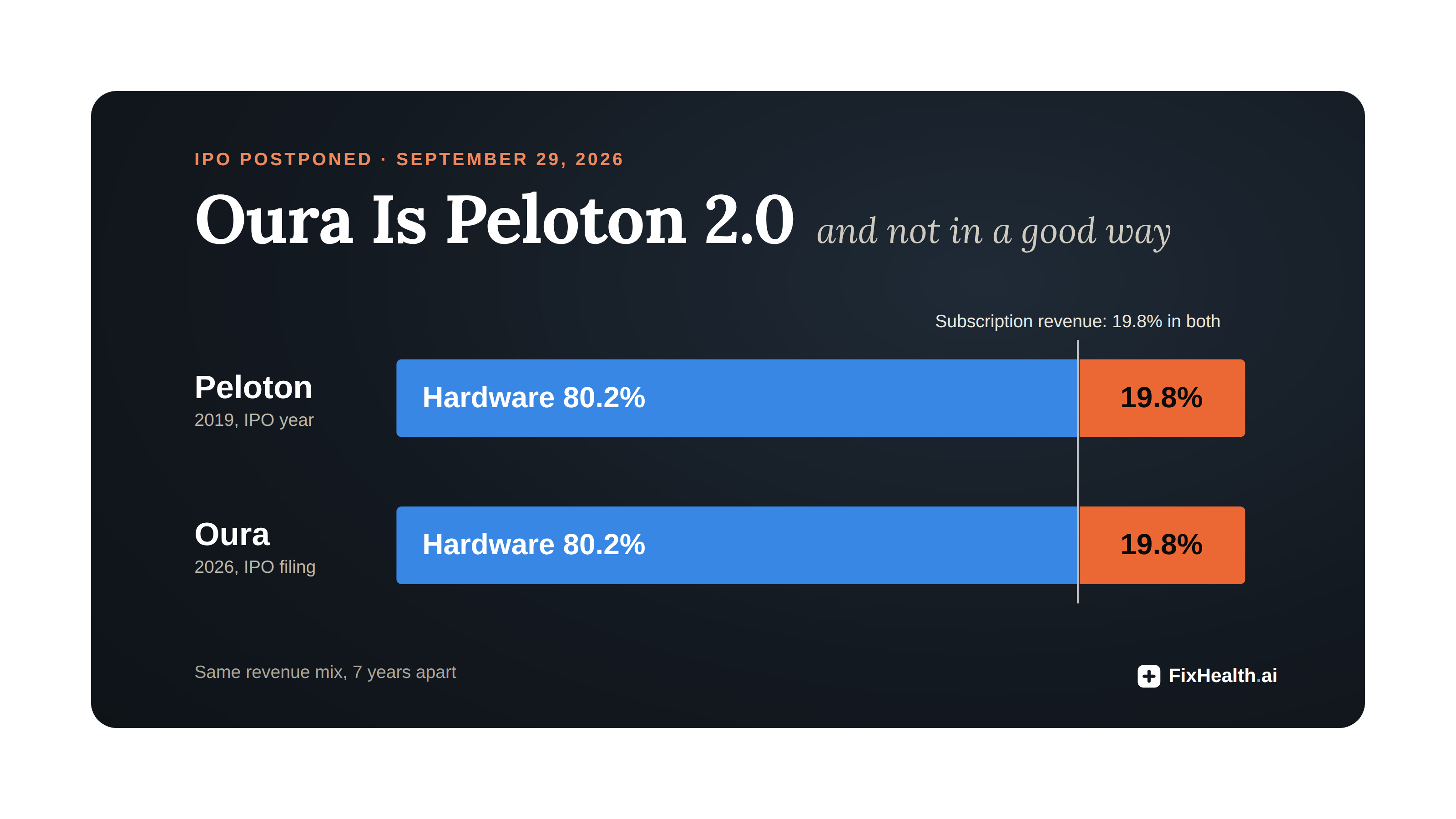
Subscriptions were 19.8% of Peloton’s revenue in its IPO year. Subscriptions are 19.8% of Oura’s today, and that share has little room to grow.
Peloton grew 110% the year it listed. Revenue has fallen every year since its fiscal 2021 peak, and its market value is down 96%.
Both learned that hardware breaks. Peloton had recalls. Oura booked $84.4M of Ring 4 warranty expense in a year it earned $12,000.
Oura is profitable. Peloton was not. But Oura’s 85% retention trails Peloton’s 95%, and I doubt even 85% will hold.
Three VCs were set to sell 73% of the IPO shares, Forerunner its entire stake. After employee RSU taxes, Oura would have kept just $6.2M.
Only 3 of 123 US IPOs since 2019 spent nearly all their proceeds on RSU taxes. None paired it with as much insider selling as Oura planned.
At the IPO midpoint, Oura would have been worth ~2443x its 2015 seed valuation and ~20.5x Forerunner’s 2020 round. Three early VCs were heading for the exit. In my view, that was a horrible signal. Private rounds are easy to inflate. Millions of public shareholders are harder to fool.
A 4x book is weak. The typical large US IPO since 2023 drew 20x. Only Reddit and SpaceX, which raised $86B, came close to Oura’s 4x. Waiting costs Oura little. Its employees pay the price, with RSUs stuck on ice. So do the selling VCs, with ~$1.53B of sales on hold.
At ~10x to 11x revenue, Oura’s IPO range was stretched, but not crazy. Peloton listed at ~9x.
On the IPO plan, Oura looks more like Fitbit, which popped 48% on day one and sold to Google 4 years later, 63% below its IPO price.
Oura’s “predictive health” looks like an unrealized vision from good people, not deception. But the IPO was priced on the vision.
Peloton had Covid. Oura has AI. My September 5 prediction is on hold with the IPO, but I’m standing by it, Finnish jewelry and all. 😉
Here is what’s inside:
1. Oura vs. Peloton: Same 80/20 Revenue Split, Same Platform Pitch
2. Peloton’s Growth Stalled Once the Tech Enthusiasts Had Bought
3. Both Learned That Hardware Breaks
4. Where Oura Is Not Peloton
5. Peloton (and Fitbit) Raised IPO Money to Fund Growth. Oura Planned to Spend It All on Day 1.
6. A Primer on Why Oura Pays the RSU Tax Bill, Not Its Employees
7. How Rare It Is to Spend an IPO on Employee Taxes
8. Who Planned to Dump Oura Shares, and What They Sold Before
9. The VC Pump and Dump: Easy in Private Rounds, Harder in Public
10. Honestly, 4x Oversubscribed Is Weak. That’s Why Oura Postponed.
11. The Oura Revenue Multiple: Stretched, but Not Crazy
12. Google Paid $2.1B for Fitbit. Oura Wanted $14.9B on the Same Revenue.
13. Oura’s Predictive Promise: Ambitious, Not Deceptive
14. My Verdict, and My On-Record Prediction
