


Welcome to AI Health Uncut, a brutally honest newsletter on AI, innovation, and the state of the healthcare market. If you’d like to sign up to receive issues over email, you can do so here.
On this Memorial Day, I’d like to thank everyone who has served to defend our freedom and our democracy. 🇺🇸 America has done this for a long time. Other countries have done it too. Today, Ukraine carries the burden of defending freedom, with hundreds giving their lives every day. Not only for the freedom of Ukrainians, but really for the freedom of the rest of the world. 🇺🇦
Now, if you’ve been reading AI Health Uncut for any length of time, you know I don’t hand out compliments cheaply. My usual mode is to name names, run the numbers, and ask the uncomfortable questions that conference moderators are too polite (or too sponsored) to ask.
So it’s going to feel strange writing what comes next. 😉
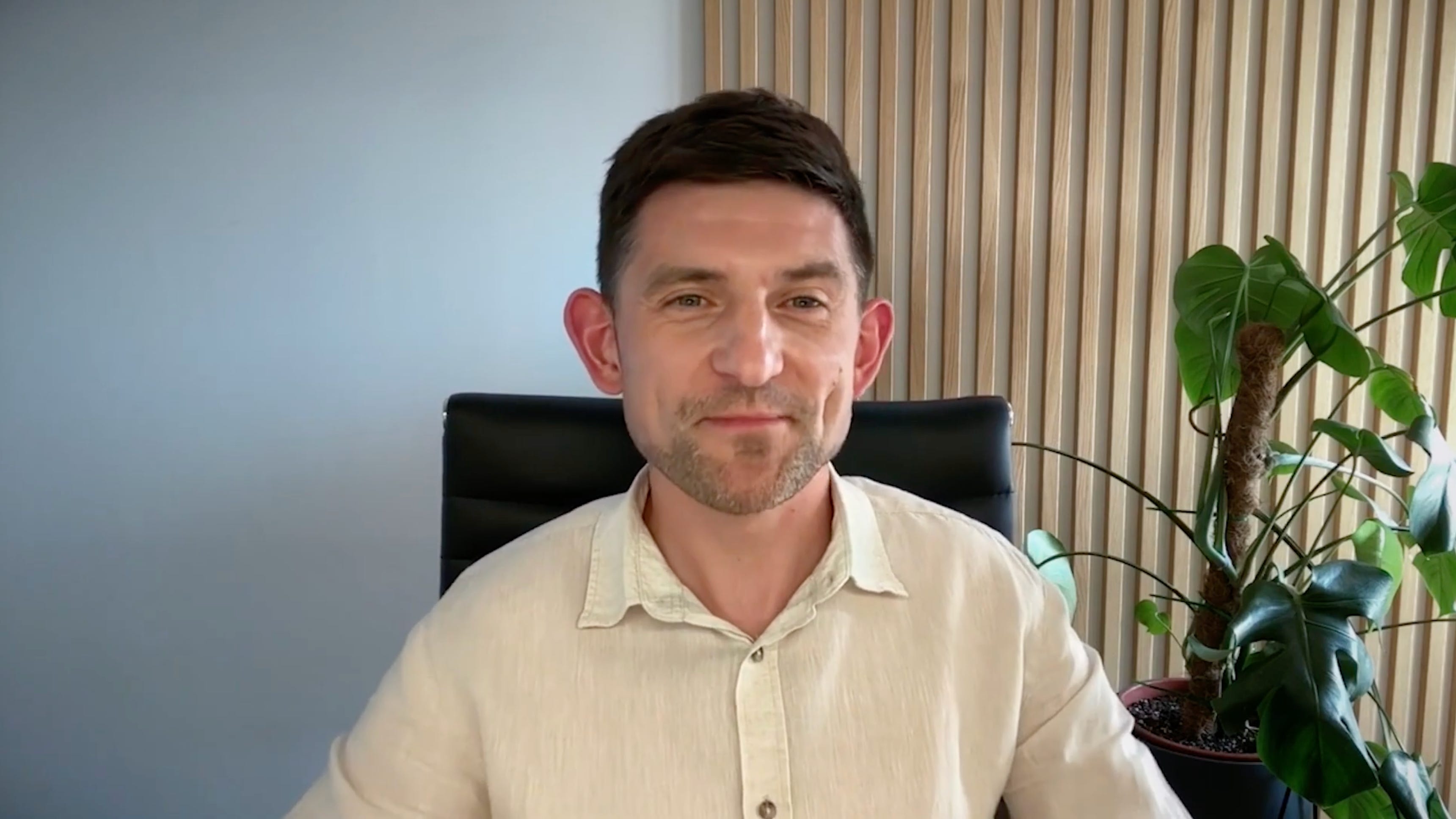
A few weeks ago, Alex Koshykov and I sat down with Piotr Orzechowski, founder and CEO of Infermedica, for an episode of our podcast Digital Health Inside Out. I went in expecting a “precanned” founder interview. I came out convinced that Piotr is, quite genuinely, one of the most humble and disciplined leaders in this industry. And I think the industry would be in much better shape if more people behaved the way he does.
Here’s the conversation, and here’s why it matters.
Disclaimer: I do not currently hold any financial interest, long or short, in Infermedica or any other company mentioned in this article.
TL;DR:
1. A quick note on how we got here
2. From a 7-year-old kid in Wrocław to a global medical-device company
3. “The symptom checker category is dead”
4. The graveyard next door
5. The 97% accuracy story (and why I owe Piotr a thank you)
6. The reaction of a true leader
7. On accuracy claims: “your product either works or it doesn’t”
8. The Silicon Valley story I cannot stop thinking about
9. The discipline that saved the company
10. On the LLM threat: neurosymbolic, not just neural
11. The bold prediction
12. So what was a multi-million ARR CEO doing handing out unicorn plushies?
13. So can you criticize a company while still respecting its leader?
1. A quick note on how we got here
For those who missed it, I wrote last November about a strange encounter at HLTH in Las Vegas. I was wandering the exhibit hall, spotted the Infermedica booth, talked my way into getting their last unicorn plushie, and then saw the guy quietly working the booth in the late afternoon, handing out plushies himself. It was Piotr, the CEO of a company that operates in more than 35 countries.
I introduced myself. He looked at my badge and, without missing a beat, quoted back to me (word for word! an unflattering line from an article I’d written a couple of years earlier in which I tore into one of Infermedica’s accuracy claims. He didn’t push back. He didn’t get defensive. He quietly addressed the problem. He told me he respects journalistic integrity and didn’t want to interfere, even when the journalism was about him.
That moment stuck with me. So when Alex and I had the chance to actually sit down with him for a long conversation, I wanted to dig into the things I’d been wrong about, the things I still wasn’t sure about, and the things that I think the rest of the industry could learn from.
2. From a 7-year-old kid in Wrocław to a global medical-device company
Piotr’s story starts where a lot of European founder stories start, but with a twist. His father is a chemistry professor who used to bring old computers home. By the time Piotr was seven, he was already programming. He wanted to build games (fantasy worlds, things from scratch), and he ended up with a degree in computer science and software engineering from Wrocław.
His first real company was the CTO role at a Polish clone of Dropbox, where he co-developed the file sync algorithm. It got acquired by the largest web portal in Poland, and he found himself looking for the next thing.
The next thing turned out to be an online version of 20 Questions. He was playing it with a friend who happened to be a medical doctor, and they had the same thought at the same time: this thing always guesses what you’re thinking. What if we turned the genie into a symptom-checking tool and replaced Dr. Google?
That was 2010. Two years later, in 2012, Infermedica was born.
(Quick side note for anyone Googling: Piotr is not the famous Polish jazz pianist Piotr Orzechowski, also known as “Pianohooligan.” Piotr the founder has actually met Piotr the pianist after a concert, introduced himself, and confused the hell out of him. He half-jokingly proposed a duo: “I’ll play guitar, you play piano.” The pianist was open to it. Sadly, no album has materialized. 😉)
3. “The symptom checker category is dead”
This was probably the most provocative thing Piotr said in the entire conversation, and he said it about his own category.
Here’s the quote:
“I almost think that this category of a symptom checker is literally dead. I think it doesn’t exist anymore… If you’re building the next WebMD, some consumer type of thing that’s standalone, that lets people check their symptoms — it doesn’t exist anymore. Everybody, including myself, would go to ChatGPT, Claude, Perplexity, you name it.”
Take a moment with that. The CEO of one of the original AI symptom-checker companies told us, on the record, that the standalone consumer symptom-checker use case is gone. Done. Owned by the foundation models.
What’s left, in Piotr’s view, is something narrower and much harder to replicate: clinical-grade triage that is deeply integrated into a real healthcare workflow. Not a chatbot floating on a marketing page. An intake module before an appointment. A standardized assessment tool that a nurse uses on a call. A post-discharge follow-up that catches a fever or a wound infection before it becomes a readmission.
This is the unglamorous version of the industry. But it’s the version that actually works.
And it explains why so many of his loudest competitors are no longer with us.
4. The graveyard next door
Piotr didn’t gloat about this (that’s not his style), but the facts are the facts:
Babylon went bankrupt.
K Health was marked down.
Buoy restructured.
Ada Health laid off roughly half its staff.
Meanwhile, Infermedica is still here. Operating in 35+ countries. Class 2B medical device certified in the European Union. More than 27 million people have used the platform to assess their symptoms. And, most importantly, they expect to hit break-even this year or next, driven by signed customers and tight fiscal control, not another funding round.
How? Three things, in Piotr’s own framing:
Clinician-built and validated. They’ve put more than 150,000 hours of physician input into manually assembling their medical knowledge graph. It’s slow, mundane, and unsexy. It also means there’s no hallucination, the work can be audited, and they can sign off on it.
Medical device status. Class 2B in the EU, which Piotr argues is a stricter standard than what the U.S. requires. He’s blunt: “Getting this medical device status is nowhere possible right now on the roadmap of ChatGPT, Perplexity, or Claude. It’s absolutely impossible.” Because it requires external auditors, ISO processes, and a quality management system that an LLM provider has no incentive to build.
They take responsibility. This was the line that stayed with me. Class 2B is the device category for products that can cause serious harm if they fail. If Infermedica tells a patient “you don’t need to go to the emergency room” and that turns out to be wrong, Infermedica is the one accountable. Not the partner, not the LLM provider, not the hospital. Them.
That last point is something I want every healthtech investor reading this to write down somewhere. The companies that survive the next five years will be the ones willing to absorb liability. The ones offloading it to “the model” or “the doctor in the loop” or “the consumer’s own judgment” are running on borrowed time.
5. The 97% accuracy story (and why I owe Piotr a thank you)
This was the part of the conversation I was most nervous about.
A few years ago, I wrote a piece criticizing Infermedica’s claim of 97% accuracy on a particular study. I called the company a “tech copycat” and a “tech parasite.” I doubted the validity of the number, and I wasn’t gentle about it.
On the podcast, I told Piotr (on tape) that I was wrong. Not about questioning the number. (I still don’t believe that number tells you what it’s marketed as telling you.) But I was wrong about Piotr personally and about the company’s intent. I’ve watched him operate for two years since. The behavior is consistent. The humility is not a press strategy.
His response was extraordinary, and I want to quote it in full because it’s the kind of answer you almost never hear from a CEO:
“When I reflected on it, I think it might be really the case. The study you referred to was from 2020. I remember when you brought it up, I went to our marketing team and said, ‘Well, guys, look, how come we have 97% accuracy, even I don’t believe it?’ So I did challenge our team back then… Since your intervention, we were much more careful when it comes to the numbers we provide. So you had a positive impact on the company. Since then, we have published our results in 26 peer-reviewed papers. So we switched from this — to a much more evidence-based and solid approach.”
Read that again. The CEO publicly credited a hostile critic for making his company better. And then went and did the work to back it up: 26 peer-reviewed papers.
I’ve been in this industry long enough to know how rare this is. The default founder reaction to criticism is one of two things: ignore it, or fight it. Lawyer letters. PR pushback. Subtweets. Whisper campaigns to investors. And sometimes … worse.
Piotr did none of those things. He went to his marketing team and asked, internally, whether the critic might be right. And when the answer turned out to be yes, sort of, he changed how the company communicated.
This is how the industry should work!
6. The reaction of a true leader
I want to dwell on this for a moment, because it’s so rare these days (especially in healthtech) that I almost don’t know how to write about it without sounding like I’m fawning.
Here’s what actually happened, in plain terms: I once criticized Infermedica in one of my articles. Instead of trying to silence me or attack me, the management team used the information in my article to fix the problems I was pointing out. The CEO, Piotr Orzechowski, circulated my article inside the company, and eventually the problem was addressed.
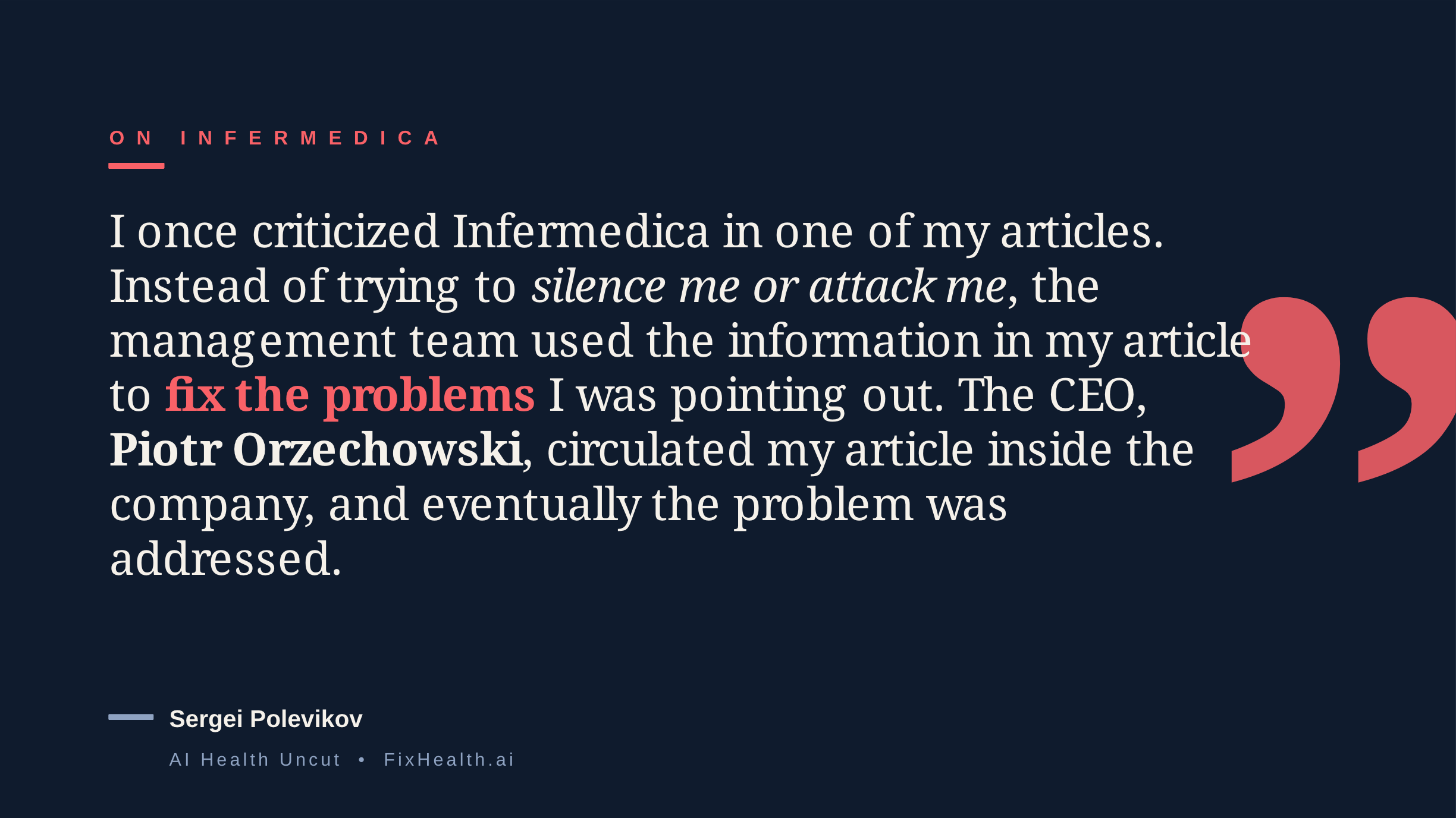
That is the reaction of a true leader. I wish more leaders responded to constructive criticism that way.
Instead, what I usually see is the opposite. Lawyer letters. Backchannel calls to mutual contacts. Attempts to get me discredited.
The pattern is so consistent that when a CEO behaves like Piotr did — reads the criticism, takes it seriously, asks the team if the critic has a point, and then changes course when the answer is yes — it stands out as genuinely unusual. It shouldn’t be unusual. It used to be what professional adults did. Somewhere along the way, in this industry in particular, the playbook flipped to attack the messenger and hope the message goes away.
That is the kind of work I want to keep doing. I want to expose problems, yes — that is what AI Health Uncut is for, and that’s not going to change. But I also want to highlight the companies and the leaders who are willing to listen, improve, and do the right thing. Because if I only write the critical pieces, I’m contributing to the false impression that everyone in this industry is bad. They’re not. Some of them (Piotr is one) are doing the work the right way, and they deserve to be named for that just as much as the bad actors deserve to be named for the opposite.
Those who are belittling me and other journalists are, in the most literal sense, killing the messenger. And nine times out of ten, in my experience, they are trying to divert attention from the real problems. The volume of the pushback is almost perfectly correlated with how much they have to hide. The founders who have nothing to hide tend to engage calmly, ask good-faith questions, and quietly fix what needs fixing.
If you’re a healthtech founder reading this, and you ever find yourself drafting a furious response to a piece a journalist or analyst wrote about your company, I’d gently suggest: put it down, walk away from the keyboard, and ask yourself what Piotr would do. Then ask your team whether the critic might be right. You may not like the answer. But your company will be better for having asked the question.
7. On accuracy claims: “your product either works or it doesn’t”
I asked Piotr the bigger version of this question: how should a buyer or a journalist call BS on an AI symptom-checker accuracy claim? Every company in this space is publishing some flavor of an accuracy number, often on vignettes, often on cherry-picked specialties, often without anything you could call rigorous methodology.
His answer surprised me:
“We almost don’t use accuracy metrics, to be honest. We don’t even bring them up during calls with partners… For me, accuracy is table stakes. Your product either works or it doesn’t.”
The interesting part is why he thinks pure accuracy benchmarks are a category error. Triage isn’t diagnosis. There’s no universal gold standard for “where should this patient with chest pain go?” — because the answer depends on the country, the cost structure, the proximity of services, and the risk profile of the system. He pointed out that you can put the same patient case in front of three doctors and get three different triage answers. Triage is, in his words, harder than diagnosis, because diagnosis at least has ICD-10 codes and guidelines.
So what does Piotr think buyers should ask instead?
Be transparent about how you define accuracy. Accuracy of what? Disposition? Differential ranking? Top-three diagnosis? Final outcome? These are wildly different metrics.
Show peer-reviewed evidence from real-world data, not vignettes. Prospective studies. Comparison against nurse triage or final physician diagnosis.
Let the chief medical officer test the thing. “If the CMO doesn’t like the first five cases, you can have 99.999% accuracy and that’s not going to help you.”
That last point should be carved into the wall of every healthtech founder’s office.
8. The Silicon Valley story I cannot stop thinking about
Somewhere in the middle of the conversation, Piotr told us a story about his first trip to the US in 2013 that I want to share verbatim, because it captures something true about what it means to build a company from outside the American tech ecosystem.
He was 24 or so. A naive Polish founder with one local investor who’d had the “crazy idea” of sending portfolio companies to Silicon Valley to absorb the vibe. Piotr’s words:
“It would not be an overstatement if I said that I thought California is a city, not a state, at that time.”
He landed in San Francisco. Slept in hacker houses. Slept in someone’s garage for two weeks, next to the car. Started pitching anyone who would listen — including, by his own admission, the immigration officer at SFO. (”The guy was like, ‘OK, just welcome to the United States, you can go, please stop.’”)
His first big meeting was with the president of the California Healthcare Foundation. He showed up with his investor — who was, Piotr says, wearing flip-flops. Everyone else in the room was in suits.
“I felt like a startup version of Borat in America.” 😊
But here’s the part that matters. He kept going. People kept taking the meetings. The openness of the Silicon Valley feedback culture (even toward a wide-eyed kid from Wrocław who couldn’t tell California from a city) was, in his words, something he had never experienced before. He met his medical co-founder, Dr. Irving Loh, and his medical advisors Dr. Jordan Schlain and Dr. Ben Rosner on those early trips. The relationships seeded the next decade.
And then there’s the flip side — the Europe part:
“I once spoke to an investor in Sweden. They were very interested, but the feedback I got: ‘You know, we cannot invest. Maybe if you were not Polish, we would go ahead. But that’s not the case.’”
Read that one twice. A Western European investor told an Eastern European founder, with a straight face, that his nationality was the disqualifying factor.
Things have changed. Poland is now home to ElevenLabs (founded by Poles), DocPlanner, and a host of other serious companies. But anyone who tells you the Eastern European discount has fully gone away in venture is not paying attention.
9. The discipline that saved the company
Infermedica has raised approximately $45-50M total since 2012. Their last announced round was the $30M Series B led by One Peak in early 2022. That’s more than four years ago. In healthtech years, an eternity.
Piotr’s framing of why they haven’t raised since is the most counterintuitive thing in the whole interview, and I think it’s the most important:
“Our funding history, I think, saved the company. Look at other companies that raised hundreds of millions. The fact that it was difficult for us to raise money over time — this disadvantage of raising money in Poland or from Poland — it resulted in a situation where we don’t owe too much money to anyone in particular. And in that situation, I think it’s slightly more comfortable to manage the path forward.”
The Eastern European fundraising disadvantage that he just described (the Sweden investor, the Polish discount, the suits-vs-flip-flops moment) became the structural protection that kept the company alive while the well-funded Western competitors blew up.
Babylon raised more than $1B and went to zero. K Health raised more than $270M and is a shadow of what it was. Infermedica raised ~$50M and is about to hit break-even. There is a lesson here about cap-table dilution, burn discipline, and the moral hazard of being too well-funded. I have written about this extensively. Here is the irony: the very thing that was supposed to hold this company back ended up being what kept it standing.
And here’s the part that made me sit up. I asked about exit paths and obligations. His answer:
“We are a venture-backed company. So of course at some point you need to return the money back to your shareholders. You also need to return the money back to your employees, to everybody who committed to building a company through 14 years.”
I’ve been writing for years about founders in healthtech who I genuinely don’t believe ever intended to return capital to anyone. You can see it in the behavior. The pattern is raise, burn, restart, repeat. And pump-and-dump.
Piotr’s frame is the opposite. He treats investor capital and employee equity as obligations he has a responsibility to honor. This shouldn’t be unusual. In healthtech in 2026, it is.
10. On the LLM threat: neurosymbolic, not just neural
The obvious challenge to every dedicated AI healthtech company in 2026 is: what stops OpenAI, Anthropic, or Google from eating your lunch?
Piotr’s answer is technically interesting and worth understanding. Infermedica is built on what he calls a neurosymbolic architecture:
The symbolic layer is the knowledge graph — physician-curated, ~1 million connections, mapped to SNOMED CT and ICD-10, with probabilistic reasoning on top. This is the part that’s certified as a medical device, the part that doesn’t hallucinate, and the part that can be audited.
The neural layer is large language models, but used specifically for the conversational and empathy layer — understanding the patient, structuring their input. Not for the clinical reasoning itself.
The reasoning happens on the grounded knowledge graph. The LLM is the front door, not the brain.
The advantages Piotr listed:
Adding a new disease or condition takes days, not retraining cycles. Their clinicians update the graph; no model retraining required.
Full governance and audit trail. Every output traces back to evidence and physician sign-off.
No hallucination. Or more precisely: the parts that could hallucinate are deliberately separated from the parts that make clinical decisions.
The product they’re working on next is a conversational triage agent (chat and voice) that combines this neural front-end with the symbolic clinical reasoning, certified as a Class 2B medical device in the coming months.
This is the right architectural answer for a regulated, high-stakes domain. It’s also one of the very few architectures where a smaller company can credibly defend a moat against frontier models. Foundation model providers will not, in any realistic timeframe, take responsibility for being wrong about a heart attack.
11. The bold prediction
Alex asked Piotr the closing question: give us one bold prediction about healthcare AI in the next three years.
He didn’t hesitate:
“Just as we’ll have self-driving cars with a driving license, we’ll have self-care agents with some sort of medical license. I know we are saying often, ‘Oh, AI will never diagnose patients.’ No, I think it will, for sure. And it’s a matter of maybe one, maybe two years… not every condition, but a group of like 20 to 30 low-acuity conditions — common cold, bladder infection.”
I’ve been on record for a long time saying this exact thing. AI diagnosis without human intervention is coming, and it’s coming sooner than the medical establishment is psychologically prepared for.
What I appreciated about Piotr’s version of the prediction is that he immediately added the caveat: he wants to get there by the book. Doctor and nurse approval. Human-in-the-loop now, with the goal of freeing up clinician time for the cases that actually need a human. And when that fully autonomous product exists, he believes it should be a Class 3 medical device (the highest classification) not a chatbot with a disclaimer.
That’s the right answer. That’s what responsible deployment of autonomous clinical AI actually looks like.
12. So what was a multi-million ARR CEO doing handing out unicorn plushies?
I have to come back to this, because it was the question I never got around to asking him at HLTH and I finally got to ask on the podcast.
Piotr’s answer:
“I think it’s interesting. It’s maybe also part of the culture we are all from. I want to work hard. I want to be on the ground. I have low ego. For me, it’s not even a question whether I should be at the booth handing the unicorns. I think it’s my responsibility to be at the booth at HLTH and hand the unicorns. That’s my perspective.”
Three Eastern Europeans on a podcast, and there’s something in that answer that I recognize in my bones. The cultural muscle memory that says: show up, do the work, don’t be too good for the job.
You can name fifty CEOs in healthtech right now who would never be caught at their own booth on the last afternoon of a conference, in person, handing out plushies. You can probably name some of them on the front of Forbes. The ones who do show up, in my experience, tend to run the companies that are still here in ten years.
13. So can you criticize a company while still respecting its leader?
I asked this question in November. I think this interview is my final answer: yes — but only if the leader gives you something to respect.
Piotr did. He challenged his own marketing team’s numbers when a stranger on the internet challenged them. He published 26 peer-reviewed papers. He kept Infermedica solvent through the worst stretch in digital health history by treating capital as an obligation, not a renewable resource. He’s building a product architecture that takes regulatory accountability seriously instead of routing around it. And he hands out his own unicorn plushies.
I still have open questions about Infermedica — the durable moat against frontier models, the path to scaled US provider adoption, the exit math for One Peak and the earlier investors. We talked about some of these on the podcast. I’ll keep watching, and I’ll keep writing about them honestly, including the uncomfortable parts.
But here’s the thing I want to leave you with: the healthtech industry has spent the last five years rewarding the loudest founders, the biggest rounds, and the boldest claims. Most of those companies are gone or going. The ones still standing tend to be run by people who look a lot more like Piotr Orzechowski than like the next Forbes cover.
I think that’s the lesson. I think humility, discipline, and a serious commitment to evidence have turned out to be the real competitive advantages of this cycle. I think more founders should be paying attention.
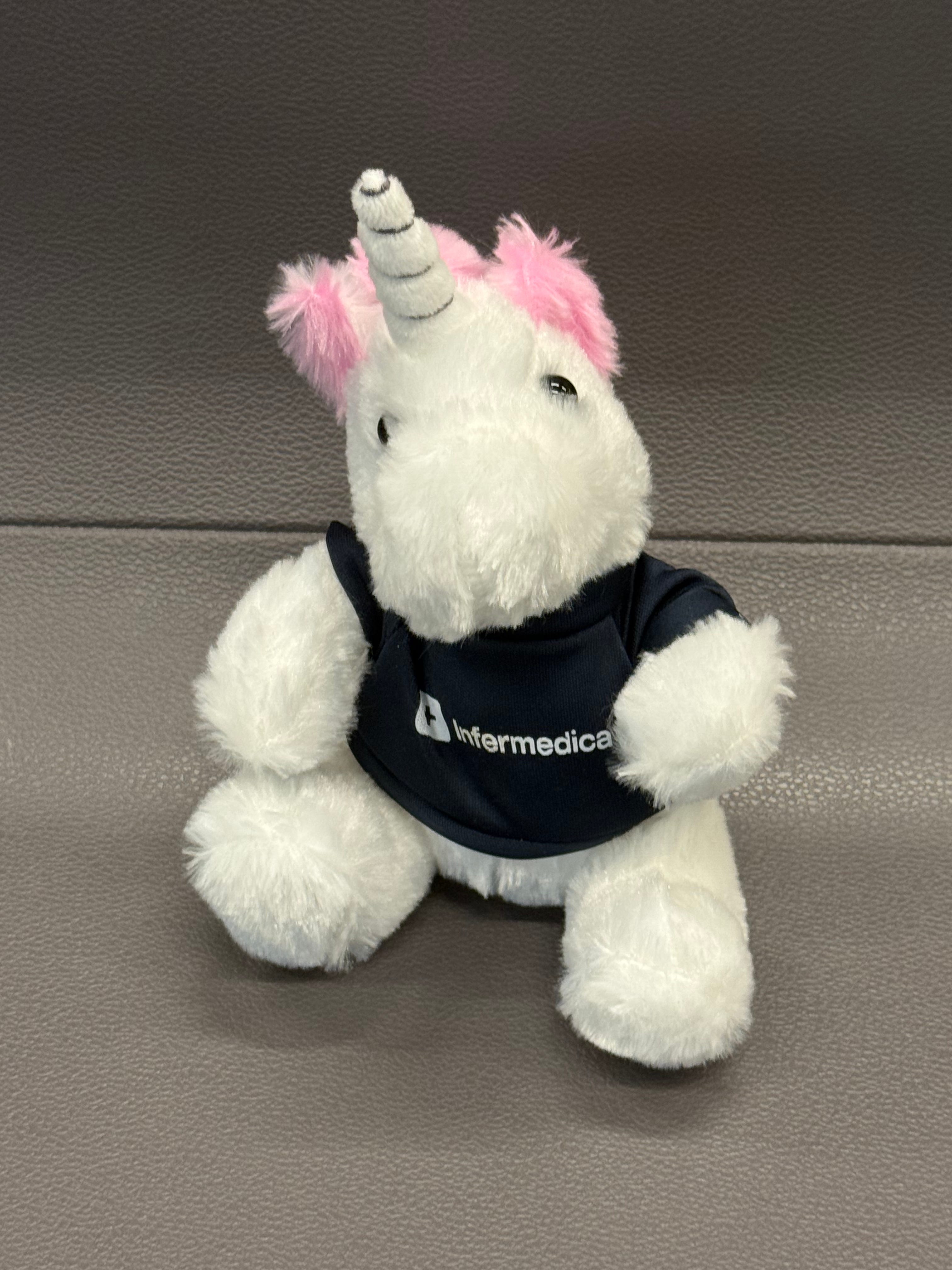
And if you’re at HLTH this year and someone hands you a unicorn, check the badge. The CEO might be the one giving it to you. 🦄
You can listen to the full Digital Health Inside Out episode with Piotr Orzechowski here.
And don’t forget: as promised, Part 2 of the OpenEvidence story is coming. That’s where I dissect its AI. Stay tuned…
Like what you’re reading in this newsletter? Want more in-depth investigations and research? Alright then, go tell your friends!
👉👉👉👉👉 Hi! My name is Sergei Polevikov. I’m an AI researcher and a healthcare AI startup founder. In my newsletter ‘AI Health Uncut,’ I combine my knowledge of AI models with my unique skills in analyzing the financial health of digital health companies. Why “Uncut”? Because I never sugarcoat or filter the hard truth. I don’t play games, I don’t work for anyone, and therefore, with your support, I produce the most original, the most unbiased, the most unapologetic research in AI, innovation, and healthcare. Thank you for your support of my work. You’re part of a vibrant community of healthcare AI enthusiasts! Your engagement matters. 🙏🙏🙏🙏🙏
🔥