


Welcome to AI Health Uncut, a brutally honest newsletter on AI, innovation, and the state of the healthcare market. If you’d like to sign up to receive issues over email, you can do so here.
Important Disclosure. This publication is written and distributed by an independent journalist. It is protected by the First Amendment to the U.S. Constitution and related principles of free expression. Those protections do not relieve me of the obligation to report accurately, and I take that obligation seriously. I have no financial interest, long or short, in BioXcel Therapeutics, Teva, Novartis, Ionis, Amgen, Eli Lilly, Novo Nordisk, Recursion, Relay Therapeutics, Absci, AbCellera, Schrödinger, Insilico Medicine, Isomorphic Labs, or any other company mentioned here. This article is for informational and opinion purposes only and should not be construed as financial or investment advice.
Happy Labor Day! 🇺🇸
I hope you’ve got some time this long weekend to relax, enjoy the last days of summer, and spend time with the people you care about.
And thank you, as always, for reading and supporting AI Health Uncut. ❤️
🚨 First, a quick personal announcement…
I’m honored to be speaking at the Origin Point healthcare technology conference in beautiful La Jolla, CA, on September 16–18, 2026. If you’re there, please come say hello!

On August 27, 2026, BioXcel Therapeutics filed for Chapter 11 in Delaware. The next day it announced that Teva had agreed to be the stalking-horse bidder for substantially all of its assets.
I have written a lot of these autopsies. Babylon. Olive AI. Cue Health. Carbon Health. I predicted the wave in January 2025.
This one is worse for the AI story, for one reason. BioXcel did the hard thing. It got a drug approved. IGALMI, a sublingual dexmedetomidine film for agitation in schizophrenia and bipolar disorder, has been FDA approved since 2022. Most of the AI drug discovery industry has never come close.
And BioXcel still went bankrupt…
🚨 TL;DR
BioXcel Therapeutics got an AI-branded drug through the FDA and filed Chapter 11 on August 27. IGALMI booked $182,000 of net product revenue in the second quarter of 2026, against a $14.7M quarterly loss and a $747.5M(!) accumulated deficit. That’s quite a chunk of cash that went up in smoke.
Teva’s widely repeated “up to $125M” is $57.5M of guaranteed upfront cash. Everything else is regulatory and sales milestones, and the real theoretical ceiling is $145M.
BioXcel’s own 10-Q says the EvolverAI engine was created and owned by a related company run by the same CEO, that the public company’s option for further work expired unexercised, and that no development happened through it after 2024. The bankruptcy announcement still calls BioXcel a company “built on artificial intelligence.”
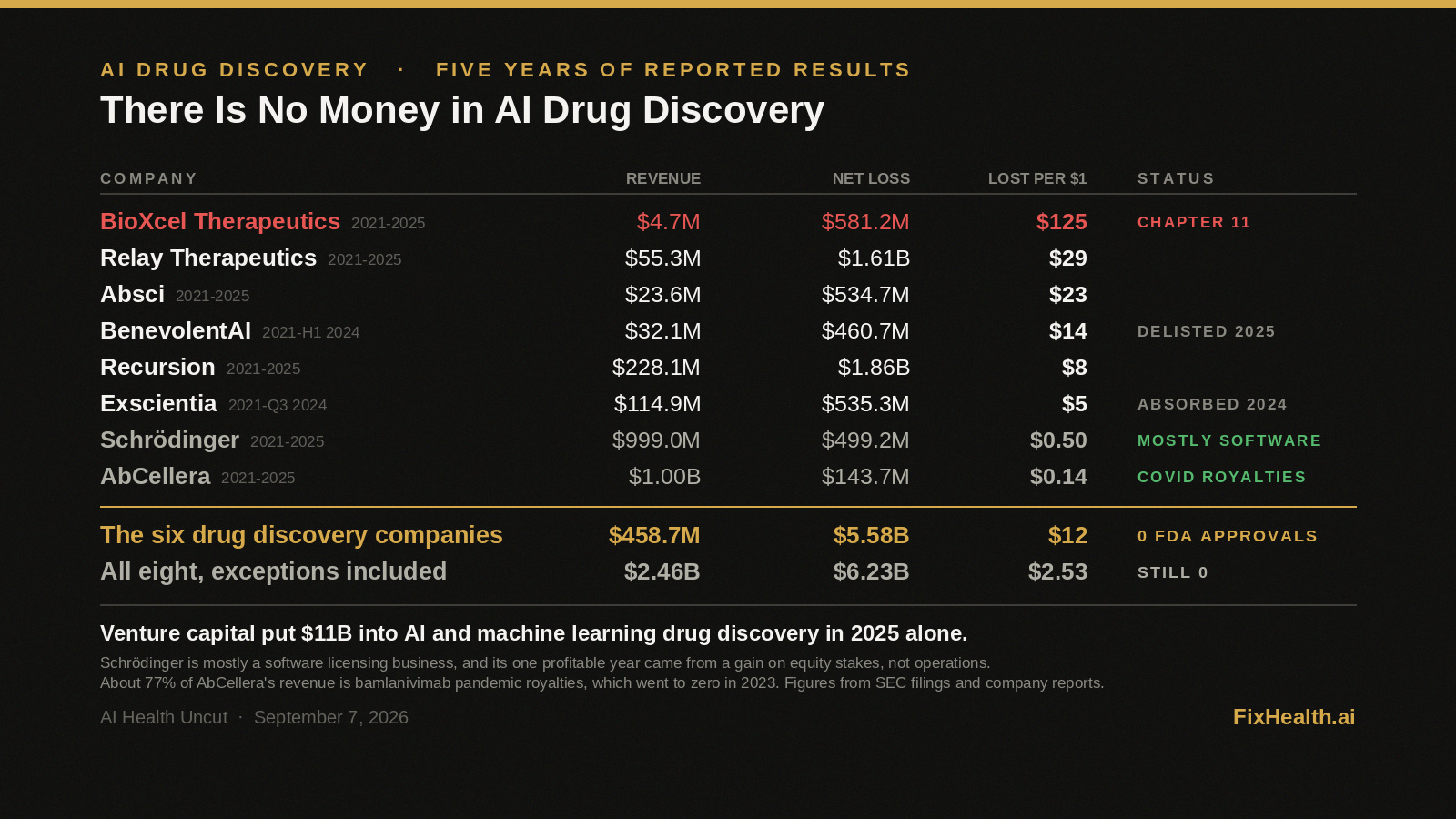
I look at 5 years, 6 companies, $458.7M of revenue against $5.58B of losses. $12 burned for every dollar booked, and zero FDA approvals to show for it.
The rest of the sector is no better. In the second quarter of 2026, Relay lost $239(!) for every $1 of revenue, Absci $104, BioXcel $81, Recursion $17. Schrödinger, which mostly sells software, is the only name that made money.
Six years after the first “AI-designed” molecule entered a human, exactly one is in Phase 3, and it is in China. None has been approved by the FDA.
I spent many years in quant investing, and every quant learns the same lesson. You cannot predict one trial or one stock, but you can know the shape of the distribution, and for “one drug wonders” it is fat-tailed, right-skewed, and the median draw loses. Biotech and pharma with revenue returned +10.4% a year from 1996 to 2023. Without revenue, negative 9.3%. The average is pulled way up by a handful of rare “one-hit wonders.” For the typical investor, the actual experience is losing money.
On Friday, Novartis lost an 8,323-patient Phase 3, five weeks after Novo Nordisk lost one of its own. Both drugs moved their biomarker exactly as designed and neither reduced cardiovascular events. Neither is an AI drug, and that is kind of the point: the molecule was never the hard part.
The 2024 Nobel was well deserved. It also got us excited about the seemingly endless possibilities of AI in drug discovery and DNA and genomics research. It also demolished the barrier to entry. 842 venture rounds have walked through that door since the start of 2024, and produced zero approved AI-discovered drugs.
AI compresses the cheapest step in the chain. Phase 1 is about 5% of R&D cost. Phase 3 alone is about 52%.
Why hasn’t AI cured cancer (yet)? An oncology drug entering Phase 1 has just a 5.3% chance of ultimately being approved, and oncology’s Phase 2 transition rate is the worst of any clinical stage. That matters because Phase 2 is where a drug has to show that it actually works in patients. AI may be helping us find candidates faster, but it has not yet meaningfully improved that efficacy bottleneck.
🚨 Here is what’s in the rest of this piece:
1. $182,000 of Revenue. A $14.7M Loss. Same Quarter.
2. Teva Is Paying $57.5M for BioXcel
3. The AI Engine Belonged to Someone Else
4. Nobody in This Industry Makes Money
5. I Used to Be a Quant. Quants Don’t Buy Lottery Tickets.
6. Six Years. One Phase 3. Zero Approved AI Drugs.
7. AI Fixed the Cheap End of the Pipeline
8. Novartis Just Made the Same Point With $325M and 8,323 Patients
9. Why AI Has Not Cured Cancer (Yet)
10. The 2024 Nobel Was Real. So Was the Stampede.
11. The Money Is in Selling AI, Not Selling Drugs
12. It Is Not Just Drug Discovery. It Is All of Healthcare AI.
13. “Built on AI” Is Not a Business Model
If you cannot afford this article, perhaps you’re a student or currently between jobs, please reach out. That’s precisely why I created the AI Health Uncut Founding Member Club. Thanks to generous donations from these wonderful individuals, I’m able to provide access to anyone who needs it.
