


Welcome to AI Health Uncut, a brutally honest newsletter on AI, innovation, and the state of the healthcare market. If you’d like to sign up to receive issues over email, you can do so here.
Important Disclosure. This publication is written and distributed by an independent journalist. It is protected by the First Amendment to the U.S. Constitution and related principles of free expression. Those protections do not relieve me of the obligation to report accurately, and I take that obligation seriously. I strive to rely on verifiable facts, primary-source documentation, and other evidentiary material concerning companies and individuals. Disagreements over interpretation, opinion, tone, or editorial framing are not the same as factual errors. I stand by my reporting, my research, and my sources absent a demonstrated and material factual mistake. I have no financial interest, whether long or short, in any of the companies mentioned in this article. This article is for informational and opinion purposes only and should not be construed as financial or investment advice.
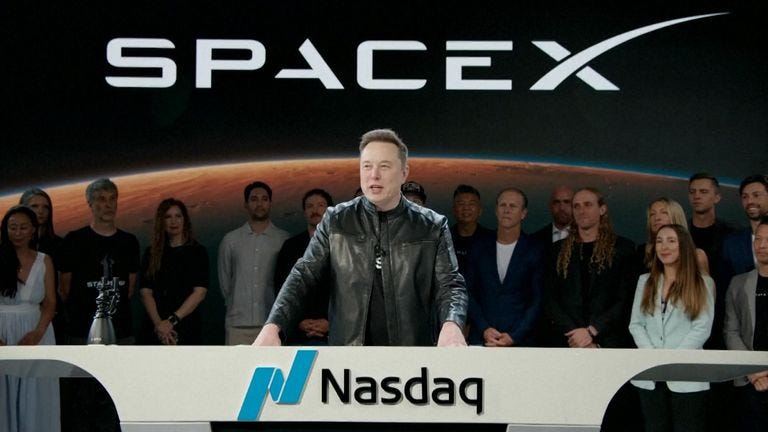
On Friday, SpaceX started trading on the Nasdaq under the ticker SPCX. It priced at $1.77T market cap, and after only two trading days SPCX became a $2.52T company. It’s now the 6th-largest company in the United States, right after Amazon. And it made Elon Musk the first trillionaire in history.

But first, I want to take a moment to thank all of my supporters. I’m often very critical of certain things happening in AI and healthcare. But I promise you, it’s only because I genuinely care and want to make things better for all of us. So, thank you for your understanding.
I receive a lot of messages daily, and I always respond promptly to every one of them. Most are incredibly kind and supportive.

I want to highlight one recent message in particular. A student reached out recently asking for full, paywall-free access to my Substack. Of course, I granted it, as I always do.
This brings me to another important message. If you cannot afford this article—perhaps you’re a student or currently between jobs—please reach out. That’s precisely why I created the AI Health Uncut Founding Member Club, currently at 17 and counting. Thanks to generous donations and support from these wonderful individuals, I’m able to provide access to anyone who needs it. By the way, students reach out frequently, and I’m always glad to help.
If you’d like to support my mission to uncover the brutal truth in healthtech and healthcare AI, please consider becoming a Founding Member of the AI Health Uncut community. You can join through this link. You’ll be making a real impact, helping me continue to challenge the system and push for better outcomes in healthcare through AI, technology, policy, and beyond.

Also, I want to take a moment to thank Dr. Amir Lahav and his team for putting together such an important event at last week’s Digital Health & AI Innovation (DHAI) Summit, for inviting me to speak, and for putting me on the main stage. Till next year!
Alright, back to SpaceX and the misery of healthtech… 😉
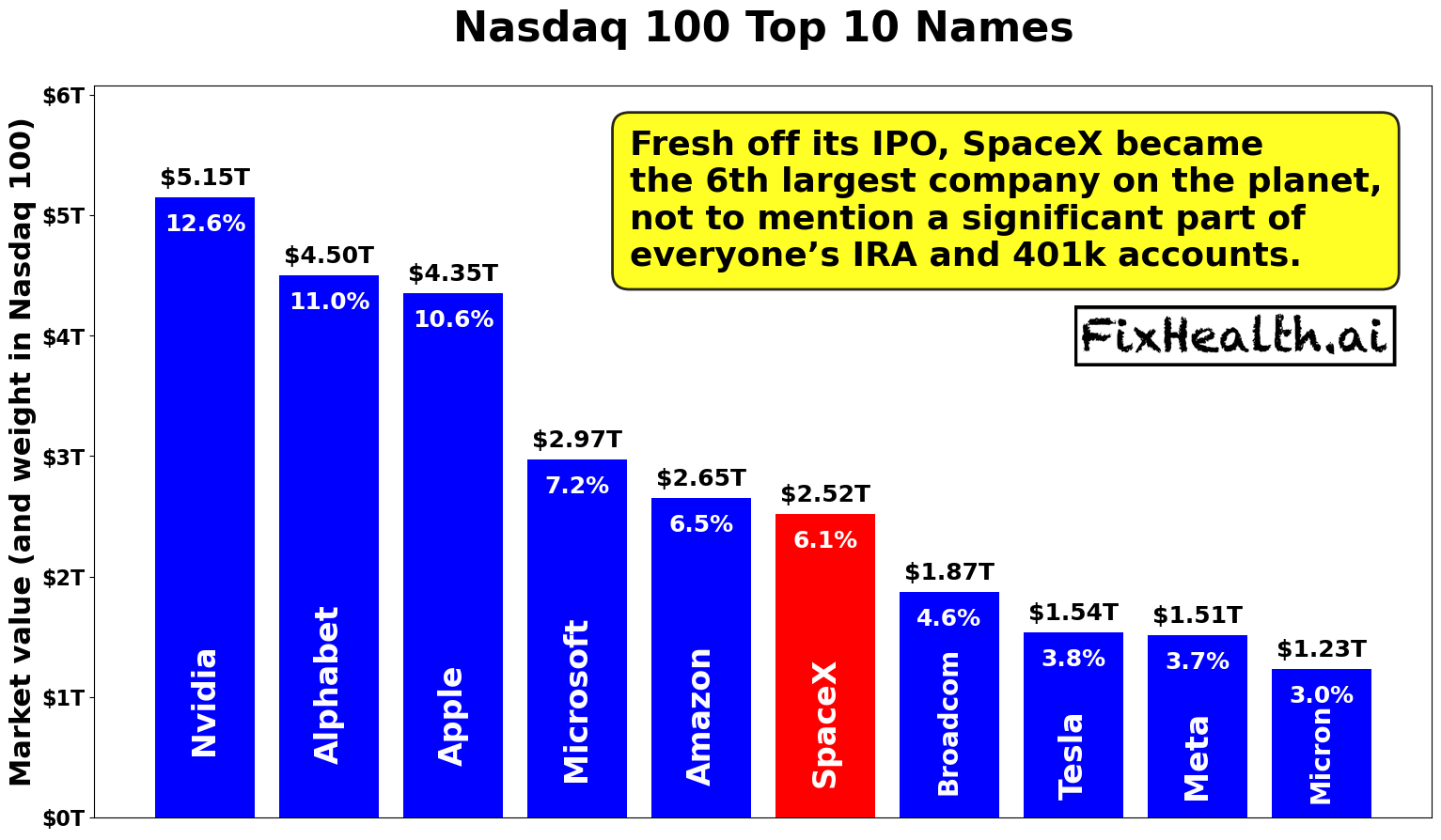
In this piece I’ll show you that you don’t have to own SpaceX outright (or OpenAI, or Anthropic, both of which have filed confidentially to go public later this year) to be exposed to it.
I’ll explain why SpaceX is expected to keep appreciating in the short term, despite being one of the most expensive companies in the world.
And I’ll explain why healthtech is expected to keep underperforming in the public market, as it has since the Covid-induced investment scare of 2020-21.
By the way. If you’re close to retirement, you own a 401(k) and/or an IRA, you’re invested in popular indices like the S&P 500 or the Nasdaq 100, and your financial advisor is now pushing you to buy SpaceX on top of all that, you should probably fire him. (And yes, statistically, it’ll be a “him.” 😉) You already own SpaceX. Paying someone to sell you more of what you passively hold isn’t advice. It’s a markup, unless he can genuinely see the future.
I will also explain why the so-called SaaSpocalypse is now over for every industry except healthtech. Healthtech never resurrected.
Another person who brilliantly explains why healthtech has never recovered from the SaaSpocalypse is my colleague and podcast co-host, Stephanie Davis, who covered this topic beautifully in our recent live episode of Digital Health Vitals:
I’ve written extensively about the lack of innovation in healthtech over the past three years, and I’ve lost friends over it. But I can’t unsee the facts.
So let me show you why healthtech, healthcare AI, and digital health are doing so badly compared to other industries — because to fix a problem, you first have to name it.
I’ll suggest solutions too, as I do in every piece. Fair warning, though. This is a long, painful process, not a quick fix.
TL;DR:
SpaceX, OpenAI, and Anthropic joining the public market doesn’t just add three names. It tips the entire stock market into being, functionally, an AI market.
Wall Street rewards growth with profit and a moat (SpaceX). It punishes growth with no profit and no moat (most of healthtech).
Healthtech’s problem isn’t the market’s mood. It’s that the industry mostly copies instead of innovates, so it has neither durable growth nor profit — and the market has noticed.
The fix isn’t another pivot. It’s actual innovation, plus a grassroots revolt against the EHR and PBM monopolies.
The most interesting part of this research article is behind the paywall, out of respect to my loyal paid subscribers who keep AI Health Uncut independent. Here’s what’s behind it:
1. Even before you add SpaceX, OpenAI, and Anthropic, the entire stock market is already an AI market.
2. Revenue multiples: AI vs. healthtech, side by side.
3. If you’re not in the index, you’re not in the stock market.
4. The SaaSpocalypse is over — for everyone except healthtech.
5. The real disease: copycats, AI tourists, and the VC pump-and-dump.
6. So how do we actually fix this?
