


Welcome to AI Health Uncut, a brutally honest newsletter on AI, innovation, and the state of the healthcare market. If you’d like to sign up to receive issues over email, you can do so here.
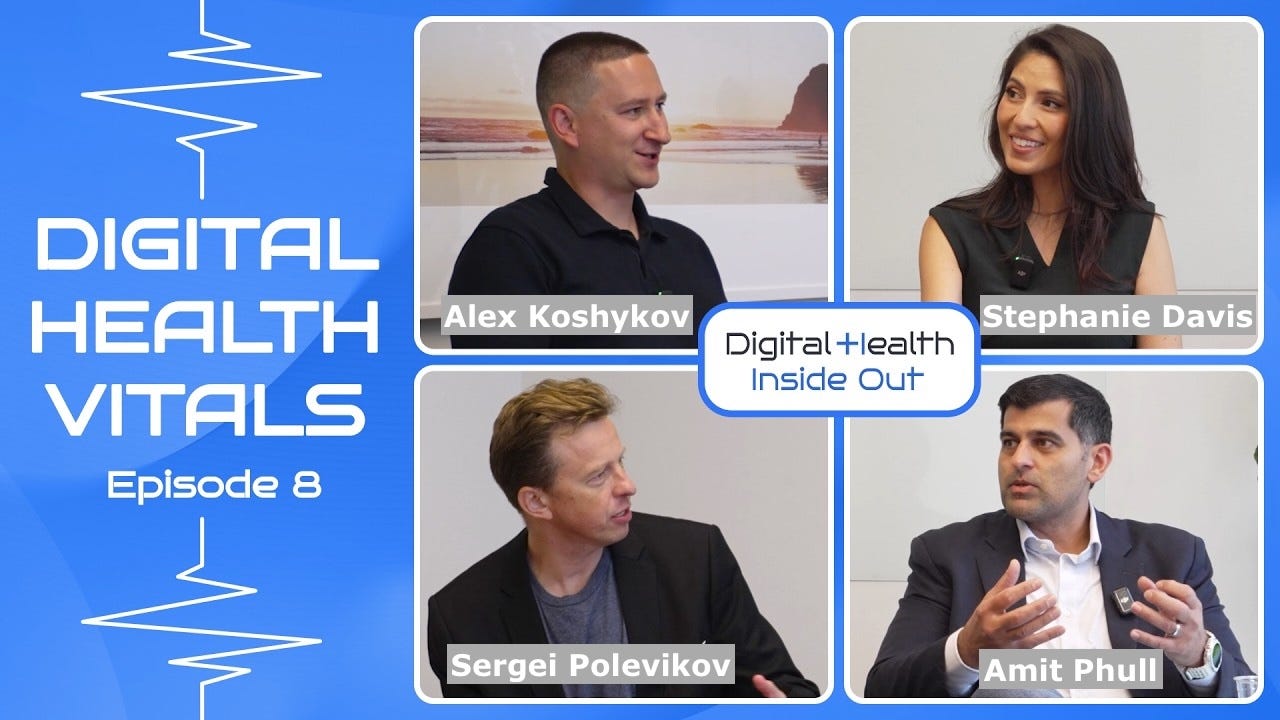
Digital Health Vitals is back. (Listen on your favorite podcast app.) Somehow we went from clinical AI benchmarks to UnitedHealth, AI-powered spa diagnostics, Abridge trying to eat the EHR, and whether healthtech will ever have its “iPhone moment.”
So yes. Very normal healthcare AI conversation. 😉
And wow, was June 2026 one of the spiciest months in healthtech, or what?
Who participated:
This episode featured the usual gang of experts: Stephanie Davis, Alex Koshykov, and me, plus an honored guest: Amit Phull, emergency medicine physician, clinical assistant professor at GW, and Chief Clinical Experience Officer at Doximity.
What we discussed:
1. General-purpose LLMs beating specialized clinical AI tools
2. OpenEvidence and the art of not playing nice in the sandbox
4. Midjourney, medical imaging, and the AI sauna
5. Abridge’s NVIDIA partnership pushes it beyond ambient scribing
6. SpaceX, OpenAI, Anthropic, and why healthtech does not get the same hype multiple
7. The real theme of the episode
Here we go:
1. General-purpose LLMs beating specialized clinical AI tools
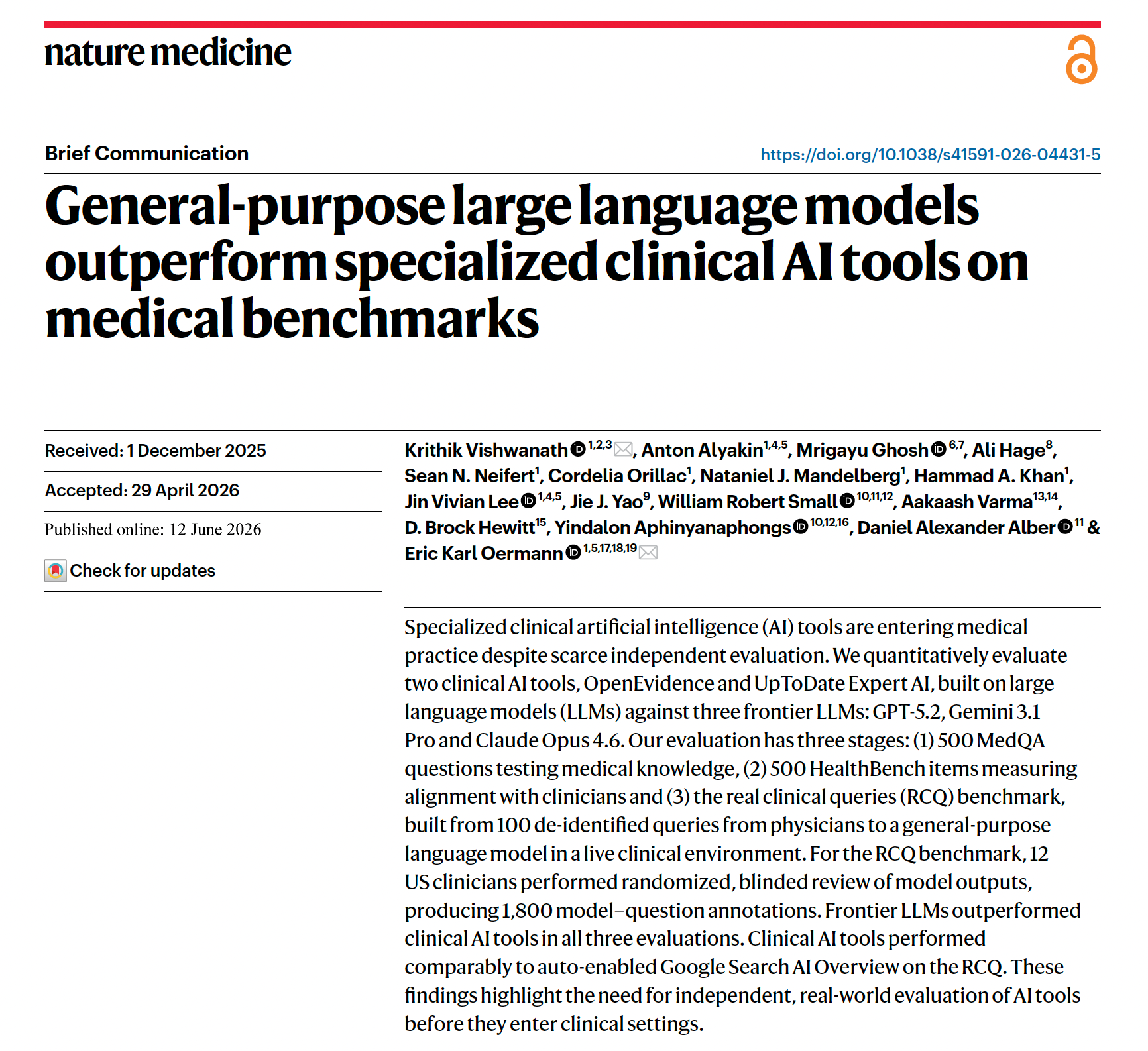
We started with the Nature Medicine paper arguing that general-purpose large language models outperformed specialized clinical AI tools on medical benchmarks.
My spicy version: clinical AI as a moat is looking shakier by the month.
The counterpoint: healthcare companies do not exist only because their models are better. They exist because healthcare needs workflow, trust, security, compliance, distribution, clinical context, and a lot of patience.
Also, if your model gets beaten by the frontier model it is built on top of, maybe the right answer is not a Twitter storm. Maybe it is a better peer-reviewed study.
Companies discussed: OpenEvidence, Doximity, Veeva, Salesforce, OpenAI.
2. OpenEvidence and the art of not playing nice in the sandbox


We talked about OpenEvidence’s reaction to the paper.
The product may be solid. Many doctors use it. But the communication strategy? OMG. 😱
Let’s just say healthcare is probably not the best industry for “everyone else is stupid except us” energy.
The bigger point: independent evaluation is coming to clinical AI. That is good. It will be uncomfortable. It should be uncomfortable.
Companies discussed: OpenEvidence, Doximity.
3. UnitedHealth’s $3B AI push
Then we moved to UnitedHealth’s announcement that it is investing billions in AI to cut costs and automate workflows.
Obviously, everyone wants less administrative waste.
But when a company is already under intense scrutiny for coding practices and then announces a massive AI investment focused largely on administrative automation, people are going to ask the obvious question:
Is this AI going to reduce bureaucracy?
Or just make the existing bureaucracy faster, cheaper, and more scalable?
One of the best lines from the discussion was this one, by Amit:
There is nothing so useless as doing more efficiently something you should not be doing in the first place.
Healthcare heard that and said, “Hold my prior authorization.” 😊
Companies discussed: UnitedHealth, Optum, AI scribe companies.
4. Midjourney, medical imaging, and the AI sauna

Yes, we discussed Midjourney’s wild healthtech-adjacent announcement around a spa-like imaging experience using ultrasound-based technology.
The optimistic view: if this works, it could be a major advancement. Faster, more pleasant, more accessible imaging would be incredible.
The skeptical view: healthcare has seen a lot of magical press releases before.
My view: I hope it works. But I would like to see evidence before we declare that the future of diagnostics is a hot tub.
Companies discussed: Midjourney, Butterfly Network, Ezra, Forward.
5. Abridge’s NVIDIA partnership pushes it beyond ambient scribing
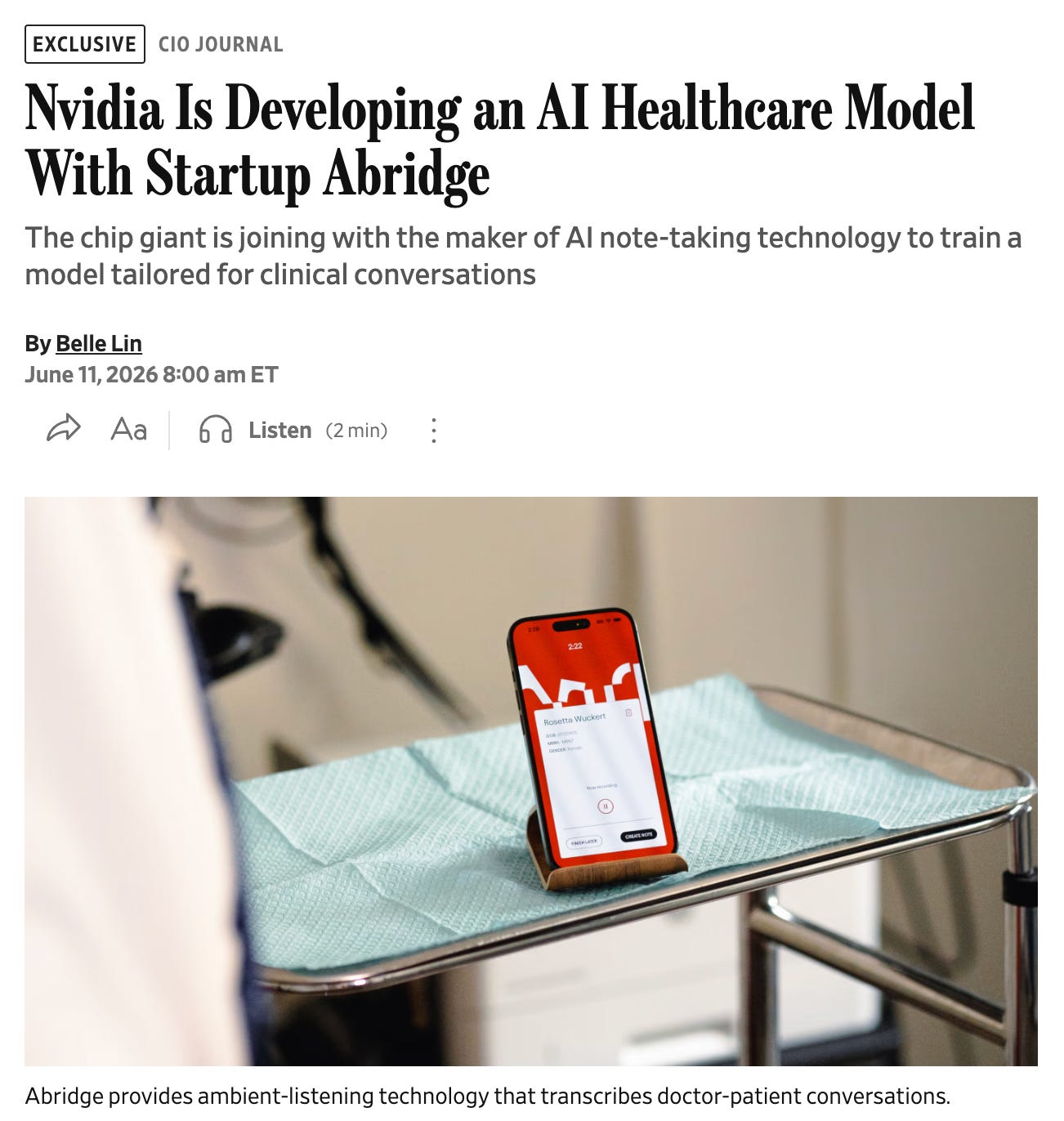
Abridge had a very polished, almost Apple-style announcement about expanding from ambient documentation into a broader clinician intelligence platform across care delivery, payment, medical necessity, and evidence-based treatment.
This led to the obvious joke:
Healthtech yearns for the EHR.
The big question is whether ambient AI companies are just making documentation better, or whether they are slowly rebuilding the operating system of healthcare piece by piece.
Very ambitious. Very logical. Also very hard.
Because in healthcare, even the best software eventually runs into the reality that half the hospital still cannot find a working ophthalmoscope.
Companies discussed: Abridge, NVIDIA, Epic, Cerner, Mayo Clinic, Microsoft.
6. SpaceX, OpenAI, Anthropic, and why healthtech does not get the same hype multiple
Why SpaceX's Success Is Bad News for Healthtech

Welcome to AI Health Uncut, a brutally honest newsletter on AI, innovation, and the state of the healthcare market. If you’d like to sign up to receive issues over email, you can do so here.
We ended with public markets, AI infrastructure, and how massive IPOs from companies like SpaceX, OpenAI, and Anthropic could affect healthcare.
The real question: why does healthcare rarely produce companies that feel like SpaceX, Tesla, or the iPhone?
Healthcare is a giant market. But each sellable wedge is often painfully narrow. Selling into providers, payers, employers, pharma, or government all comes with different economics, different incentives, and different pain.
That may be why healthtech has lots of useful companies, but fewer “rewrite the world” companies.
Or maybe healthcare is just harder to memeify because everyone’s personal experience with the system is already a horror story.
Companies discussed: SpaceX, OpenAI, Anthropic, Doximity, Abridge, NVIDIA, Epic, Cerner.
7. But here is the real theme of the episode
Healthcare AI is stuck between two very different ambitions:
Use AI to make the current broken system more efficient.
Use AI to change the system itself.
The first is easier to sell.
The second is what everyone actually wants.
And somewhere between those two sits the entire healthtech industry, trying to turn a 1980s fax machine into a rocket ship. 🤦♂️
Fun episode. More coming soon. Tune in, and subscribe to the podcast. 👈
Like what you’re reading in this newsletter? Want more in-depth investigations and research? Alright then, go tell your friends!
👉👉👉👉👉 Hi! My name is Sergei Polevikov. I’m an AI researcher and a healthcare AI startup founder. In my newsletter ‘AI Health Uncut,’ I combine my knowledge of AI models with my unique skills in analyzing the financial health of digital health companies. Why “Uncut”? Because I never sugarcoat or filter the hard truth. I don’t play games, I don’t work for anyone, and therefore, with your support, I produce the most original, the most unbiased, the most unapologetic research in AI, innovation, and healthcare. Thank you for your support of my work. You’re part of a vibrant community of healthcare AI enthusiasts! Your engagement matters. 🙏🙏🙏🙏🙏
🔥