


Welcome to AI Health Uncut, a brutally honest newsletter on AI, innovation, and the state of the healthcare market. If you’d like to sign up to receive issues over email, you can do so here.
It’s time for some seriously spicy healthtech news from August. 🌶️🔥 And wow, did this month deliver.
We had Epic basically going, “Yep, I’ll take all of healthcare, thanks.” 😏 Then came yet another group of investors confidently telling us that AI is about to replace doctors. You know, basically tomorrow. 🤖🩺 And, naturally, Commure managed to f*ck things up again, this time shutting down its infamous referral program after a STAT investigation. 🍿
So yes, there’s a lot to unpack.
But let’s start at the beginning. 👇
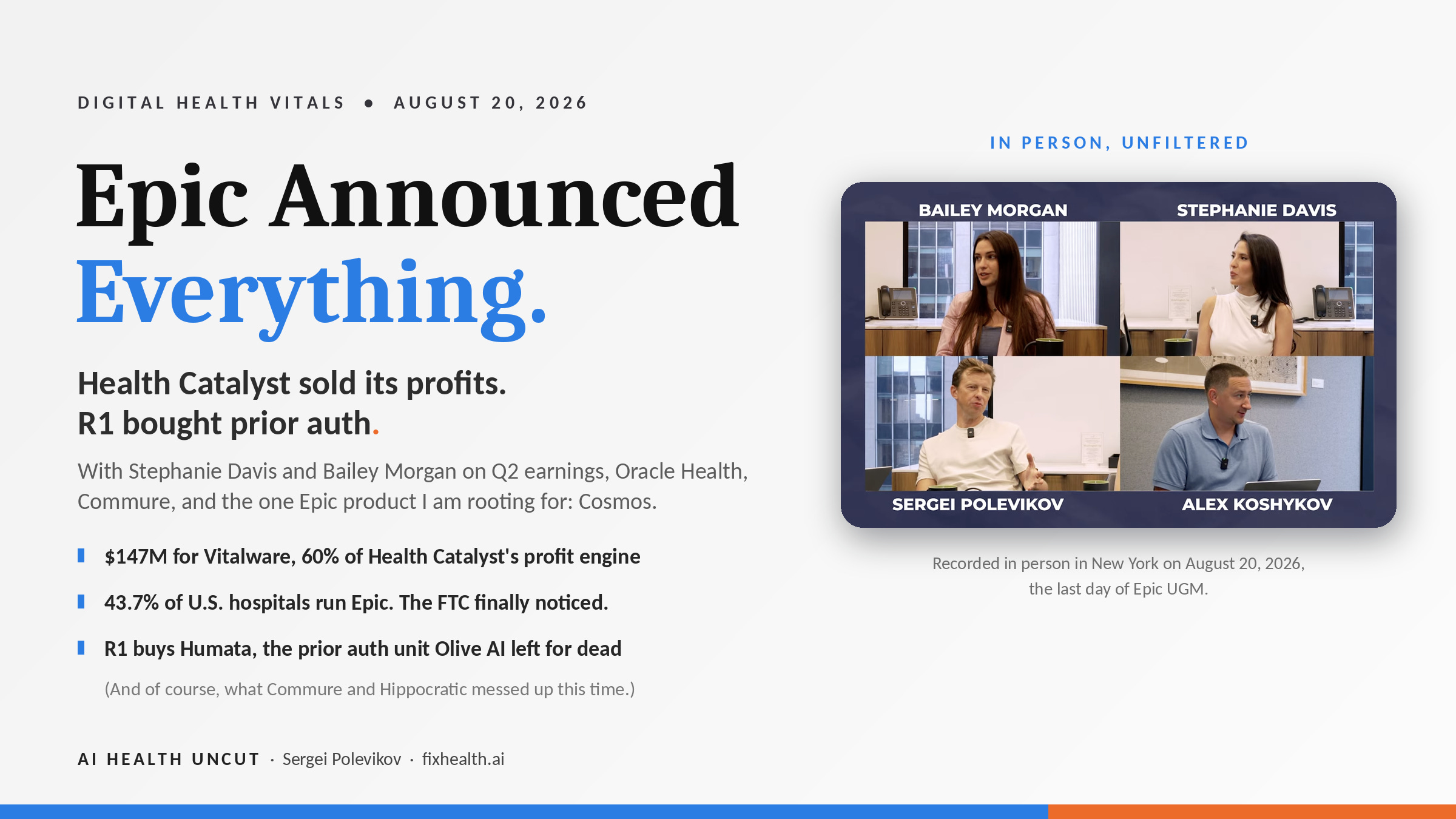
On August 20, the final day of Epic’s UGM, we recorded the August “Digital Health Vitals” episode of Digital Health Inside Out in person with my dear friends and colleagues Alex Koshykov, Stephanie Davis, and Bailey Morgan. 🎙️ Alex Koshykov hosted. Stephanie Davis, who spent pretty much her entire career covering health tech on Wall Street, brought the Q2 earnings scorecard. Bailey Morgan brought an operator’s view from a large pain practice on Long Island, plus a past life at Athelas, now known as Commure.
As for me, I mostly sat back, listened, and learned. Well, mostly. 😉
The full episode is here:
Three stories matter most. Health Catalyst, a company that has never posted a GAAP profit, sold the unit that produced 60% of its adjusted EBITDA. Epic announced literally everything, including things that do not exist yet. 😉 And R1 bought the prior authorization company that Olive AI left for dead. Everything else, from Teladoc to Commure, is in the quick hits at the bottom.
TL;DR:
1. Health Catalyst sold 60% of its adjusted EBITDA to become debt-free
2. Epic UGM 2026: promises, partners, lawsuits, and a cowgirl hat 🤠
3. Cosmos is the one Epic product I am rooting for
4. R1 bought the prior auth company Olive AI left for dead
5. Quick August healthtech hits
1. Health Catalyst sold 60% of its adjusted EBITDA to become debt-free
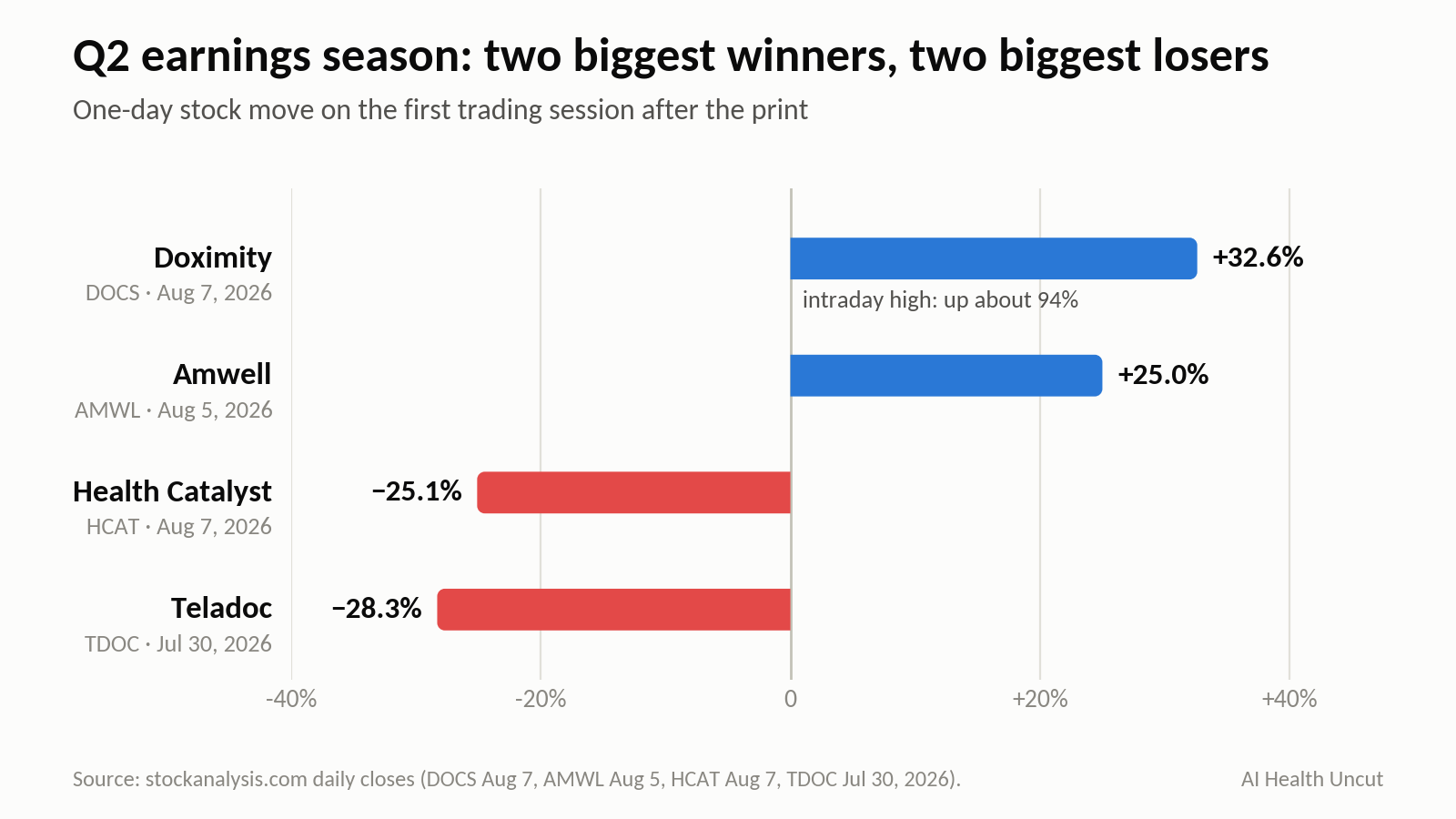
Stephanie’s two biggest losers of the Q2 season were Teladoc and Health Catalyst. Teladoc I expected. Health Catalyst: not really. I said on air that they are one of the good guys, and Stephanie’s reply was the line of the episode: “They’re a great product, but their stock wasn’t one of the good guys.”
The HCAT stock bottomed at $0.96 on April 10, or $73M in market cap. On June 4, Health Catalyst announced the sale of Vitalware to Med-Metrix for $147M in cash, more than the company’s entire market cap at the time! The shares jumped 46% in a day, and by the eve of the Q2 print the stock had more than doubled off the April low. Heroic, until you read the fine print. 😉
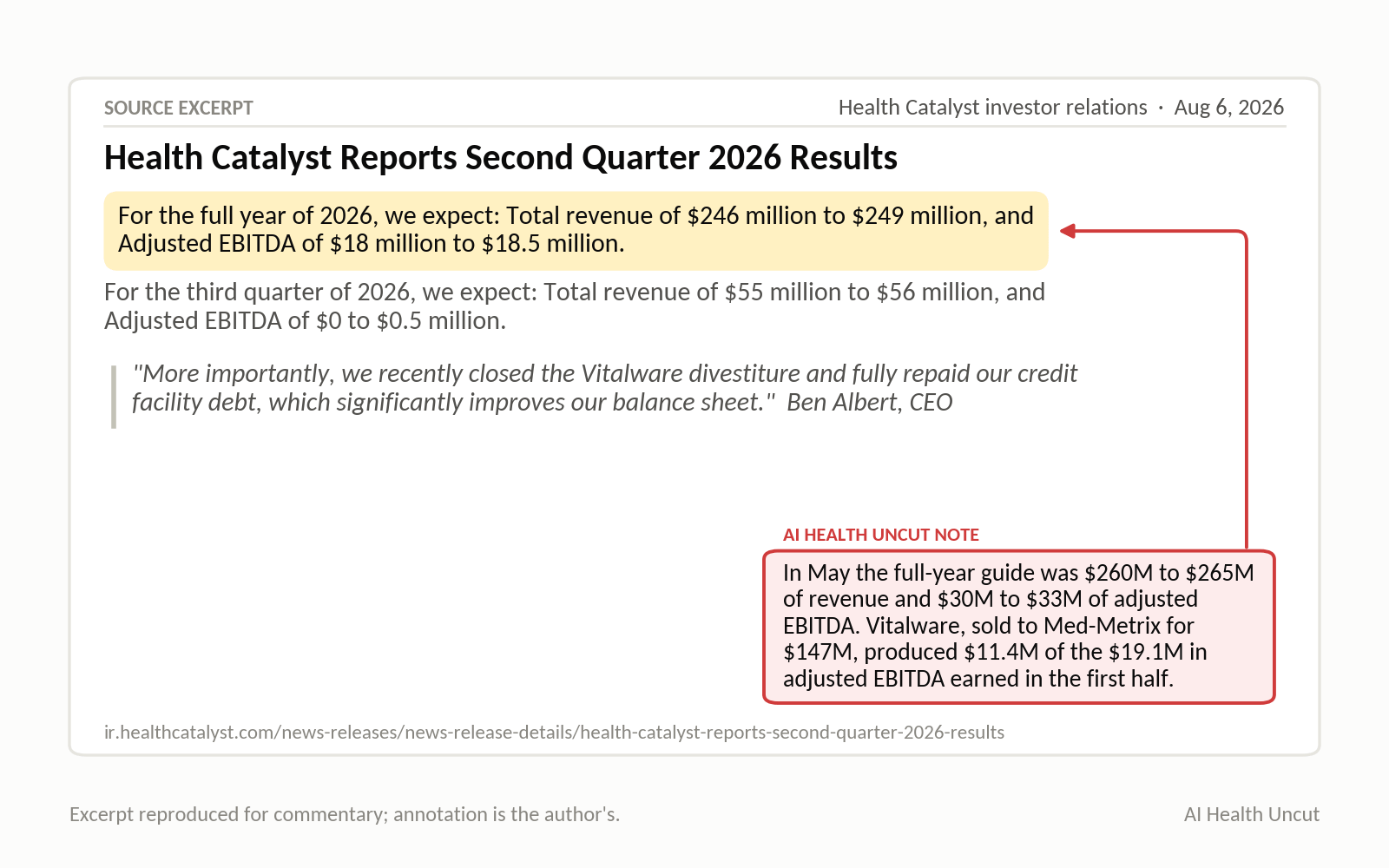
On August 6, the company cut 2026 revenue guidance to $246M to $249M from the $260M to $265M it guided in May, and cut adjusted EBITDA guidance to $18M to $18.5M from $30M to $33M. Vitalware had contributed $11.4M of the $19.1M in first-half adjusted EBITDA. They sold roughly 60% of their adjusted EBITDA, and adjusted EBITDA is the generous yardstick. Health Catalyst has never(!) reported a GAAP net profit, and it is not about to start. Q3 adjusted EBITDA guidance is $0 to $0.5M. The stock fell 25% the next day, and Canaccord downgraded it to Hold on August 20.
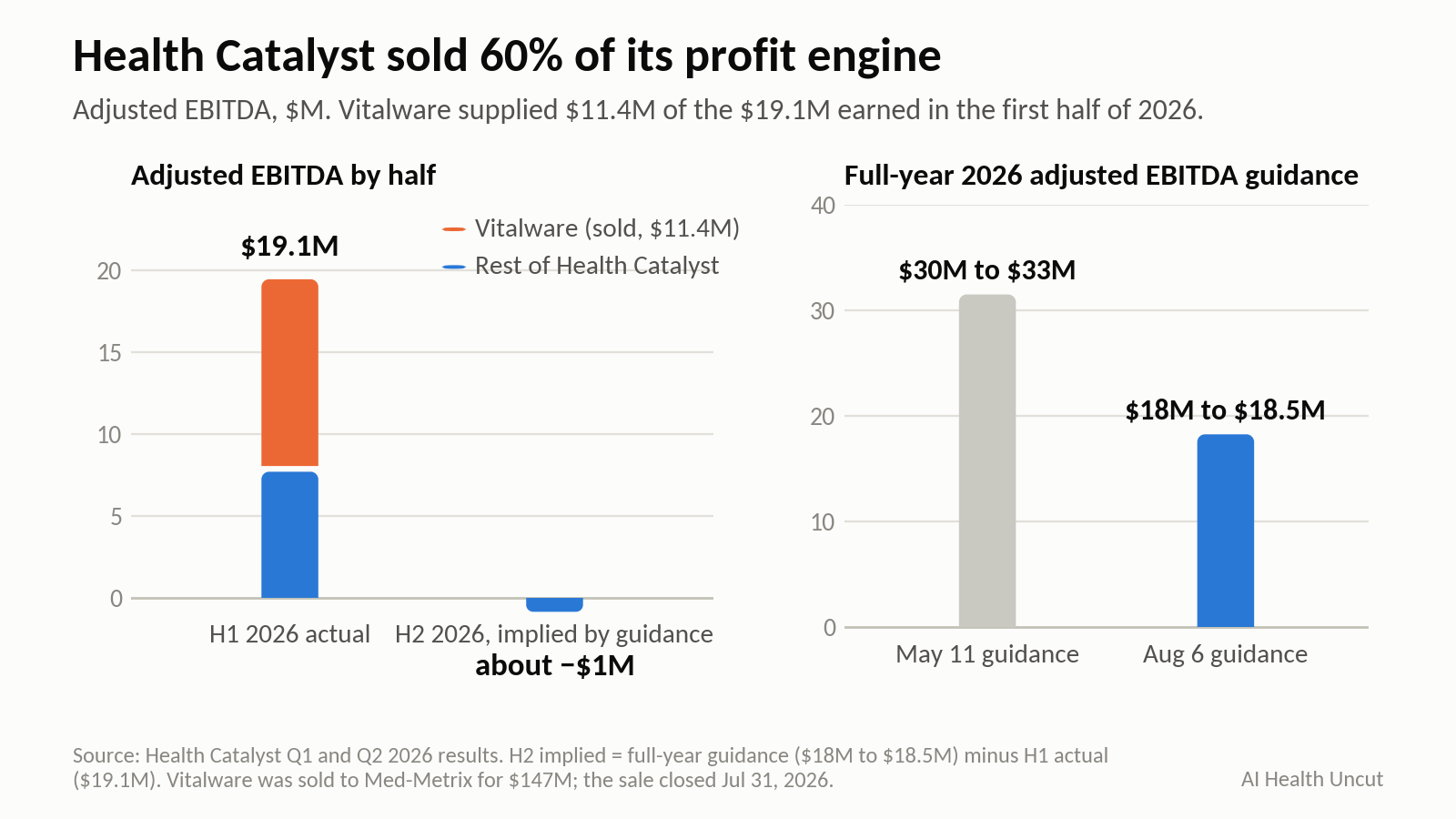
The proceeds repaid the credit facility in full, so Health Catalyst is now debt-free.
That is survival, not a growth story.
What is left is a healthcare data company with under $250M in revenue, a second half guided to roughly break-even adjusted EBITDA, a $122.5M goodwill impairment already booked this year, and a $118M market cap. Private rival Innovaccer last priced at $3.45B, roughly 29 times that.
Stephanie’s verdict: they need to change the narrative, and she does not know how they dig out of it. Neither do I.
2. Epic UGM 2026: promises, partners, lawsuits, and a cowgirl hat 🤠
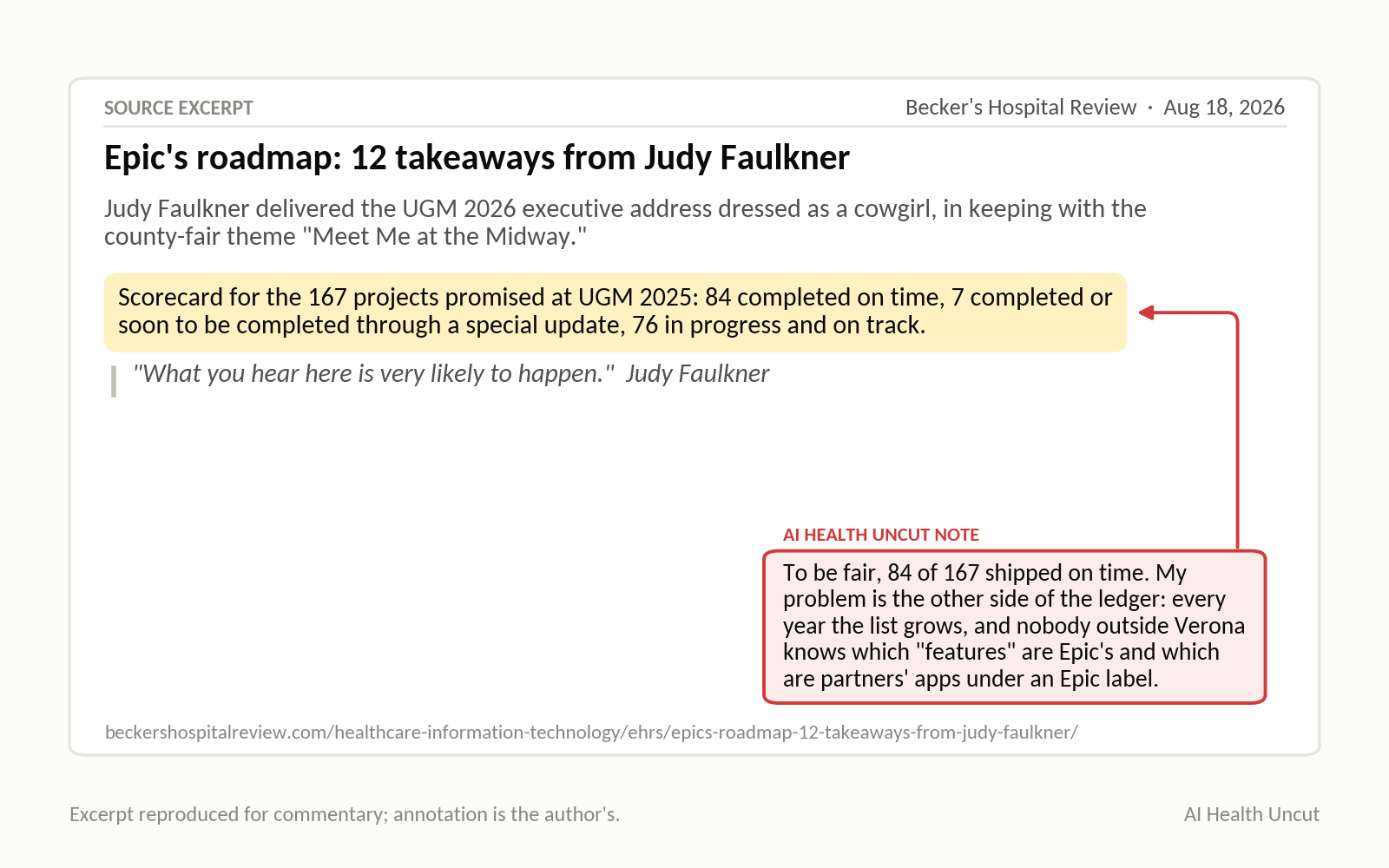
Judy Faulkner gave her executive address on August 18 dressed as a cowgirl, in keeping with the county-fair theme “Meet Me at the Midway.” The list was enormous: Ergo, Epic’s new “healthcare intelligence” layer built around its Art charting assistant (Ergo is Latin for “therefore”), an Agent Factory with about 120 agent features live, real-time prior authorization checks, and EpicOps, Epic’s new enterprise resource planning (ERP). My problem is the same every year: nobody knows what is real and what is “in the works.” To be fair, Judy’s own scorecard says 84 of the 167 projects promised at UGM 2025 shipped on time.
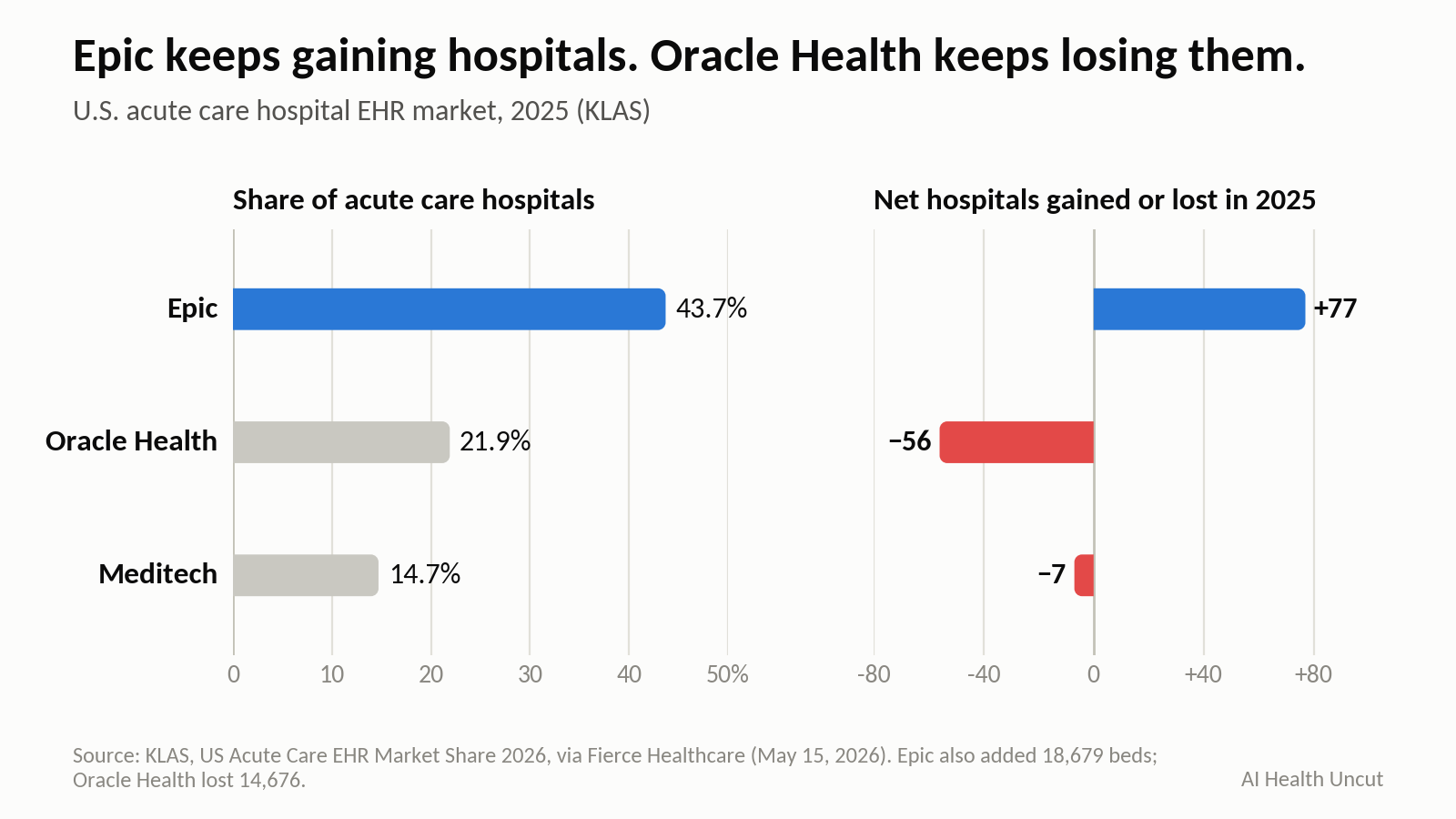
Epic is going down market. Organizations that cannot get Community Connect are now offered Sonnet, Orchard and Garden Plot, Garden Plot is being extended toward smaller hospitals, and a “Flower Pot” tier for very small practices is in development. That is eClinicalWorks and athenahealth territory, and Epic already holds 43.7% of the U.S. acute care EHR market. Bailey’s read was the most honest in the room: small practices are getting rolled up by private equity, and being on Epic makes a practice easier to integrate and “sexier” to sell. Good for the industry, maybe. Bad for patients. Patients always pay.
Abridge and Epic now compete at Epic’s own conference. On August 17, the first morning of UGM, Abridge made its clinical decision support agent available to every clinician at its partner health systems, including clinicians who do not use the Abridge scribe. The next day Epic unveiled Ergo. Both lean on Wolters Kluwer’s UpToDate for evidence. Neither mentioned OpenEvidence, which after the Nature Medicine paper (my take here) and the endless Doximity litigation looks more and more like the kid nobody wants in the sandbox. When we interviewed Shiv Rao on this show in April, his answer on FDA clearance was that a scribe transcribes and assigns codes, so there is nothing to clear. Once the product starts interpreting results, that answer stops working, as I argued in “Mayo Clinic + Abridge: Not FDA Approved!“ Also absent: Microsoft, whose Dragon technology was supposed to power Epic’s scribe a year ago. With Judy, nothing is exclusive. I wrote a year ago that Epic picked the wrong horse in the AI scribe race.
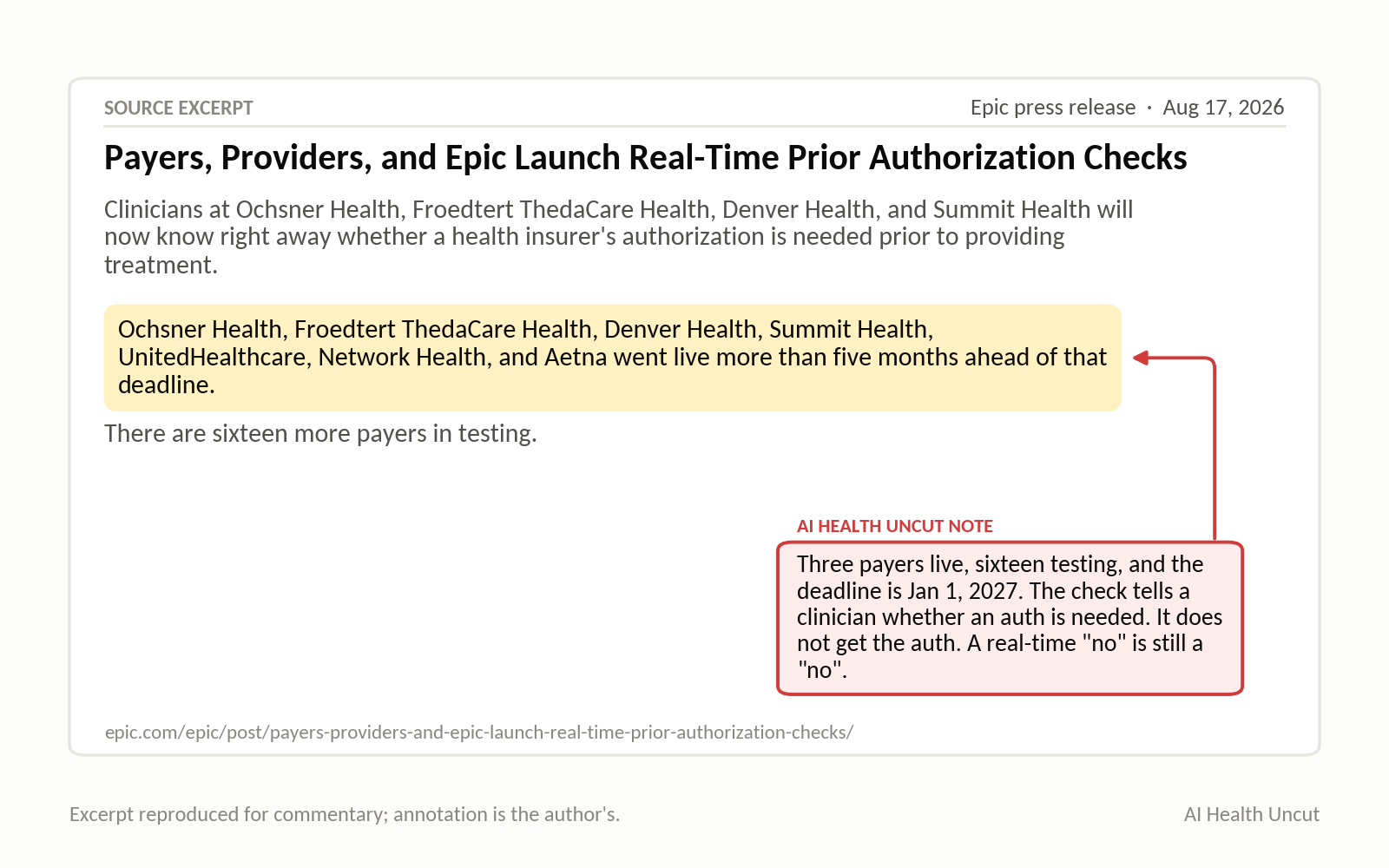
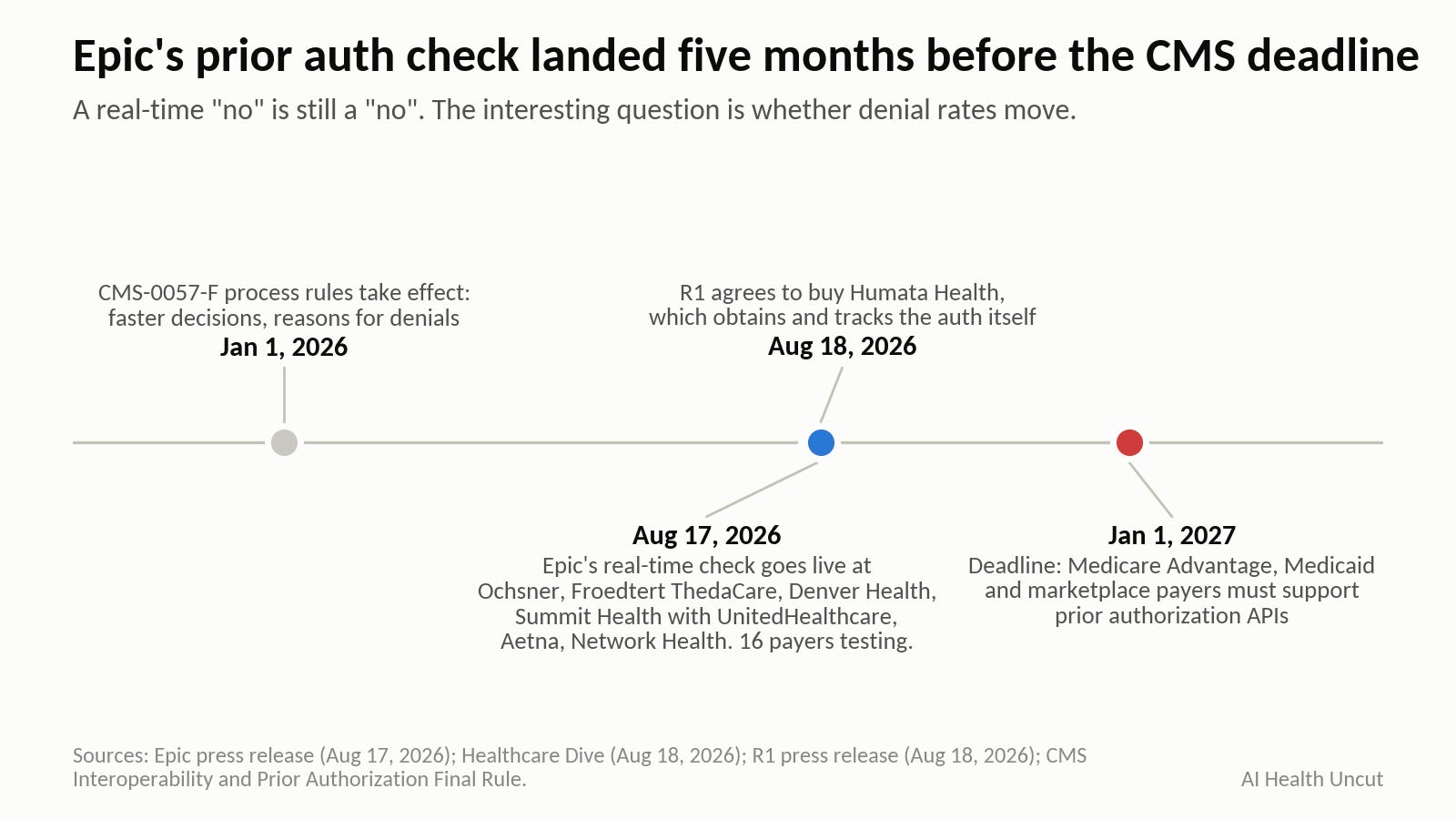
Real-time prior auth is a “no” delivered faster. Epic’s prior authorization check went live at four health systems with UnitedHealthcare, Aetna and Network Health, five months ahead of the January 1, 2027 payer API deadline under CMS-0057-F. Bailey, who lives inside payer rules every day, shrugged: any practice that has worked with payers long enough already knows which CPT codes need an auth. My concern is different. If the denial rate stays the same, or goes up, I do not care that the “no” arrives in real time. What Epic bought with this launch is a seat at the table in Washington as the compliant one.
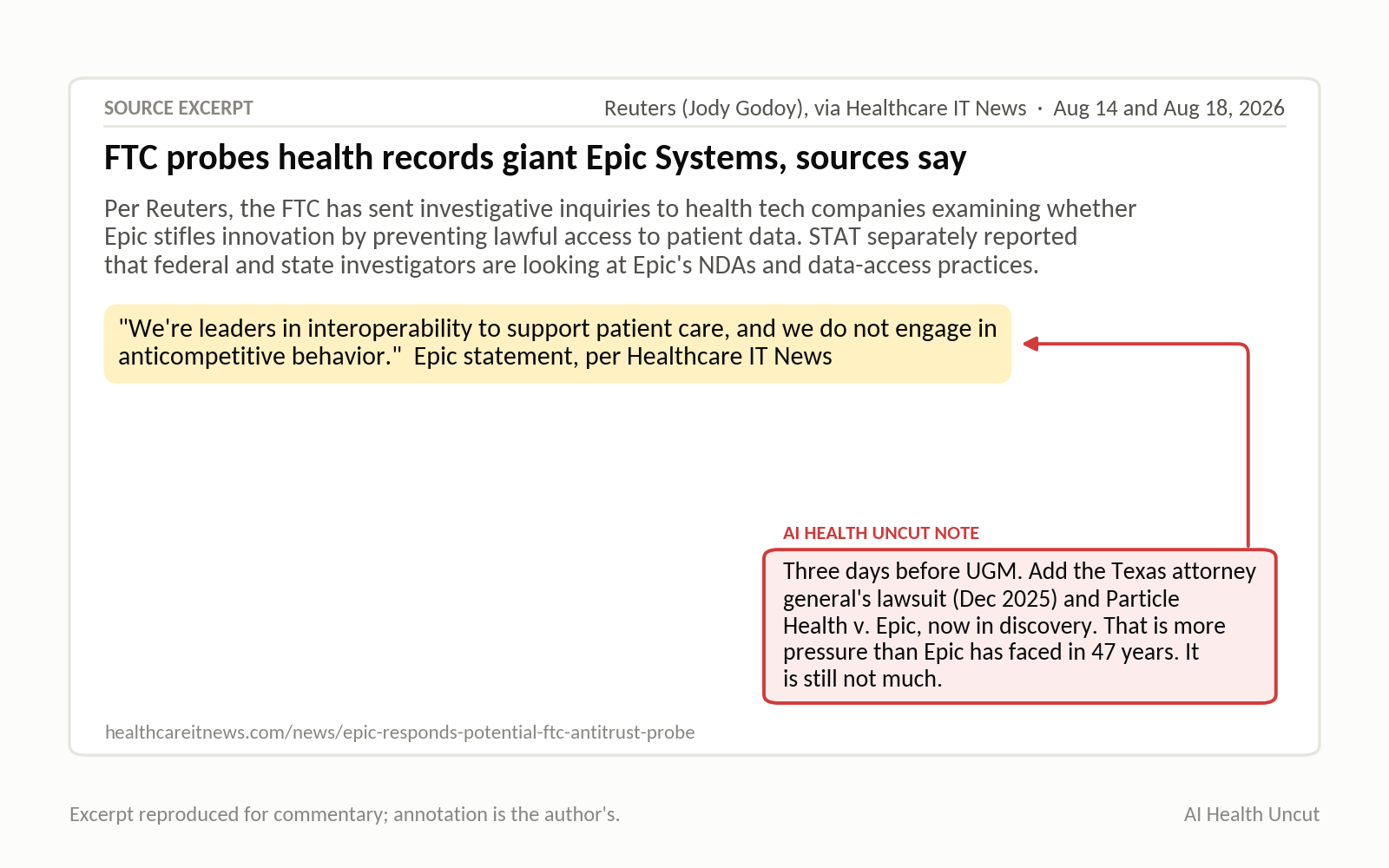
The monopoly debate. Stephanie’s counter to my monopoly complaint was Apple: similar dominance, and nobody says Apple is bad for phones. My answer is that Apple innovates because regulators and Android breathe down its neck, while many of Epic’s “features” are partner apps under an Epic label. Until there is real pressure, Epic will keep maximizing revenue with minimum effort. And here is what I underplayed on air: three days before UGM, Reuters reported the FTC is probing Epic over data access, STAT reported federal and state investigators are looking at its NDAs, the Texas attorney general sued in December, and the Particle Health antitrust case is in discovery.
That’s probably more regulatory and legal pressure than Epic has faced in its 47-year history. And yet, it still doesn’t seem like much. Judy didn’t even break a sweat in her cowgirl outfit. 🤠
3. Cosmos is the one Epic product I am rooting for
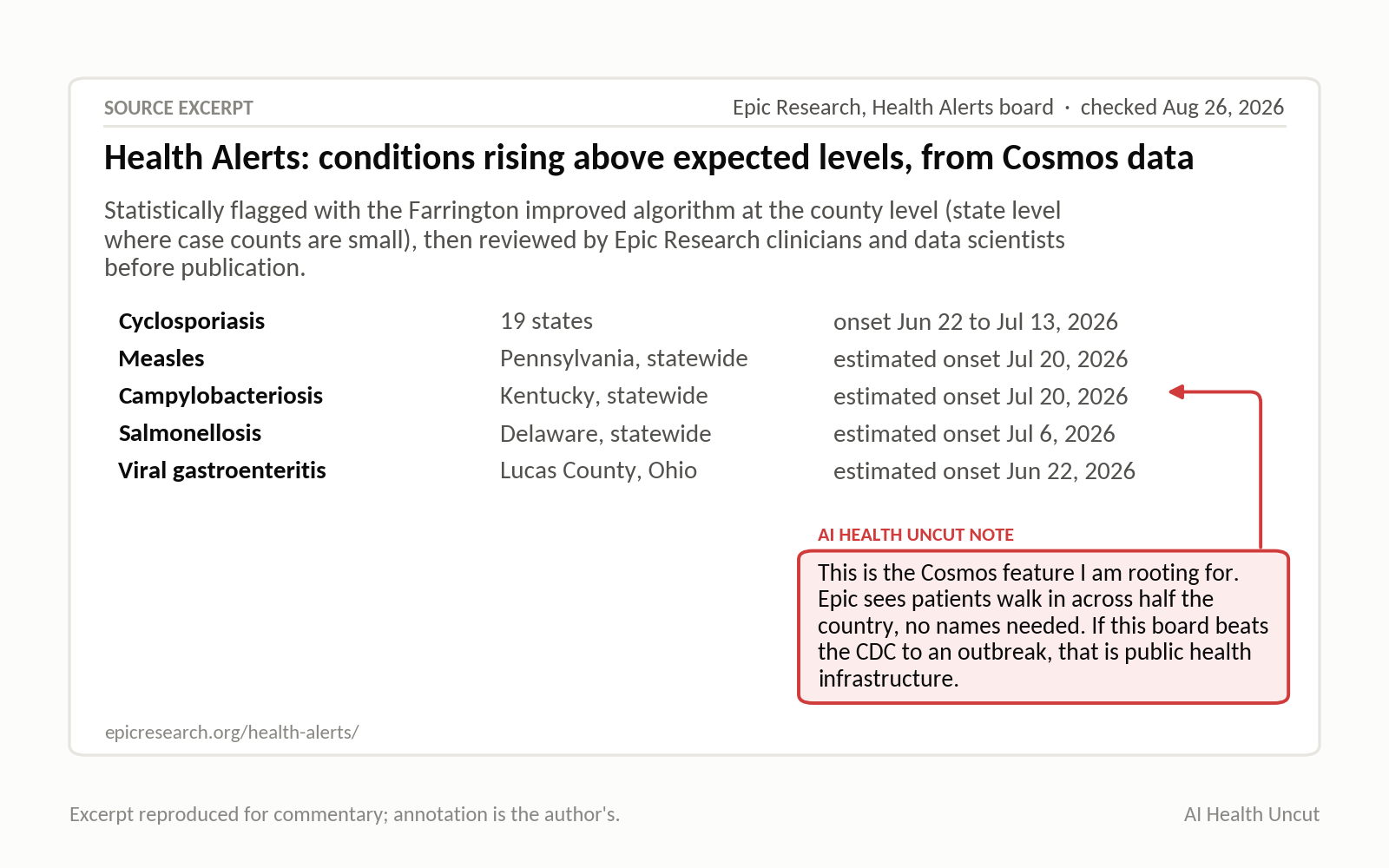
I have to be positive sometimes. 😉 Stephanie pounced: so now I am positive on something that owns most of the market? 😉 Yes. Cosmos, Epic’s de-identified research dataset, now covers 320M patients and 23B encounters and has produced more than 220 peer-reviewed papers. Curiosity, the generative model trained inside Cosmos to simulate patient trajectories, is being validated at 20 organizations ahead of general availability in March 2027. And Epic Research Health Alerts, launched in April, publish county-level warnings when diagnosis rates spike. As I write this, the board shows cyclosporiasis across 19 states and measles in Pennsylvania.
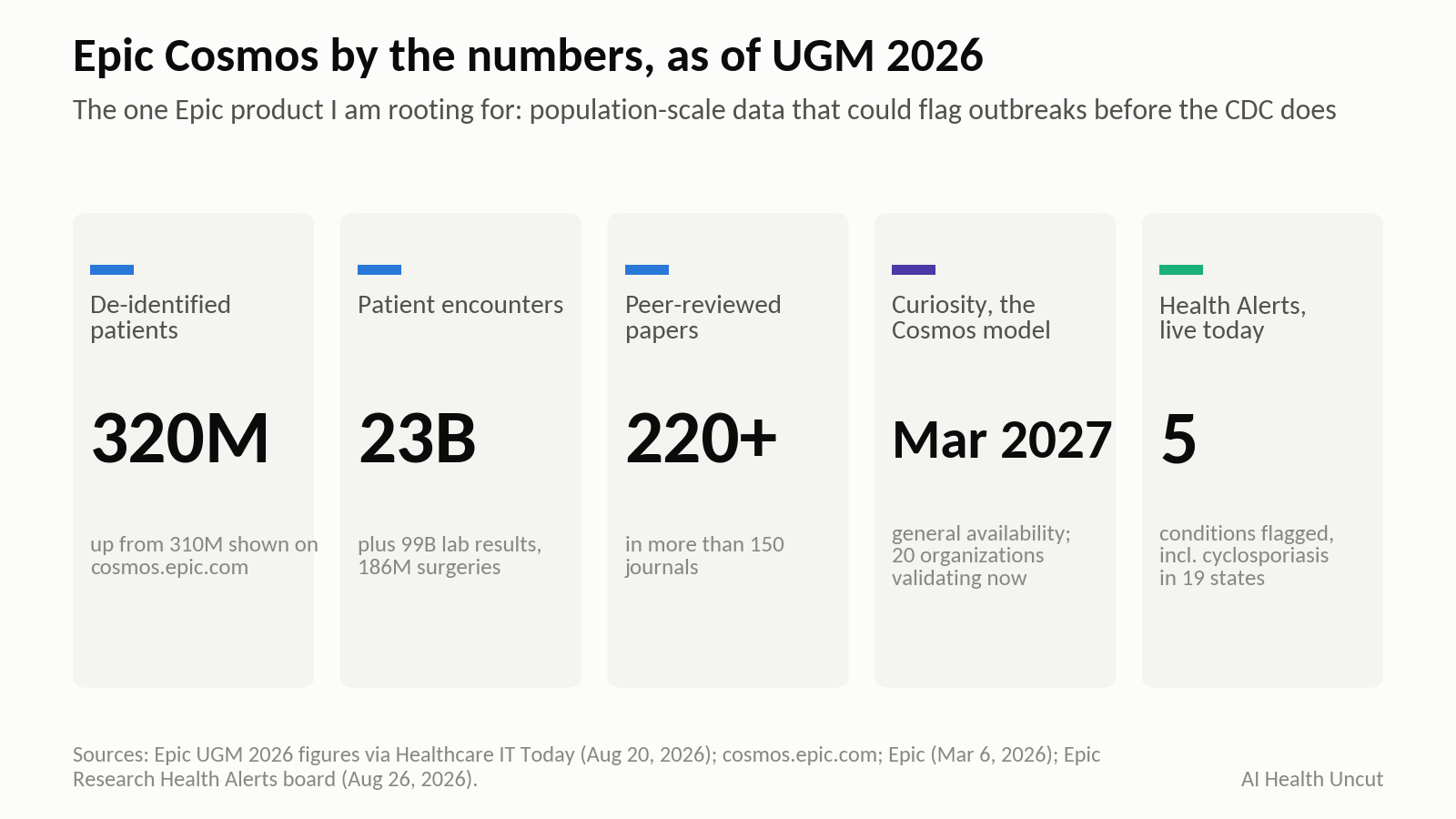
That last piece is my hope. Epic sees patients walk into clinics in near real time across half the country, no names required. If Cosmos can flag an outbreak in a county a week before the CDC does, that is public health infrastructure the government never managed to build. Nobody has proven it at scale yet. On paper, Epic has it. Prove it, Judy, and I will say something nice about Epic twice in one year. 😉
4. R1 bought the prior auth company Olive AI left for dead
On August 18, in the middle of UGM, R1 announced it is acquiring Humata Health, terms undisclosed. It is R1’s second AI acquisition in ten months, after Phare Health, the London coding startup it bought in October 2025 and then named its entire operating system after. Both go into R37, the AI lab R1 launched with Palantir in March 2025. Stephanie’s framing: Ensemble got the credit as the RCM innovator because it never carried the burden of being public, while R1, historically an offshoring play with roughly 60% of its workforce outside the U.S., went private in an $8.9B deal in 2024 and is now building an AI-native revenue cycle on both the coding and the claims side.
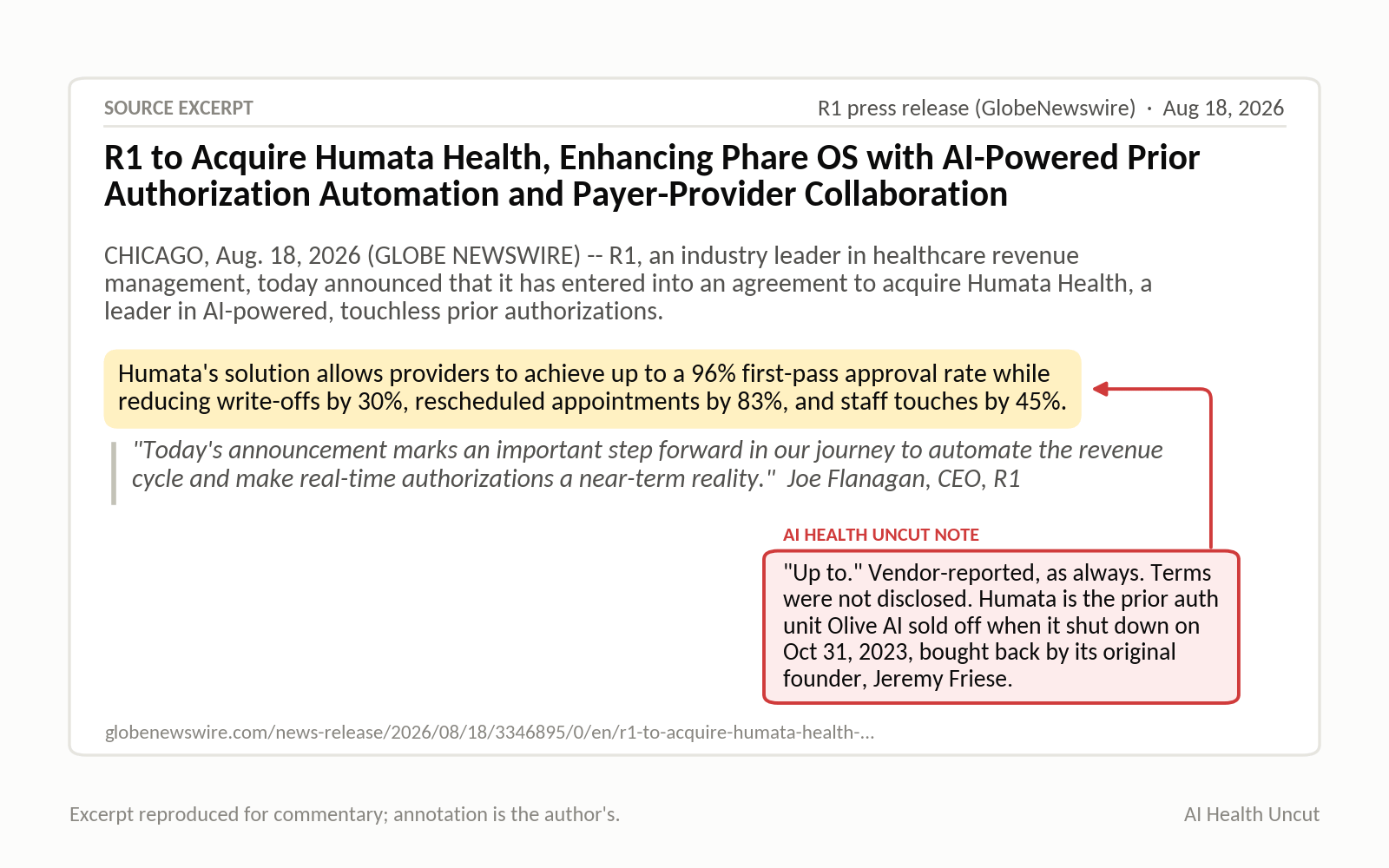
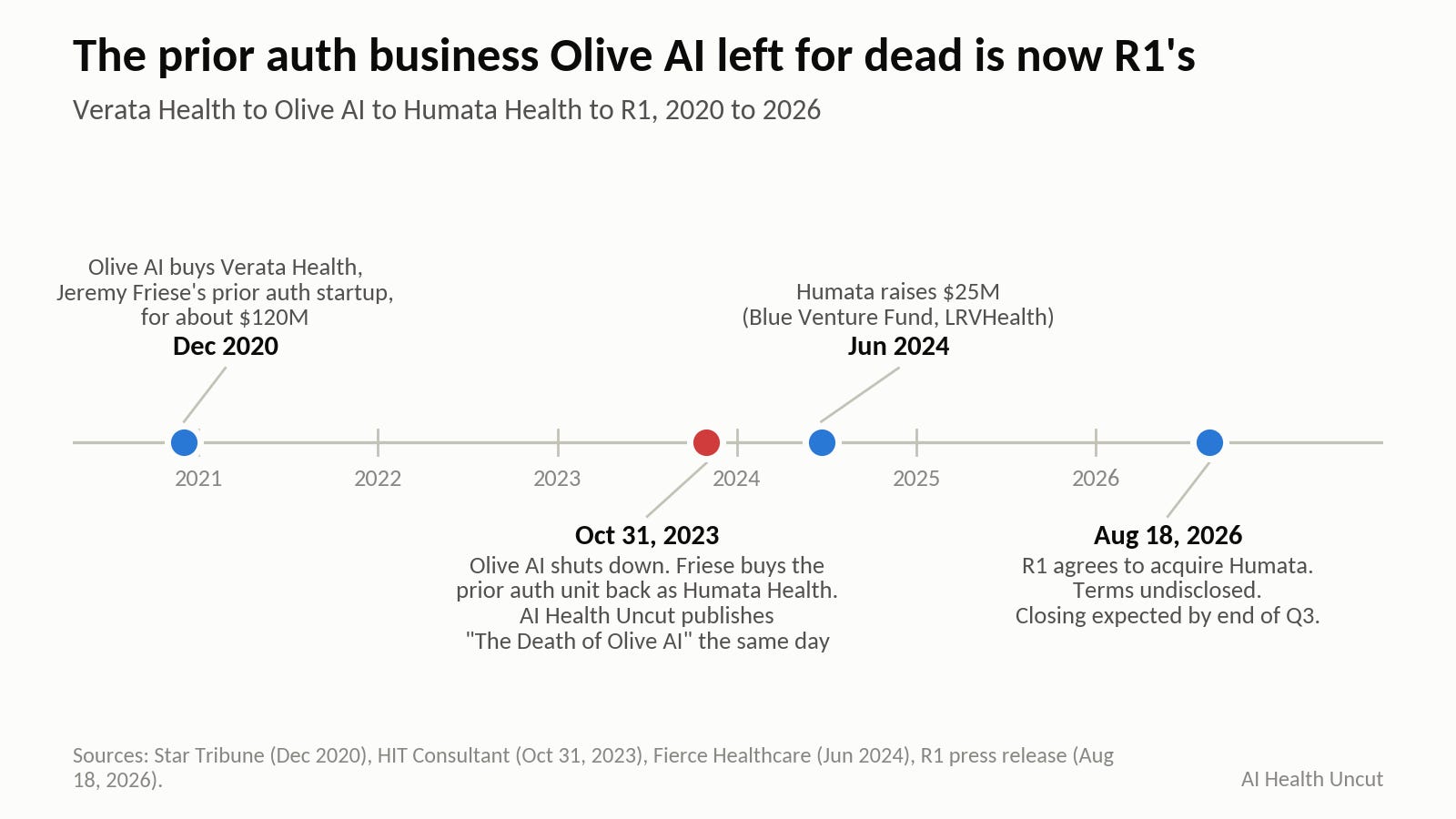
Bailey didn’t hesitate for a second to say on air that she’s bullish on R1. Part of it is the Humata story itself. Jeremy Friese sold Verata Health to Olive AI for about $120M in December 2020. When Olive collapsed on October 31, 2023, the day I published “The Death of Olive AI,” Friese bought Olive’s prior authorization unit back, rebuilt it as Humata, raised $25M in 2024, and has now sold it a second time. You have to give it to this guy. He is quite a trader. Meanwhile, prior auth in America still runs on fax machines. 📠
Bailey drew the distinction that matters. Epic’s new product is an authorization check. Humata obtains the authorization and tracks it to the end, which is the more valuable of the two. Stephanie added the detail everyone forgets: R1 is largely a Cerner shop, with Ascension, its largest customer at about 40% of revenue, running Oracle Health, while Epic shops lean Ensemble, which says 86% of its clients run Epic. Different user bases, different fights. And Ensemble took a Thoreau investment in June at a reported $12B valuation.
Revenue cycle is where the money in healthcare AI is being made right now. Not the scribes.
5. Quick August healthtech hits
Teladoc fell 28% on July 30 after cutting BetterHelp’s growth outlook by about 12 points and guiding full-year revenue down about 5%. Cash-pay therapy is evaporating because insurers now cover it, and Teladoc does not have enough in-network therapists to catch the demand. Stephanie: “I don’t know how they fix it.” I wrote in January 2025 to expect massive public bankruptcies in digital health. Nothing here changes my view of where the Livongo hangover ends.
Doximity closed up 33% on August 7 and nearly doubled intraday. Revenue guidance went up, EBITDA guidance came down on AI spending, and with 19.7% of the float sold short, the squeeze did the rest. Alex, of course, credited Amit Phull’s appearance on our podcast in July. 😉 The OpenEvidence-eats-Doximity panic I dissected on Doximity’s worst stock market day in February looks weaker every quarter. Doximity is profitable, which still counts for something in a sector full of AI companies that are not.
Amwell jumped 25% on the print. I wrote “COVID Finally Killed Amwell“ in July 2024. The patient is not only alive, it is beating and raising under CFO and COO Mark Hirschhorn, the former Teladoc CFO, with a Defense Health Agency intent to award in hand. Stephanie says management teams change stories. I asked where the moat is when every local provider offers telehealth. Her answer, government contracts and subscription revenue, is at least a real answer. I don’t know, Stephanie. Time will tell. 😉
Oracle Health bracketed UGM with a patient portal on August 12 and an expanded Clinical AI Agent on August 19, both timed to look busy. Bailey’s Oracle demo last December was the first she had ever sat through where the vendor said, “We actually don’t have this yet, but we’re going to be selling it.” Oracle cut 21,000 jobs in fiscal 2026, including more than 500 in Kansas City, where Alex had just spent the day with former Cerner employees who have no idea where the product is going. The VA went live at three more hospitals in Indiana this week, 11 for the year, with every VA facility promised by 2031. Stephanie’s bet: Oracle spins or sells Cerner within five years, once the tax clock allows it. If you are Oracle, do you spend your time on OpenAI or on Cerner?
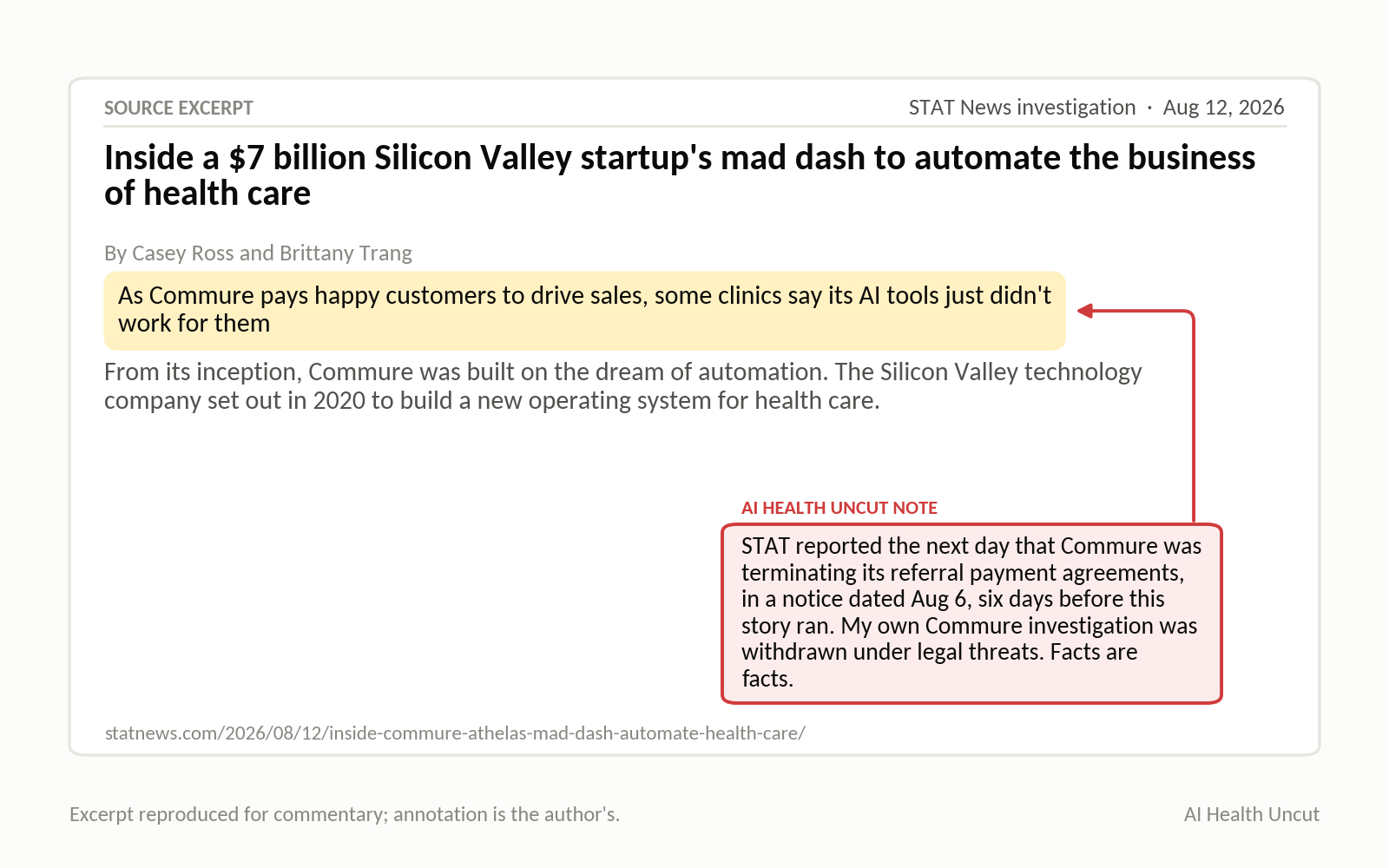
Commure. STAT’s August 12 investigation documented a referral program under which one physical therapy clinic had to send Commure $750K in new business within a year or pay a $66K “referral obligation fee.” Commure had already sent customers a notice, dated August 6, that the payment agreements would be terminated, which STAT reported the day after the investigation ran. I published “Commure’s Long History of Red Flags“ on August 13. My original investigation was withdrawn under legal threats from Commure, so forgive me if I enjoyed reading STAT’s version. Stephanie’s “devil’s advocate” defense: partnership fees are old news, and One Medical booked 42% of its 2020 revenue from health network partners before Amazon bought it. Bailey, who was at Athelas when it asked her to sell an EHR that was not finished, thinks Commure is being made an example of in an industry that runs on relationships. My view has not changed. When your customer is also your investor, the investor wants a higher price and the customer accepts it. That is a conflict of interest, however common. And Stephanie’s advice to founders is free: do not fight with journalists. Work with them.
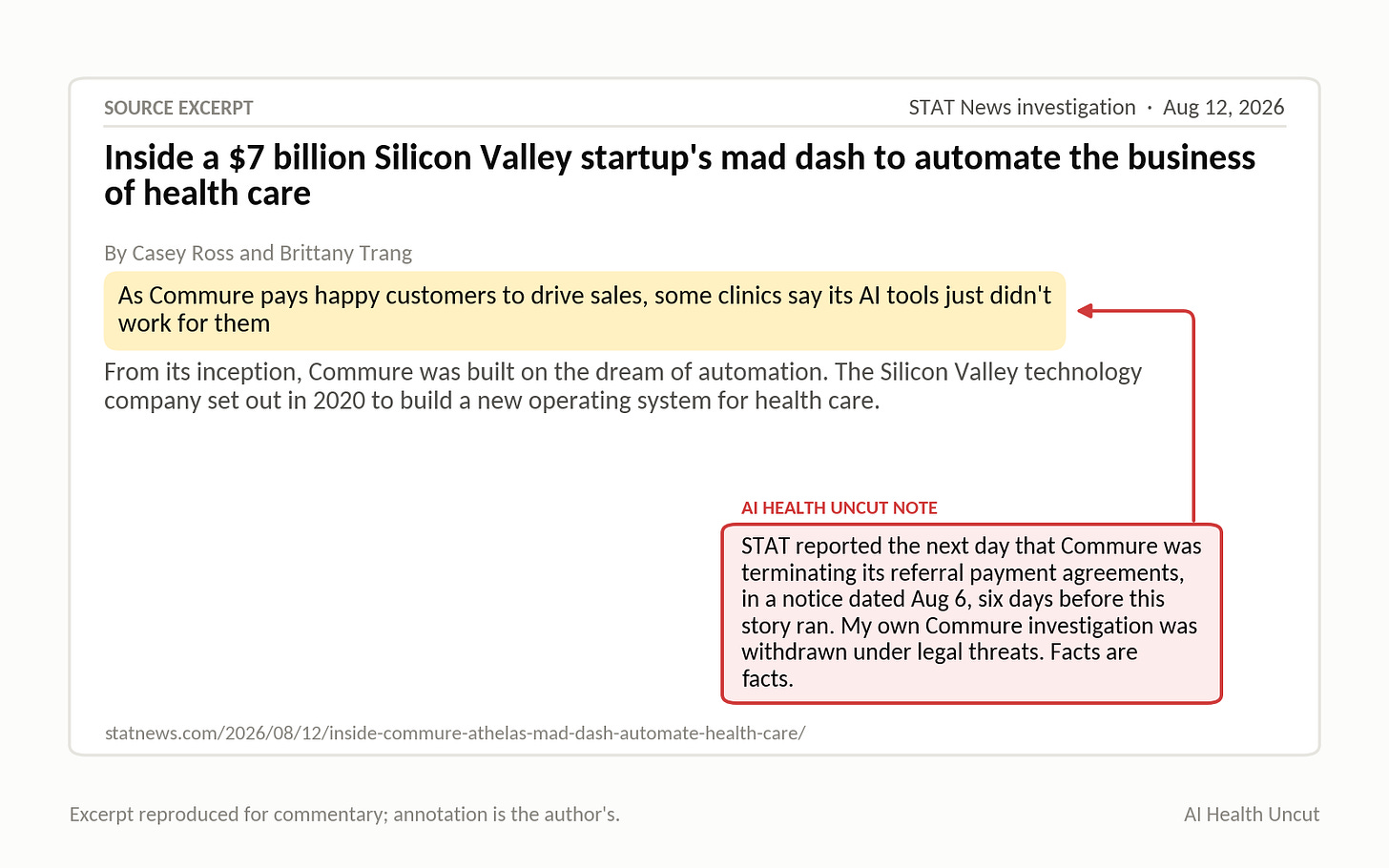
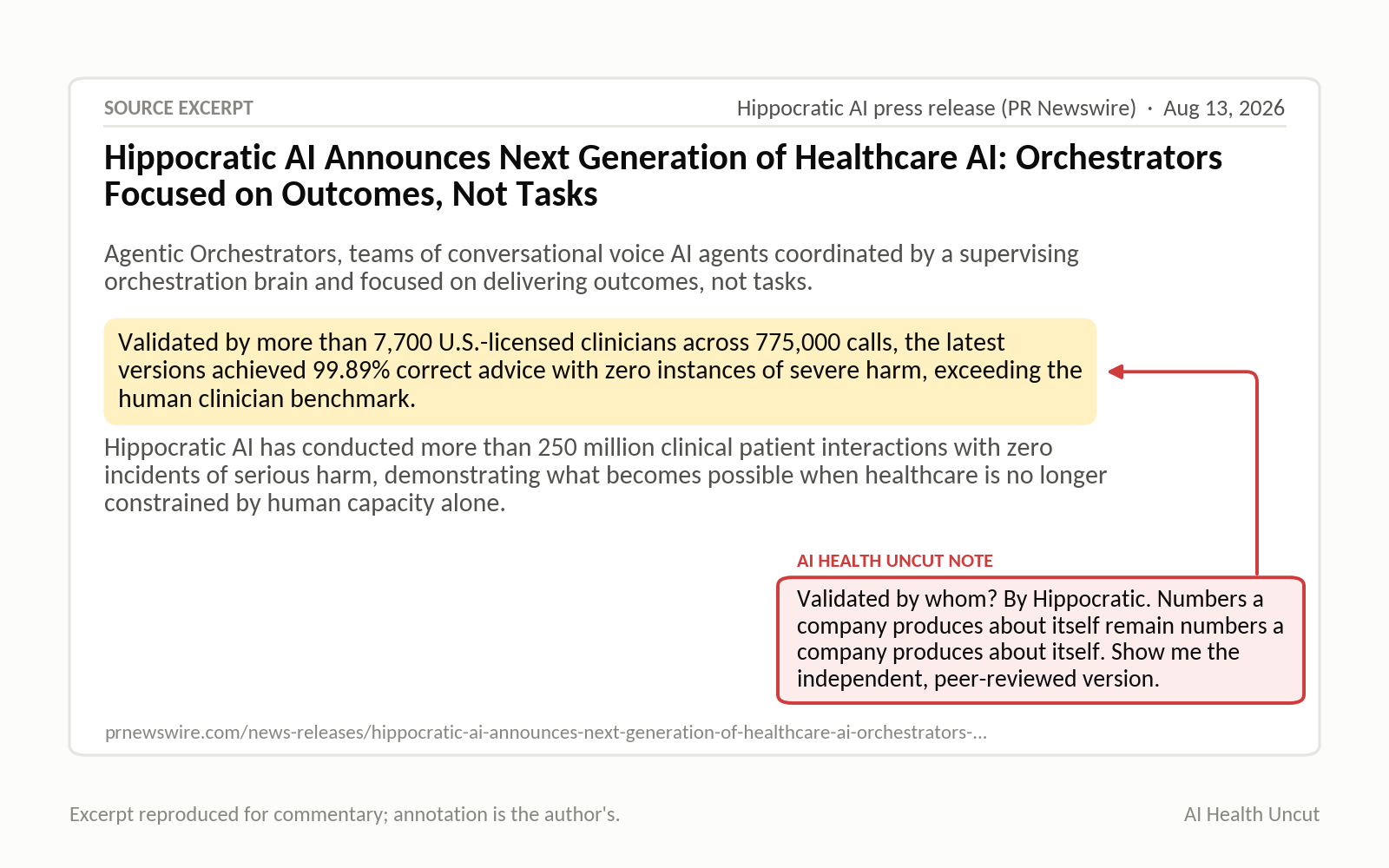
STAT’s Commure investigation, annotated. Hippocratic AI. We ran out of time for the other General Catalyst company on air, so here is the print version. On August 13, the day after the STAT piece on Commure, Hippocratic AI announced “orchestrators”, which it defines as teams of voice agents run by a “supervising orchestration brain,” and repeated its favorite statistics: “99.89% correct advice,” validated by its own count across 775,000 calls by more than 7,700 U.S.-licensed clinicians, plus 250M patient interactions with “zero incidents of serious harm.” Numbers a company produces about itself remain numbers a company produces about itself, a point I made in “OpenEvidence Goes Hippocratic AI.” The company raised $126M at a $3.5B valuation in November for acquisitions and international expansion, which reads differently now that (reportedly) the international sales team has since been “restructured.” “Point solutions will only get you so far,” says CEO Munjal Shah. I agree, just not in the way he means. In any case, even if we take Hippocratic’s own press-release numbers at face value, it now has Epic breathing down its neck. At UGM, Epic announced front-desk voice AI as part of its broader push downmarket.
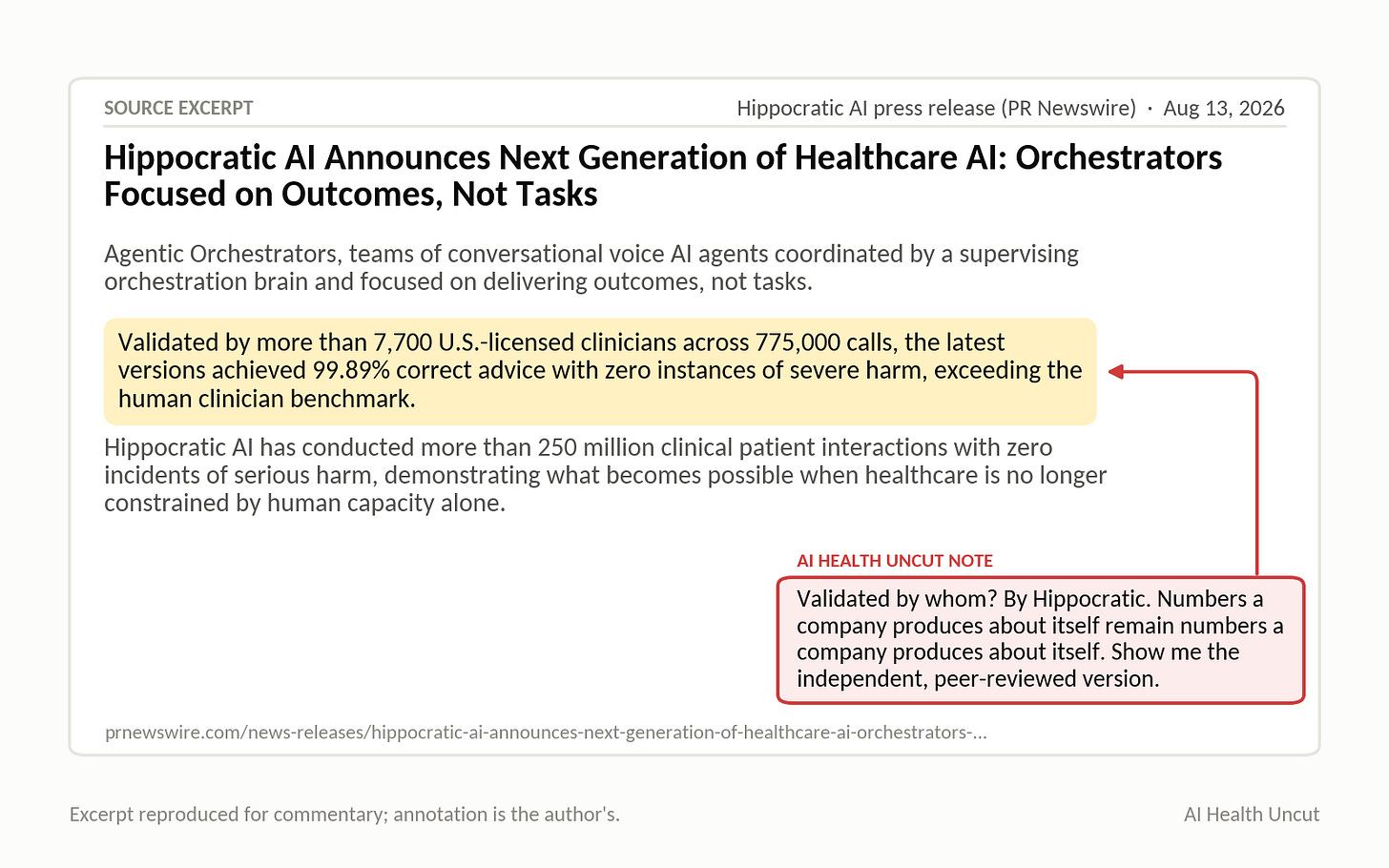
Hippocratic AI’s orchestrators press release, annotated.
Watch the full episode here:
Like what you’re reading in this newsletter? Want more in-depth investigations and research? Alright then—go tell your friends!
👉👉👉👉👉 Hi! My name is Sergei Polevikov. I’m an AI researcher and a healthcare AI startup founder. In my newsletter ‘AI Health Uncut,’ I combine my knowledge of AI models with my unique skills in analyzing the financial health of digital health companies. Why “Uncut”? Because I never sugarcoat or filter the hard truth. I don’t play games, I don’t work for anyone, and therefore, with your support, I produce the most original, the most unbiased, the most unapologetic research in AI, innovation, and healthcare. Thank you for your support of my work. You’re part of a vibrant community of healthcare AI enthusiasts! Your engagement matters. 🙏🙏🙏🙏🙏
hmm