


Welcome to AI Health Uncut, a brutally honest newsletter on AI, innovation, and the state of the healthcare market. If you’d like to sign up to receive issues over email, you can do so here.
Apologies to my regular readers, but I ought to respond to a lot of nonsense circulating on the Internet right now about the Navier-Stokes Millennium Prize Problem. Unfortunately, a good deal of that nonsense is coming from OpenAI itself. I want to set the record straight. Apologies in advance for getting technical at times, but there is really no other way to address an issue this important.
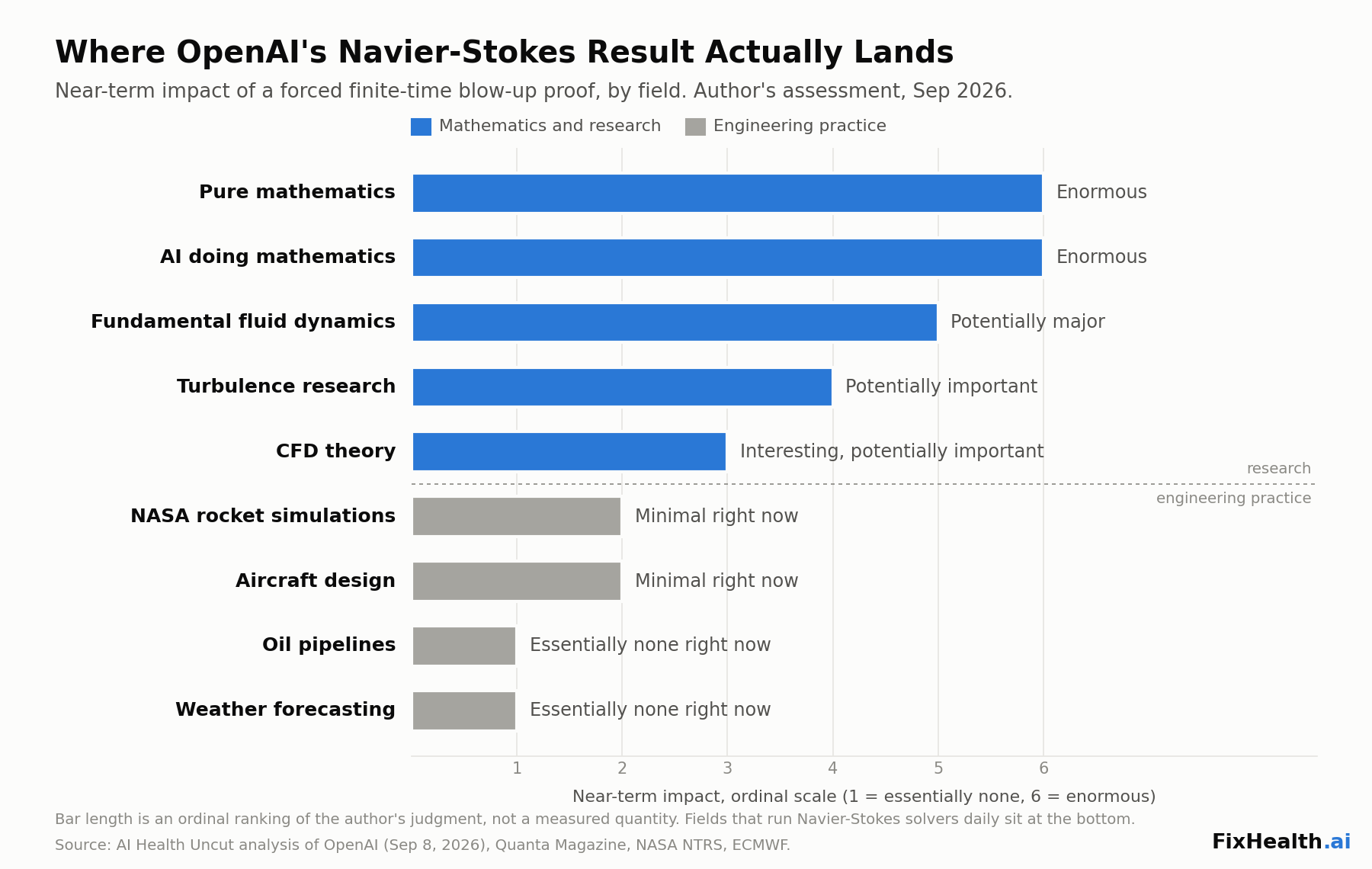
What do a NASA scientist, an oil engineer, and a meteorologist all have in common? None of them gives a sh*t about OpenAI’s Navier-Stokes announcement, even though all three run the Navier-Stokes equations in their models every single day.
TL;DR:
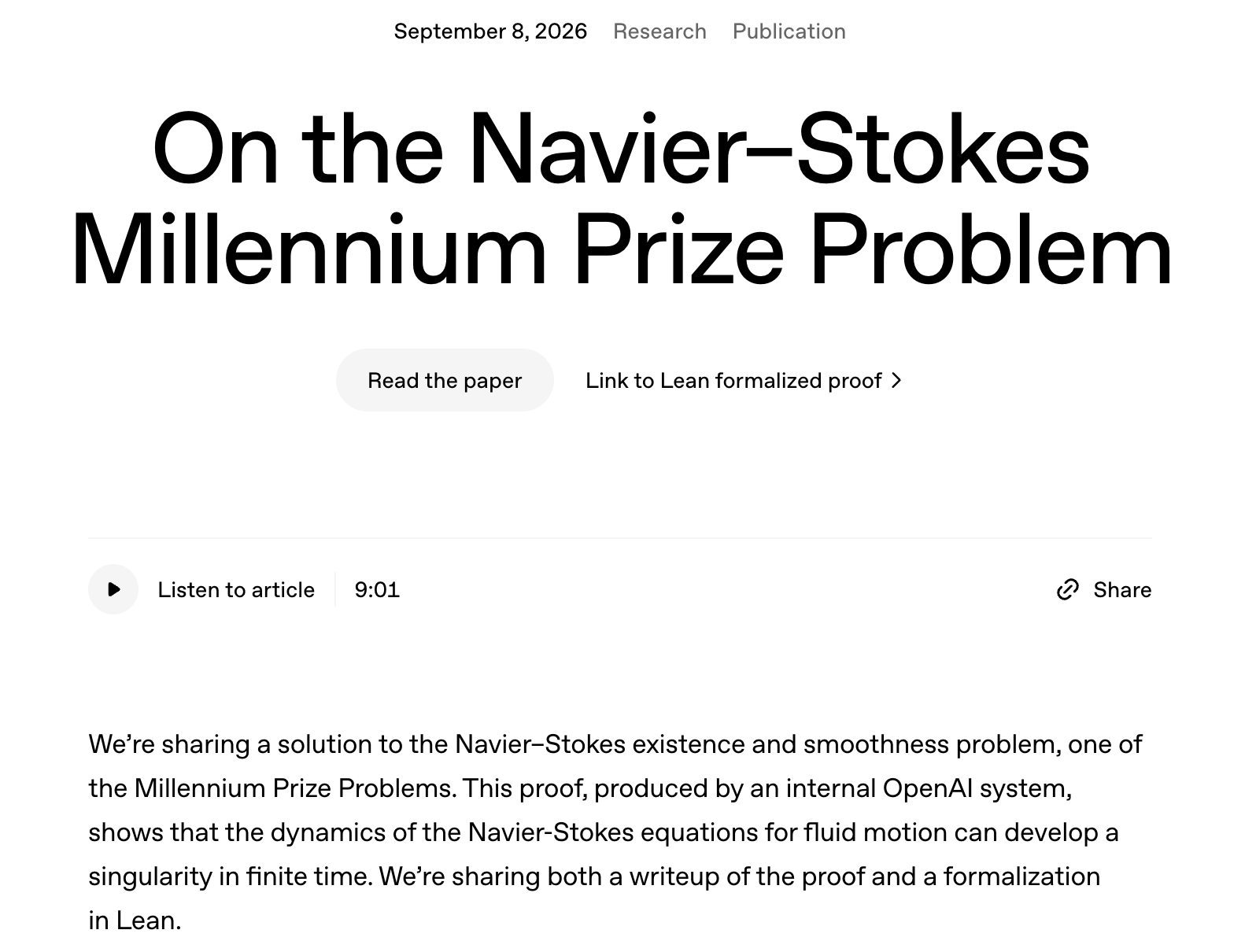
On Sep 8, 2026, OpenAI claimed that roughly 10,000 AI agents proved the 3D Navier-Stokes equations can reach infinite velocity in finite time. OpenAI won’t claim the $1M prize, the Clay Institute still lists the problem as open, and 25 Fields medalists signed a declaration on the “severe misalignment” of AI in mathematics.
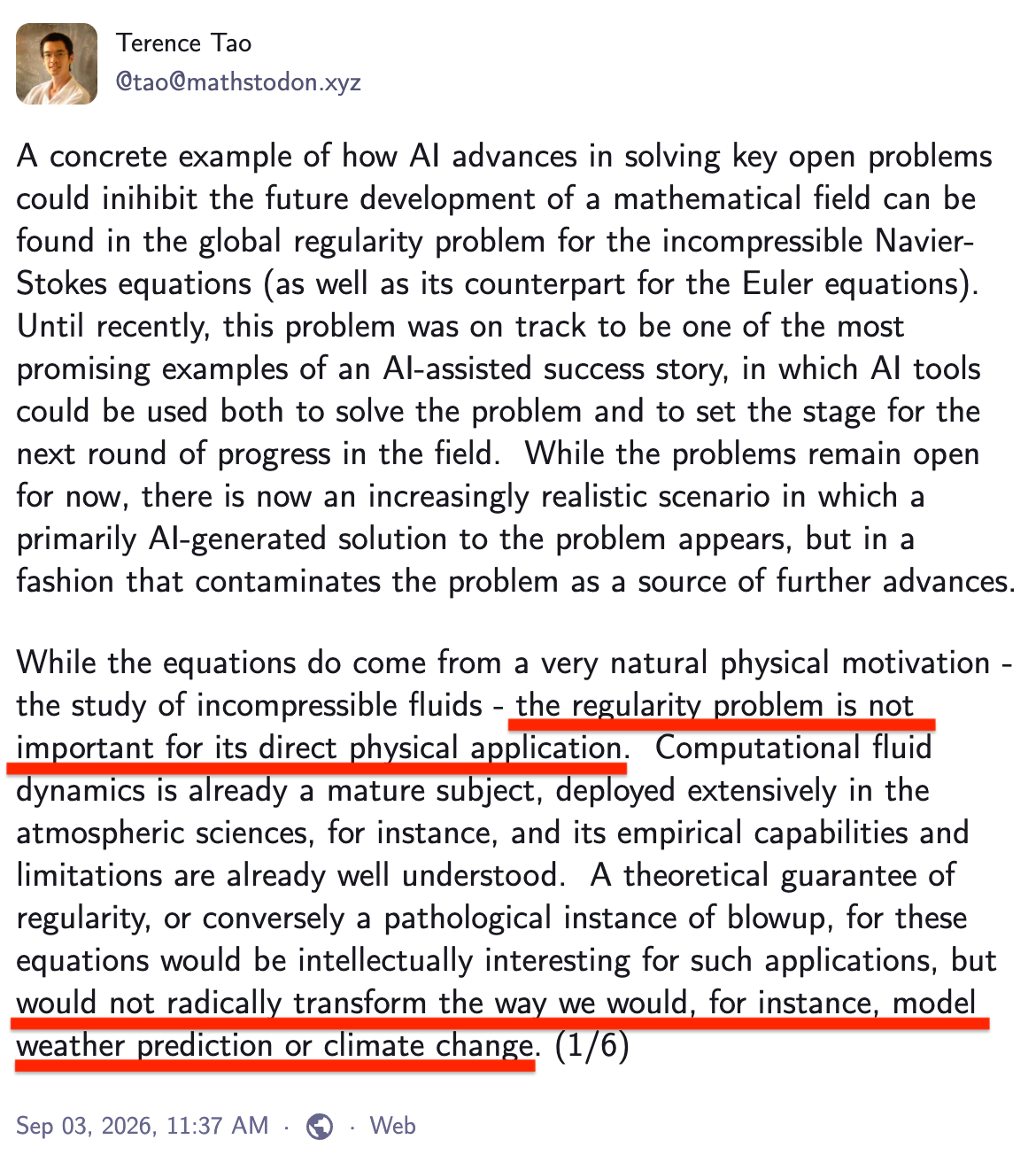
Assume, for the moment, the proof actually holds. For NASA, aircraft makers, pipeline operators, and weather models, the near-term impact rounds to 0. Not 1 practitioner announced a model change. Fields Medal winner Dr. Terence Tao said as much five days before the announcement: a blow-up “would not radically transform” how we model weather or climate.
Engineers never solved Navier-Stokes analytically. They approximate it numerically, validate against wind tunnels and flight data, and have handled its instabilities for decades. Those calculations already work.
The practical problem was solved decades before the mathematical one.
Here is what’s inside:
1. Everyone Is a Navier-Stokes Expert This Week
2. The Navier-Stokes Equation, in Plain English
3. Briefly on the Soap Opera, Then Let’s Move On
4. What NASA Actually Does With Navier-Stokes
5. Imagine NASA Simulating a Capsule at Mach 20
6. We Knew About the Swirls All Along
7. A 6th Reason Your Simulation Blew Up
8. Oil Pipelines and Weather
9. The Rockets Flew First. The Proof Came Later.
1. Everyone Is a Navier-Stokes Expert This Week
It’s funny how everyone became an expert in Navier-Stokes overnight. I spent the past week on the sidelines, listening. There are two camps. One says AI is now so good that you hand it a problem open since Leray in 1934 and it spits out a proof. The other says slow down. Both camps are mostly people who have never solved these equations for a living.
I have. I’m a mathematician and researcher who used Navier-Stokes in my academic work, and I know a bit about the practical side. Back in the day, I worked on a couple of fluid dynamics projects with my father, Viktor Polevikov, who has spent his career studying fluid dynamics, magnetic fluids, ferrofluids, heat convection, heat and mass transfer, and gravity. He has published more than 200 peer-reviewed papers, with applications across a wide range of industries and in research relevant to organizations including NASA. That work came out of the Heat and Mass Transfer Institute in Minsk, a world-renowned research school that published two internationally recognized journals in thermo- and hydro-dynamics and, over the decades, employed thousands of experts from around the world, including researchers from the U.S., UK, Germany, France, and Japan.

In June I wrote that SpaceX’s success is bad news for healthtech because Wall Street now pays for real engineering moats. After a week of hot takes, I’d add a corollary:
Being good at code and riddles does not make you good at physics.
I call this “AI tourism”. Fluid dynamics just had its first tourist season. Programmers who are not physicists went looking for famous unsolved problems, found a 92-year-old one, let a model run on it for days, and built a story about cracking it. A private company’s valuation and its position in the model race both benefit from that story. The substance is thinner than the hype.
2. The Navier-Stokes Equation, in Plain English
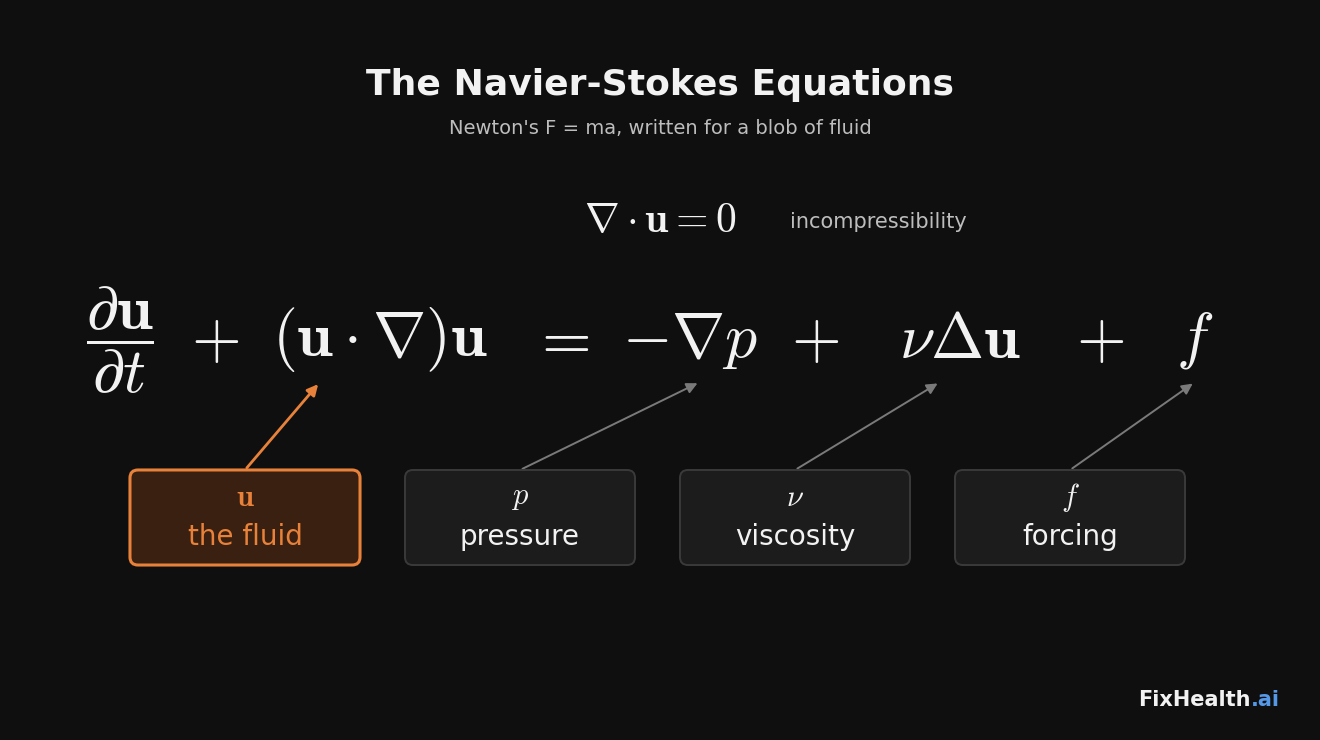
Navier-Stokes is Newton’s F = ma written for a blob of fluid instead of a cannonball. The left side is the acceleration: how fast the blob’s velocity u changes over time, plus how the blob gets carried along and stretched by the flow around it. The right side is the forces: pressure p pushes the blob from high to low, viscosity ν smooths out differences the way honey resists a spoon 🍯, and f is any outside push, a pump, a fan, gravity. The shorter line on top says the fluid can’t be squeezed. That’s the whole thing. The Millennium question asks: start with a smooth flow, does it stay smooth forever, or can it spike to infinite speed at a point? OpenAI’s answer is that with the right smooth outside push, it spikes. Note the f at the end of the equation. The result needs forcing. Whether the equations blow up with no outside push at all, the version most people picture, is still open.
3. Briefly on the Soap Opera, Then Let’s Move On
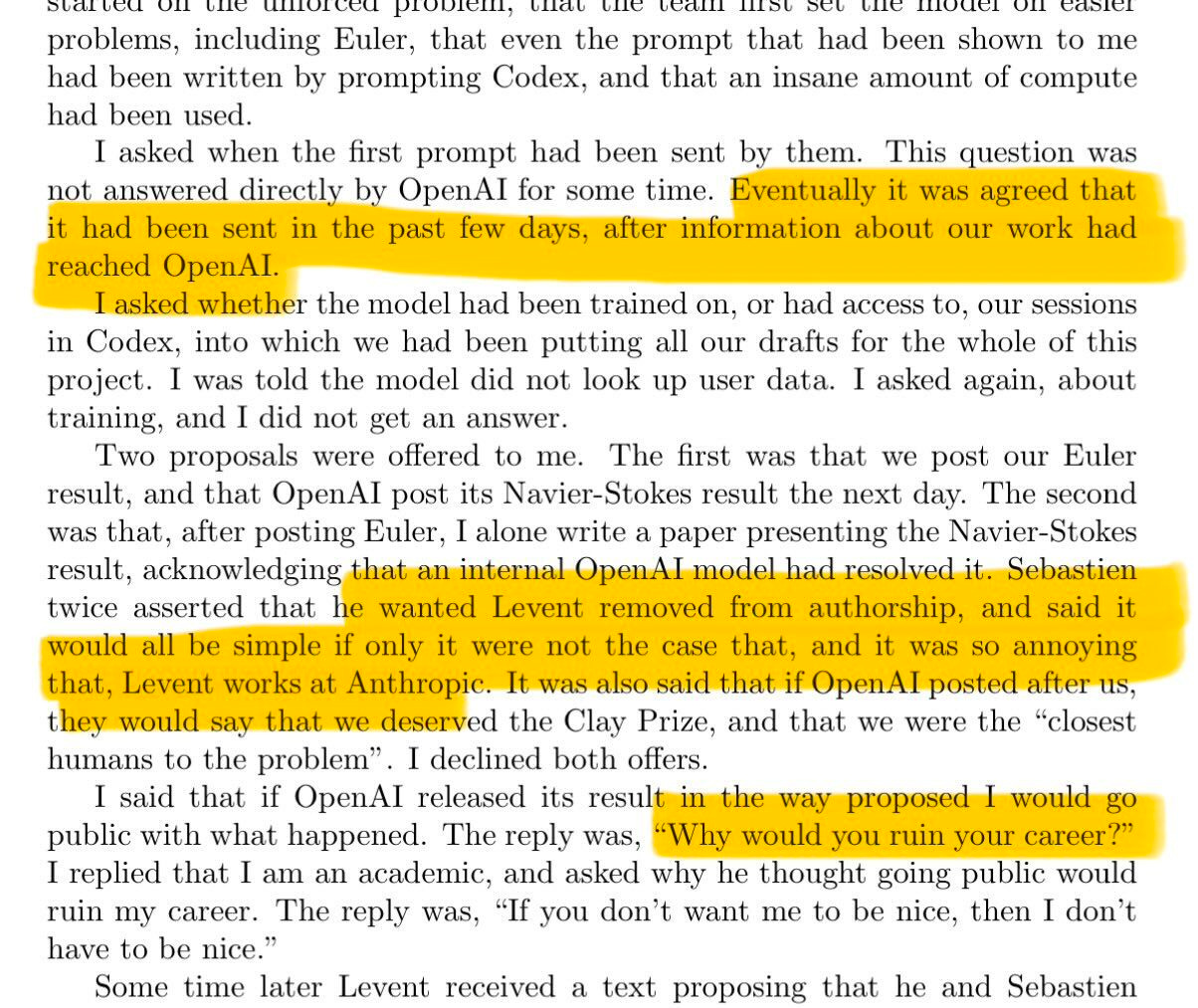
The facts behind this jaw-dropping soap opera. OpenAI says its agents needed 88 hours to find the proof and 17 more to formalize it in Lean, an AI proof assistant. It then published the result on its own website, the way you or I publish a blog post. No journal, no editor, no referee. 🤦♂️ The Clay Institute’s rules require publication in a qualifying outlet, a 2-year waiting period after that, and general acceptance by the mathematics community. So the earliest anyone can call this “solved” is 2028. NYU’s Tristan Buckmaster says OpenAI fought dirty. Everyone built on the forcing method of Diego Córdoba and Luis Martínez-Zoroa, whom Princeton’s Charles Fefferman called “the heroes”. Buckmaster and Anthropic’s Levent Alpöge posted their own AI-assisted blow-up proofs for the Euler equations a day earlier. OpenAI even admits it “cannot rule out” that de-identified data from Buckmaster’s use of its products helped its models. (I.e., there is a real possibility that OpenAI used mathematical research shared in ChatGPT conversations without the researchers’ knowledge or consent.) Who typed the prompt first is irrelevant to me. And on Sep 11, 25 Fields medalists, from Terence Tao to Peter Scholze, declared that “solving problems is only a tool and proxy for achieving the primary goal of conceptual understanding and insight.”
Amazingly, Tao either knew something was up or somehow saw this coming. On Sep 3, five days before the OpenAI announcement, he described the exact scenario: an autonomous AI harness with enormous compute runs the whole search internally, the company keeps the process out of public view, and “technically, one of the most prominent open problems in mathematics would now be solved,” with “almost no value added to mathematics as a consequence.” Problems like Navier-Stokes regularity are posed, in his words, “not because we desperately want the solution to these problems in and of themselves,” but because the human effort to solve them builds the field. Solving one prematurely by purely AI-powered methods, without transparency into the process, “can contaminate this process to the point where it actually becomes a net negative for the progress of mathematics as a whole.” Two days later he added that there is “a substantial opportunity cost in converting a historically productive and motivating problem into a mere viral social media post advertising some benchmark progress.”
If that sounds familiar, it’s because I’ve been making the same argument about medical AI benchmarks for 2 years. A 100% score on a hard benchmark (or a riddle) is not understanding. It is most likely cheating.
OK. Now assume the OpenAI proof survives. Practically, what changes?
4. What NASA Actually Does With Navier-Stokes
Start with what didn’t happen. Nobody at NASA woke up on Sep 9, read the paper, and called an emergency meeting. Not one NASA scientist, oil engineer, or meteorologist announced that a model has to change. I’d bet most of them didn’t read past the headline.
NASA doesn’t solve Navier-Stokes analytically. Nobody does. As NASA Glenn puts it, the equations are “too difficult to solve analytically,” so engineers solve approximations on computers. That’s computational fluid dynamics (CFD).
The Smithsonian displays the engineer’s version of the equations a short walk from the hardware they flew: five conservation laws (mass, momentum in three directions, energy), with density and heat terms that the incompressible textbook form above leaves out. That is the version a rocket or a cruise missile gets designed with.
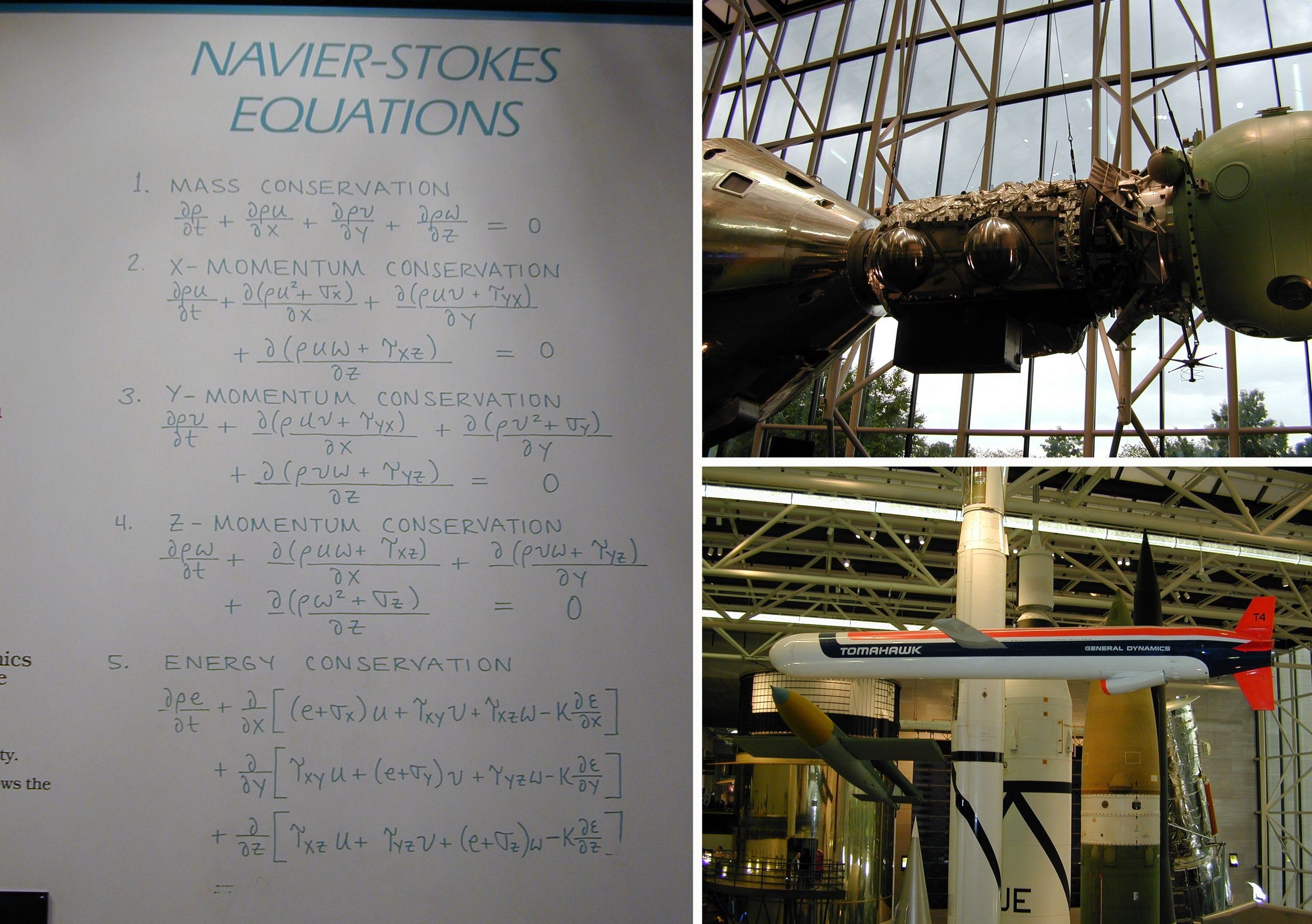
To model airflow around a rocket, a computer carves the surrounding space into millions or billions of cells:
rocket → grid → approximate Navier-Stokes in each cell → step forward in time → read off pressure, temperature, velocity, turbulence
NASA’s OVERFLOW and FUN3D codes do exactly this for aircraft, launch vehicles, and Artemis, on grids that run into the billions of cells. NASA’s own CFD Vision 2030 study calls CFD central to aerospace design for decades.
And here’s the important thing. Those calculations already work. Engineers check them against wind tunnels, flight data, and previous designs. Thousands of NASA scientists solve this equation under an enormous range of conditions, singularities included.
So the OpenAI result doesn’t mean “holy sh*t, all our CFD was wrong.” It means something far subtler.
5. Imagine NASA Simulating a Capsule at Mach 20
A capsule enters an atmosphere at Mach 20:
air → compression → shock wave → enormous heating → flow around the vehicle
For the Mars 2020 entry capsule, NASA ran two independent Navier-Stokes solvers, DPLR and LAURA, and used the resulting heat-transfer rates to validate the heat shield design. Perseverance landed. That’s the validation.
OpenAI’s result does not show those calculations are wrong. It shows that some mathematically permissible Navier-Stokes configurations can evolve into singularities: a vortex that, in OpenAI’s own words, “spirals inward and gets increasingly elongated, like spaghetti,” until velocity becomes unbounded. That is very different from showing that a CFD run of an Artemis rocket is secretly approaching a singularity.
6. We Knew About the Swirls All Along
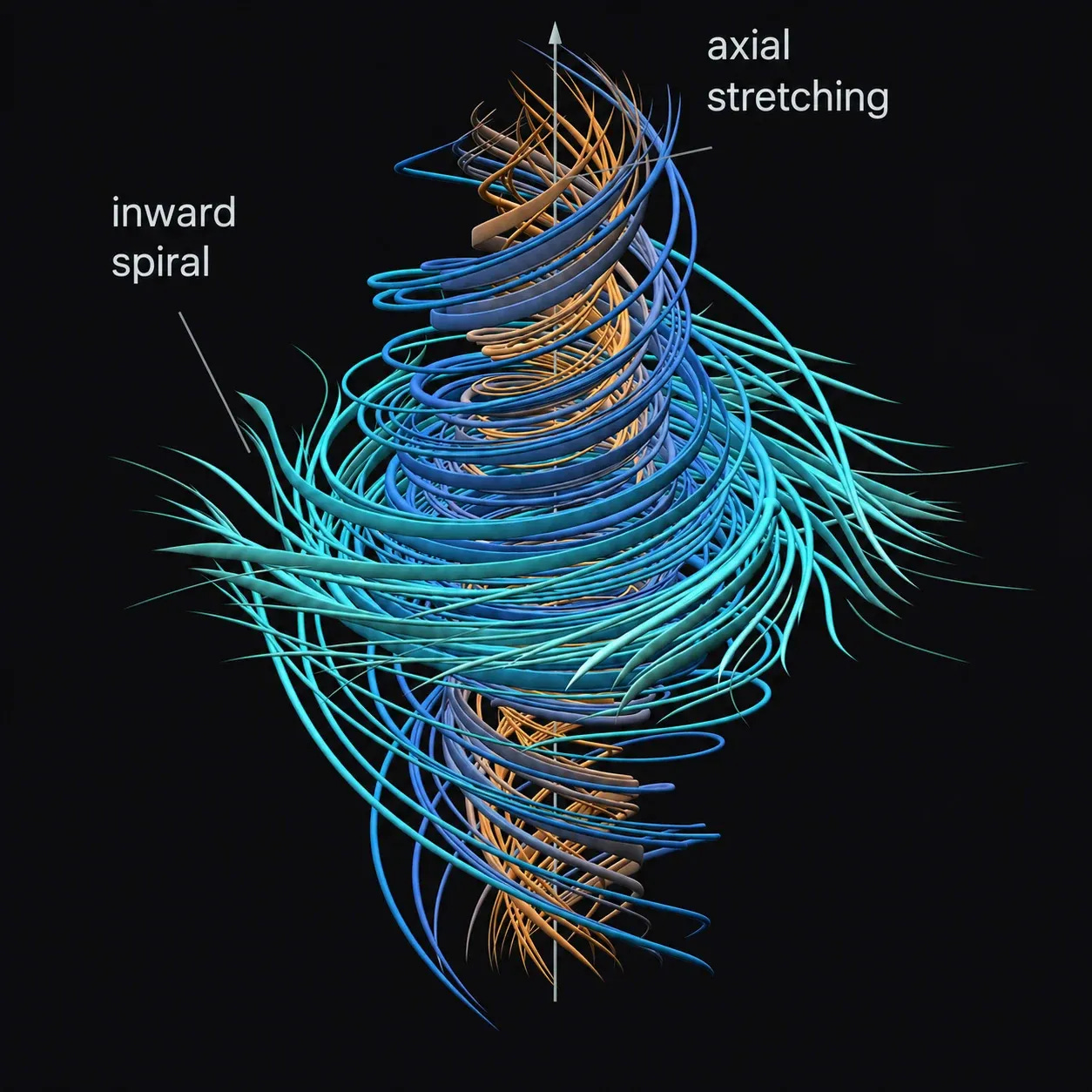
OpenAI’s pictures of spiraling vortices are pretty. They are also not news. Mathematicians and engineers have known for decades that these equations have regions of singularity and instability, and there are decades, arguably centuries, of techniques for handling them numerically. Entire careers were built on it. The most serious theoretical treatment is still Olga Ladyzhenskaya’s book, written by a pure theorist who knew exactly what practitioners were doing with the equations.
Here is what instability looks like in practice, from heat convection, the field my father spent his life on. Solve a convection problem at a low Rayleigh number, Ra (the dimensionless number that measures how hard buoyancy is pushing), and you get one big circulation cell. Push the Rayleigh number up and secondary cells appear. Around Ra ≈ 10⁷, tertiary cells show up: small-scale structures, but still steady in time, still fully described by Navier-Stokes. The structure of the motion changes quantitatively and qualitatively as you approach the crisis of laminar convection. Past that point the flow turns turbulent, and turbulence is a stochastic process: i.e. solve the same problem today and tomorrow and you get two different solutions. Nobody has “solved” turbulence, and nobody may ever solve it in the traditional sense, because you cannot solve a probability distribution the way you solve an equation.
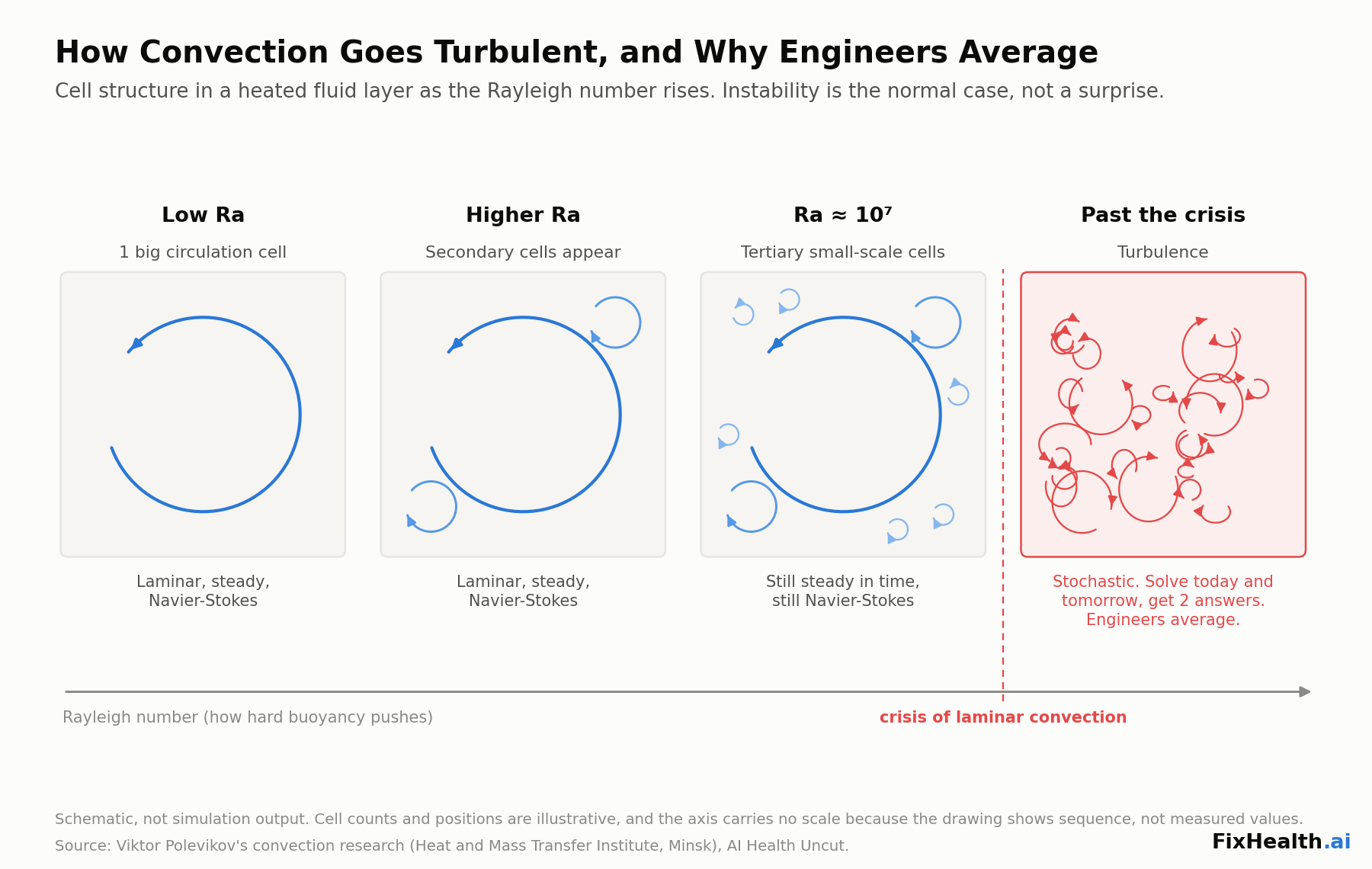
What engineers do instead is average. The small turbulent cells arise spontaneously in time and space, their velocities sit 2 to 3 orders of magnitude below the main flow, and they barely move the temperature field. So you solve for the mean flow numerically, treat the pulsations as small-scale noise, and validate against experiment. My father computed the integral heat flux (the Nusselt number) against Rayleigh number well past the laminar regime, published it in an international journal, and nobody questioned the results, because the curve continued smoothly out of the laminar range. That is the practical answer to “velocity goes to infinity.” At the point where the laminar model breaks, a different model takes over.
Physically, infinite velocity is nonsense, and every practitioner knows where to stop trusting the continuum equations.
7. A 6th Reason Your Simulation Blew Up
CFD engineers deal with runs that go bad all the time:
extreme turbulence → smaller structures → finer mesh → numerical instability → solver blows up
Historically, the checklist of explanations had five items:
mesh not fine enough,
turbulence model inadequate,
time step too large,
numerical method unstable,
physical assumptions wrong.
OpenAI adds a 6th: the equations themselves can produce a singularity.
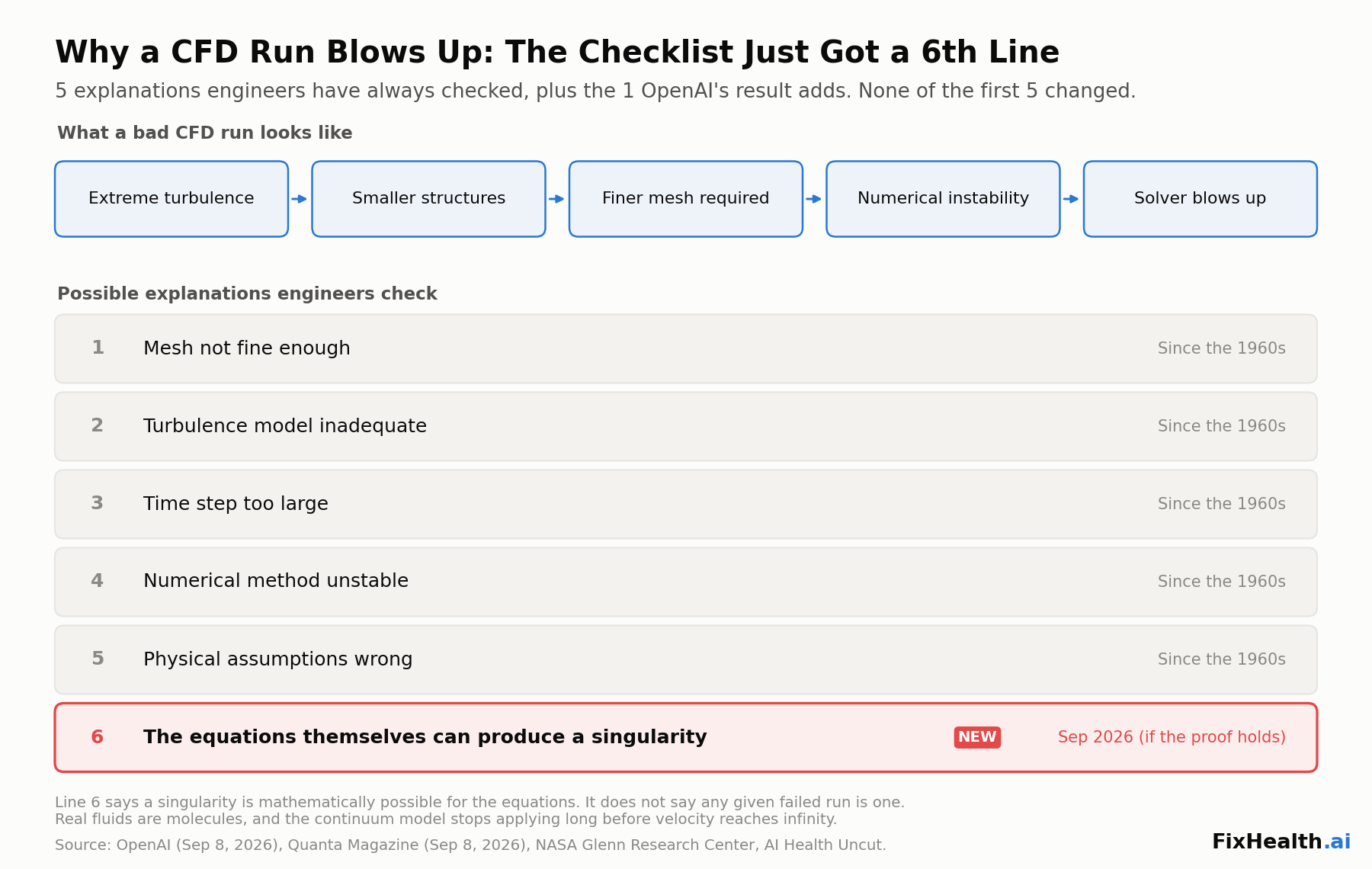
That changes what we know the equations are capable of. It does not mean every CFD failure is a singularity. Far from it. As Quanta notes, real fluids are molecules, not a perfect continuum, and at small enough scales molecular physics, compressibility, chemistry, or plasma physics take over. Years from now, this could yield a sharper criterion for when to switch models. That would be valuable. OpenAI’s proof is nowhere near handing NASA that criterion.
8. Oil Pipelines and Weather
A pipeline engineer wants: pressure here → flow rate → friction → pressure downstream.
How oil behaves when it accelerates and decelerates inside a pipe is Navier-Stokes, simplified to one dimension and validated against decades of field data. Same for reservoirs, drilling mud, pumps, and compressors.
Weather models don’t even run the full thing: ECMWF’s operational forecast discretises a hydrostatic version of the Euler equations. Don’t take my word for it. Take Tao’s. In the same Sep 3 thread he wrote that the regularity problem “is not important for its direct physical application,” that computational fluid dynamics “is already a mature subject, deployed extensively in the atmospheric sciences,” and that a pathological instance of blow-up “would not radically transform the way we would, for instance, model weather prediction or climate change.”
An equation doesn’t need to be perfect under every conceivable condition to be extraordinarily useful within a physical regime. Newtonian mechanics is “wrong” at relativistic speeds. We still build bridges with it. The ideal gas law isn’t universal. Chemical engineers use it daily.
9. The Rockets Flew First. The Proof Came Later.
The practical problem was solved long before the mathematical one. NASA was flying vehicles designed with numerical Navier-Stokes while theoretical mathematicians couldn’t prove the equations stayed well behaved.
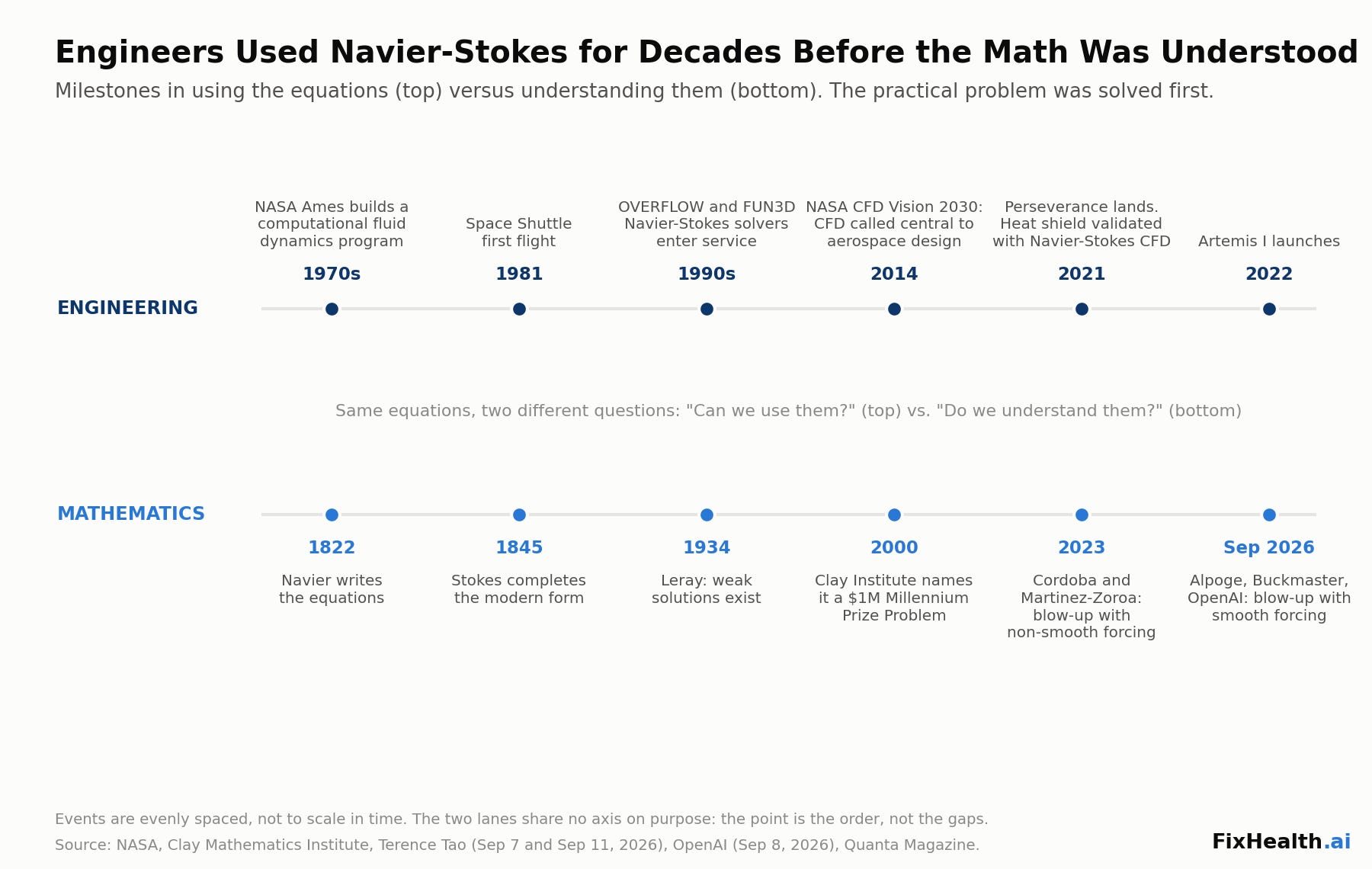
The Millennium problem never asked “can we use Navier-Stokes?” We knew we could. It asked whether we understand what these equations are mathematically capable of doing. If the proof holds, the answer is: not quite.
Which is why the loudest people last week were not the ones whose rockets depend on the answer. As I wrote when ChatGPT Health plugged into Epic, frontier labs will keep winning riddles. Domain experts still decide what the riddles are worth.
Whether OpenAI’s claim survives the next two years will be decided by mathematicians. Whether it matters was decided by engineers decades ago.
Like what you’re reading in this newsletter? Want more in-depth investigations and research? Alright then—go tell your friends!
👉👉👉👉👉 Hi! My name is Sergei Polevikov. I’m an AI researcher and a healthcare AI startup founder. In my newsletter ‘AI Health Uncut,’ I combine my knowledge of AI models with my unique skills in analyzing the financial health of digital health companies. Why “Uncut”? Because I never sugarcoat or filter the hard truth. I don’t play games, I don’t work for anyone, and therefore, with your support, I produce the most original, the most unbiased, the most unapologetic research in AI, innovation, and healthcare. Thank you for your support of my work. You’re part of a vibrant community of healthcare AI enthusiasts! Your engagement matters. 🙏🙏🙏🙏🙏
I think there's a separate issue, one that Terry Tao expressed. It's the idea that those considering a career in mathematics may think twice. Imagine setting out to tackle a problem and spending many years working on it, only to find that some else used an advanced model to prove or disprove the conjecture you were working on. It is unfortunate for Buckmaster and Alpöge that OpenAI's attention was directed to their project because of rumors that N-S had been solved. I read somewhere that OpenAI may have used an unreleased advanced model to take the problem to completion. How can you compete with that? How are mathematicians going to have confidence using Codex and other commercially available tools, when unreleased frontier models may steal their thunder? It seems that every week there is a story of some unsolved problem that amateurs solve. Some long mysterious cipher that gets decoded. This is different from Hinton's prediction about radiologists. Their existential crisis is being played out right now. NASA scientists may not care, but mathematicians do. That's why they signed the Leiden Declaration.
Thank you for this well articulated takedown of benchmark maxxing.
The research frontier of fluid dynamics has indeed long moved past the NS approximation, to handle applications where it’s not sufficient.
For example, there is a whole research program around using Renormalization Group methods to properly understand fluids from the particles up.