


Welcome to AI Health Uncut, a brutally honest newsletter on AI, innovation, and the state of the healthcare market. If you’d like to sign up to receive issues over email, you can do so here.
Important Disclosure. I am an independent journalist with no financial interest, long or short, in any company mentioned here, including Oura, Counsel Health, Heidi Health, Abridge, athenahealth, Alphabet (Google), OpenAI, Epic Systems, Oracle, General Catalyst, Khosla Ventures, Caduceus Capital Partners, Nabla, AMI Labs, Microsoft, Elion, HTD Health, Teladoc Health, CVS Health, Peloton, HLTH, and others. Opinions are my own. Not investment advice.
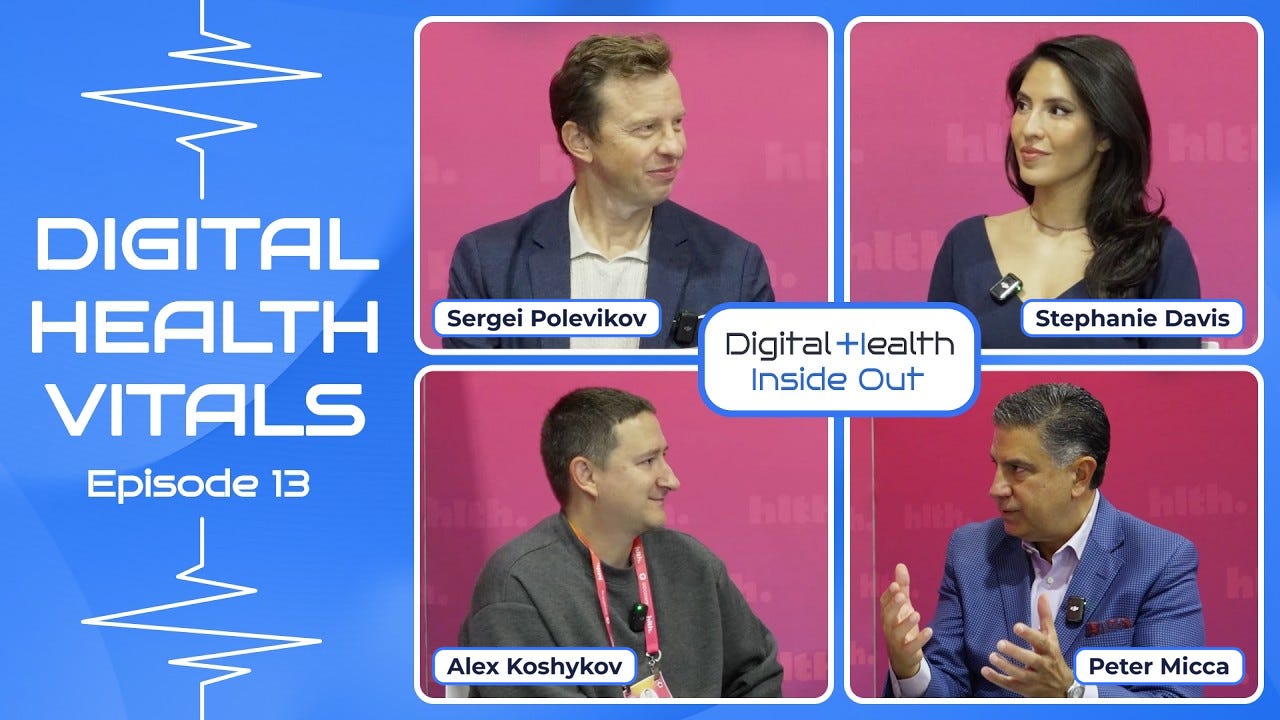
On Nov 17, Alex Koshykov, Stephanie Davis and I recorded the November Digital Health Vitals live from HLTH in Las Vegas, with special guest Peter Micca, Managing Partner at Caduceus Capital Partners. Peter is a VC who says AI is already a commodity, AI scribes are finished as an investment, and the big healthcare innovation of our time is GLP-1s, not AI. He said all of that at an AI conference. 😉
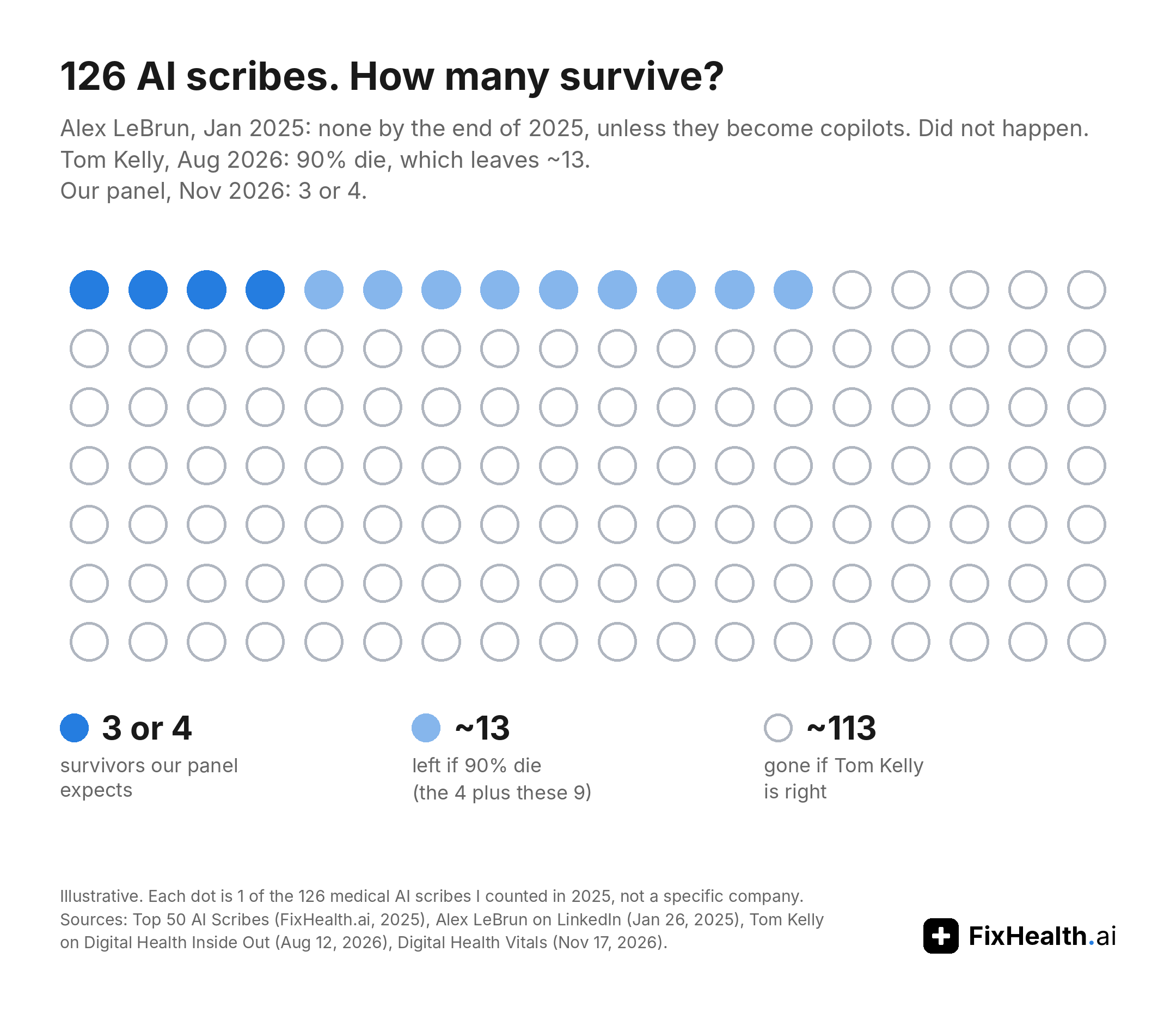
We have heard this before. In January 2025, Alex LeBrun, then CEO of Nabla, published The death of the AI scribe on LinkedIn and gave the scribes until the end of that year. In April 2025, he came on our show to debate it, in an episode called Why the Hell Do We Need 126 Medical AI Scribes? ~22 months later, the scribes are still here. So before anyone buries them again, I went back to both. See sections 5 and 6.
HLTH itself felt lighter this year. Stephanie counted fewer finance folks, bankers and VCs, and slower deal flow. Peter’s read: a limited number of investors chasing more and more deals, and now expecting revenue and clients even at Series A.
👉🏼 Watch the episode on YouTube, or listen on Spotify or Apple Podcasts. And here is October’s recap.
But first, Happy Thanksgiving to all my loyal readers and supporters! 🦃
Thank you for your support this year: for subscribing, for becoming Founding Members, for the tips, and for stopping me at HLTH last week just to say hi. None of this work happens without you.
As I wrote on Monday, if you’re spending the holiday alone, please reach out. And please check on your elderly neighbors. A phone call or a knock on the door can make someone’s day.
Happy Thanksgiving, everyone! ❤️
A word about how this work gets paid for. Independent investigative journalism comes at a significant cost, both in time and legal risk. That’s why I have launched the AI Health Uncut Sponsorship Program. AI Health Uncut’s subscribers include prominent leaders in healthcare, technology and investment, including household names you would undoubtedly recognize. Sponsorship puts your work in front of all these people, who help shape the industry’s direction, its funding and its adoption of new technologies. Sponsorship does not buy favorable editorial coverage. But I welcome like-minded sponsors who respect my editorial independence and don’t interfere with what I write.
I also encourage my readers to become Founding Members. I need your support. By joining, you’re not only supporting my continued investigations and research into healthcare AI. You’re also helping me make this work accessible to people who may not be able to afford a subscription, whether they’re students, between jobs, or simply going through a difficult financial period. (If that’s you, please reach out.) Thanks to the generosity of Founding Members, I’m able to provide access to anyone who needs it. Your support is what keeps the lights on.
Here is what’s inside:
1. CMS “Super Intelligence”: Right Direction, Wrong Evidence
2. Gemini for Healthcare: Google Is Never Late
3. Oura’s $625M Cash Deal: “A Hail Mary”
4. Heidi and Abridge Cut Staff. Is Scribing Just “a Feature”?
5. Alex LeBrun Predicted the Death of the AI Scribe. It Didn’t Happen.
6. Rewind to April 2025: Why the Hell Do We Need 126 AI Scribes?
7. Peter’s Bet: GLP-1s Over AI
8. Does Technology Make Healthcare Cheaper? No.
1. CMS “Super Intelligence”: Right Direction, Wrong Evidence
The news. On Nov 13, CMS published an 8-page roadmap for regulating and paying for clinical AI, which the government now calls “Super Intelligence.” 🙄
Stephanie: with the clinician shortage, AI may be the only way to fill the gap. Guardrails make sense. But heavy regulation is what slowed prescription digital therapeutics, and that makes her “a bit nervous.”
Me: “the whole government thing” makes me nervous. The panel: spoken like someone from the Soviet bloc. 😂 The direction is good. The premise is wrong. The roadmap’s headline number, AI at 60% vs. 15.9% for physicians, comes from the Emanuel and Khosla paper I took apart in August. It’s an opinion piece, not a study. The roadmap also raises the idea of credentialing AI the way we credential doctors. Doing that on this evidence is wrong.
Also me: this is a roadmap, not a regulation. It mandates nothing and contains 0 dollar figures. If anything, it is relaxed. Washington wants to work on the states whose AI rules it considers too tough.
Stephanie’s vote: after the “blue wave,” does any of it matter if policy is going to “flip-flop back and forth”? Me: with 2 years of vetoes ahead, maybe not.
Peter: regulation doesn’t speed up or slow down innovation. It only shapes adoption and reimbursement at the margin. And “AI is already commoditizing itself.”
Stephanie’s closer: innovation is “kind of unstoppable.” Teladoc went public when telehealth “was still illegal in a few states.”
2. Gemini for Healthcare: Google Is Never Late
The news. On Nov 10, Google put Gemini for healthcare into US preview: an agent across Epic, Oracle Health, claims and Medicare coverage data. The EHR connectors are read-only.
Alex: is Google late to the party, or just in time?
Me: Google is never late. It puts $50M to $100M into a project, which for Google is nothing, and sees what sticks. This time it has the model, the distribution and the connections. If your moat is clinical AI plus an Epic integration, your business is “very shaky.” Same as when ChatGPT moved into Epic.
Stephanie: if you own one of the models and you’re not getting into healthcare, “it feels a little crazy.” Her bigger surprise: “that Google Healthcare still has announcements. Is anyone running that business?” 😂
3. Oura’s $625M Cash Deal: “A Hail Mary”
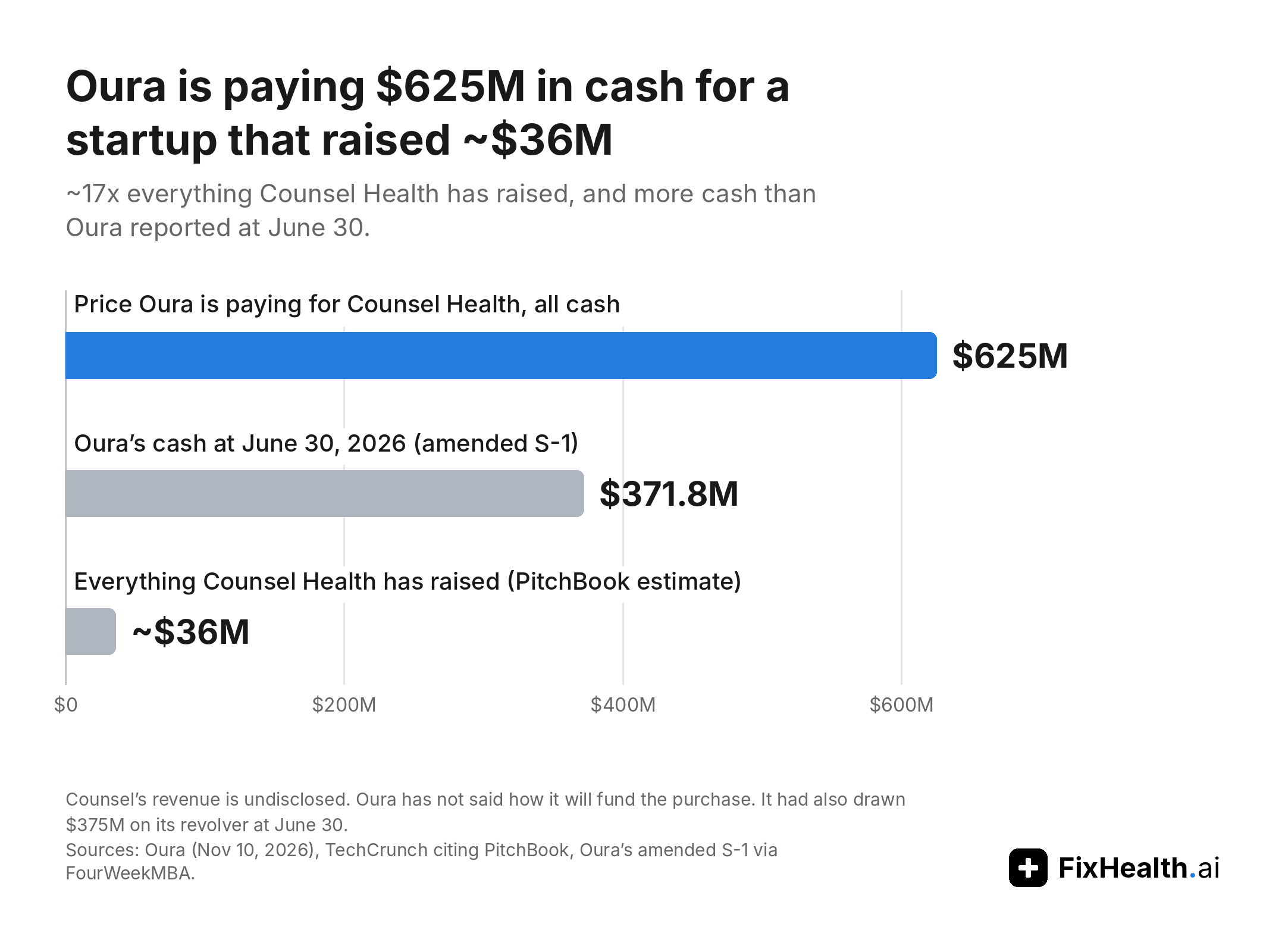
The news. Oura is buying Counsel Health for $625M in cash, 6 weeks after postponing its IPO. Counsel had raised ~$36M.
Stephanie: “It looks to me like a Hail Mary.” Oura flips from tech name to healthcare name, “and maybe this gets them public.” Her take: “If they don’t want to have a different valuation than last time, good luck.”
Me: positive for patients, great for Counsel, probably not for Oura. The ring is backward-looking. Sleep patterns are history, not prevention. If it could predict an asthma attack or a heart attack, Oura would be working with urgent care centers and ERs. It can’t.
Stephanie: harsh on every multiple in digital health, yet positive on an all-cash deal at “a high double to low triple digit revenue multiple”? (Her estimate. Counsel’s revenue is undisclosed.) “It’s great for Counsel. It’s cash.” 😂
Peter: “We’ve seen this movie before.” Companies overpay for speed to market and first-mover advantage. Technology is no longer the moat. Exclusive channel partnerships and strategic acquisitions are.
The timing is weird. A weak IPO book in September, a $625M check in November. Stephanie’s addition: it is cash, “not in stock, which doesn’t really incentivize anyone to stay.”
Stephanie’s bet: Oura’s own market cap will be $625M “at some point, not that far from now.”
My question: where does the cash come from? Oura’s S-1 showed $371.8M of cash at June 30. Oura hasn’t said.
On paper, a good deal for Counsel and a bad deal for Oura. In reality, I have more questions for Counsel than I have for Oura. A lot of things just make no sense.
How many people use it? Counsel says it is “available to more than 8 million Americans” through partnerships. But “available” is not the same as used. Its ROI paper analyzes a sample of 10,353 visits over 12 months and gives no total.
Who checked the research? Counsel’s “LLM-as-a-Judge” report is self-published. It names no authors, no outside reviewers and no AI model. Its best judge shows 96.59% accuracy on 230 threads with a Cohen’s kappa of 0.557. That is moderate agreement with the physicians who labeled the same threads. Which models does Counsel run?
The ROI paper came out a week after the deal. Counsel published its 8.5x ROI claim for health plans on Nov 17, the day we recorded. The savings come from asking members what they would have done without Counsel. 36.7% of visits got an answer. No independent reviewer is named.
4. Heidi and Abridge Cut Staff. Is Scribing Just “a Feature”?
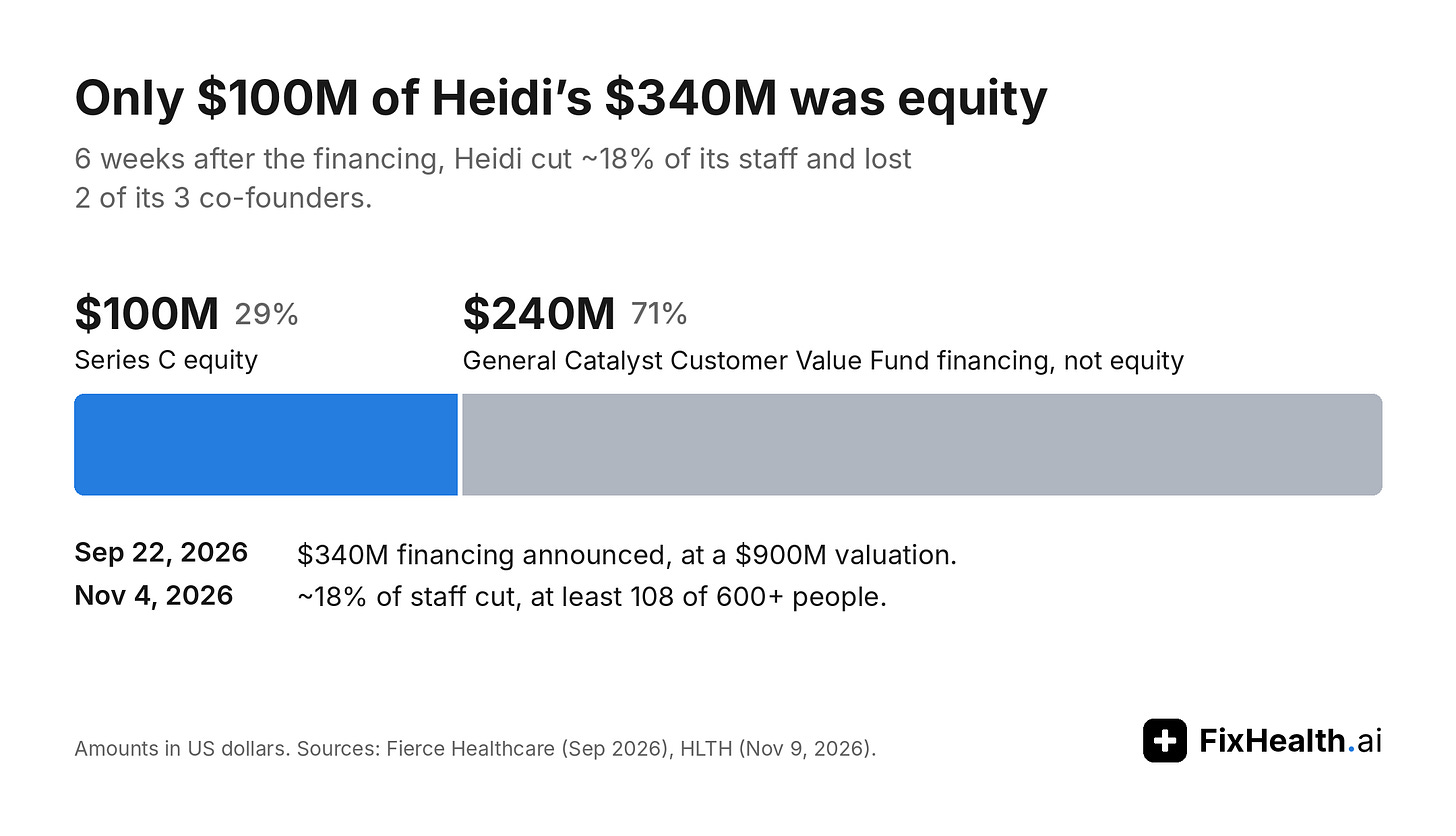
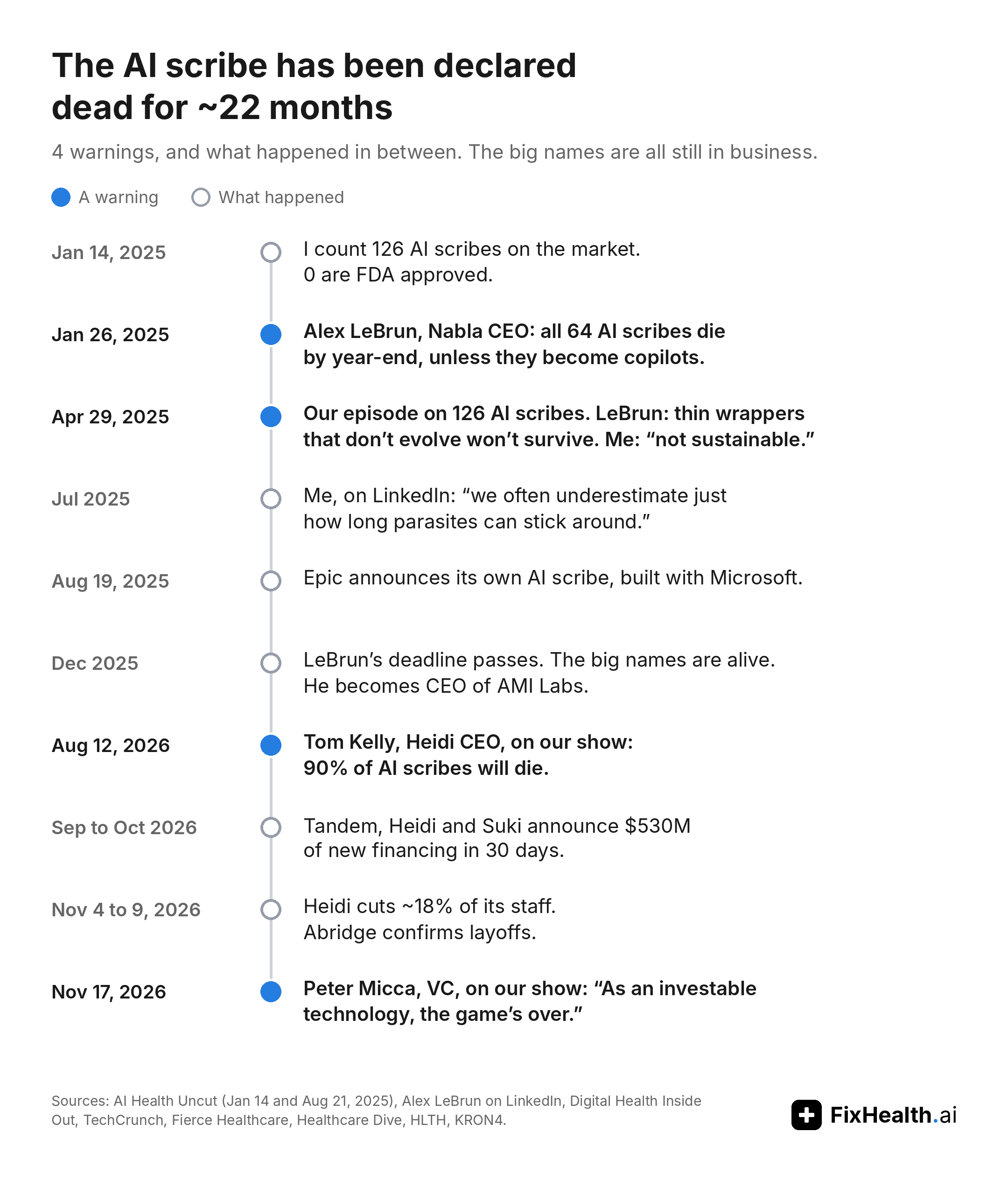
The news. Heidi cut ~18% of its staff, at least 108 of 600+ people, and is losing 2 of its 3 co-founders, 6 weeks after a $340M financing. Abridge confirmed layoffs, and athenahealth is cutting 4%.
Stephanie: scribing is “a feature.” Imagine a vendor that only bolds text, until every word processor asks, “Why don’t we bold text, too?” 😂 Valuations “got crazy and the moat wasn’t that deep.”
Peter: “We looked at a bunch of scribes over the last couple of years and the best decision we made was not investing in them.” It reminds him of telehealth during COVID, which consolidated into “effectively four companies in 6 months.” Managed care took 10 years. Scribes will go faster. The technology helps clinicians. But his bottom line: “as an investable technology, the game’s over.“
Me: “You’re speaking my language.” I counted 126 AI scribes last year. Tom Kelly told us 90% will die. Credit to Kelly for admitting Heidi overestimated demand from large health systems. I think Heidi survives. My September asterisk stands: only $100M of the $340M was equity. The other $240M is General Catalyst financing against revenue.
Alex: if only 3 or 4 win, as in telehealth, shouldn’t you speed up after a raise, not cut staff?
Stephanie is surprised there hasn’t been more M&A. To be one of the top players, you roll up features: bold text, then “italics and underlines.”
Me: none of them make money. Stephanie: “Sergei, what do you think the dollars do?” And: “You understand the concept of the land grab though?” I do. 😉 We end up with 3 or 4 players, and I think we may already have them.
5. Alex LeBrun Predicted the Death of the AI Scribe. It Didn’t Happen.
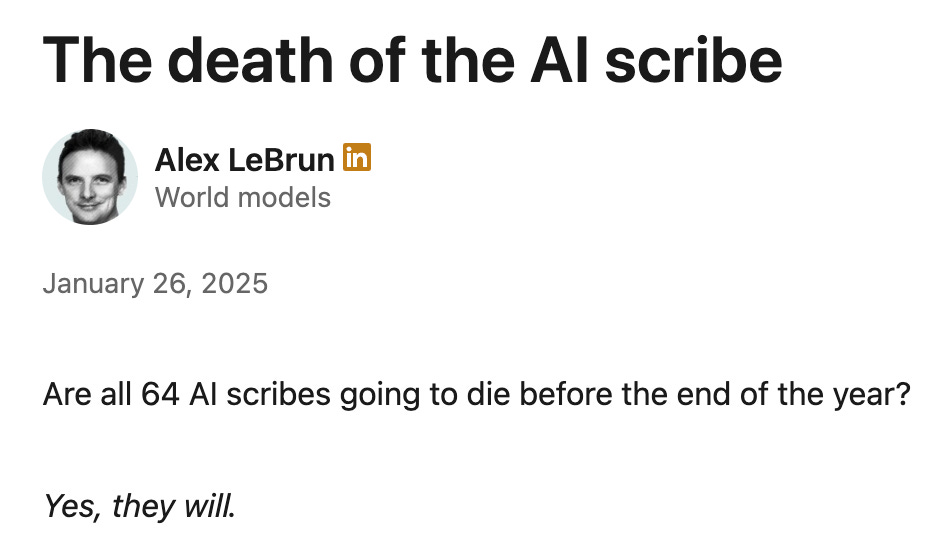
The post. On Jan 26, 2025, Alex LeBrun, then co-founder and CEO of Nabla, published The death of the AI scribe on LinkedIn. His first line: “Are all 64 AI scribes going to die before the end of the year?” His answer was yes. The only survivors would be the ones that grow into full AI copilots.
His logic. Note-taking alone is worth little. A real copilot needs deep access to the EHR, and the EHR APIs are too weak for that. EHR vendors will build copilots of their own, slowly. Startups that try to become an EHR usually fail. The radical path is an agent that works the EHR screen like a human user. OpenAI had launched Operator that same week.
My comment under his post: “Not much of a prediction, but absolutely!” I called the market “completely unsustainable.” 12 days earlier I had counted 126 AI scribes, not 64, and 0 with FDA approval. So on the diagnosis, I agreed with him.
Why he wrote it. It was a reply to Brendan Keeler, who had posted that “anyone commenting that the AI scribe market will commoditize over time is wrong.” Remember that name. He is in section 6.
What I wrote 18 months ago. From my review of the top 50 AI scribes: “There’s currently zero FDA oversight. AI scribes are copying each other, running wild, and the market has mushroomed with AI tourists and knockoffs.” I thanked “AI-vibe coding” for that. “Clinicians are bombarded daily by these fly-by-night apps. I’m here to separate the legit from the bullshit.”
What I wrote in July 2025. 6 months into LeBrun’s countdown, I said on LinkedIn that “we often underestimate just how long parasites can stick around.” I would write the same sentence today.
Scoring it ~22 months later: it did not come true. His deadline was Dec 31, 2025. On that day the big names were alive and growing. Nabla’s own ARR more than tripled that year, LeBrun said. ~11 months past the deadline, Abridge, Nabla, Heidi, Suki and Tandem Health are all still in business. Heidi cut ~18% of its staff, and Abridge announced an “organization-wide realignment.” Layoffs are not a funeral.
Dead companies don’t raise money. In 30 days, from Sep 14 to Oct 13, 2026, Tandem Health ($100M), Heidi ($340M) and Suki ($90M) announced $530M of new financing between them.
The escape hatch. LeBrun left himself a door: the scribes that turn into copilots survive. Heidi raised its money to build an “AI care partner.” Suki raised its money to build AI agents. Nabla now talks about agentic AI. If everything that is still alive counts as a copilot, the prediction can never be wrong. Then it is not a prediction.
What the scribes became instead: billing and coding tools. LeBrun’s survivors were supposed to be clinical copilots. The money turned out to be in billing and coding. Shiv Rao admitted as much in our interview: in the US, doctors are paid for the care they document, not the care they deliver, so the conversation feeds diagnosis codes, claims, risk adjustment and revenue cycle. The results vendors advertise are billing results. Texas Oncology went from 3.0 to 4.1 billed diagnosis codes per patient. Riverside reported 14% more documented HCCs per encounter. Tom Kelly’s reaction when I raised it with him: “I think Shiv’s saying that because he has to say that.” Where does capturing codes end and upcoding begin?
Where I stand. The diagnosis has not changed: too many copycats, and a market that ends with 3 or 4 major players. The timing was wrong. 3 or 4 winners someday is not the same as 64 funerals by Dec 31, 2025. How many of the 126 have quietly folded? If you have a count, DM me.
Peter’s claim is a different one. He did not say the scribes will die. He said the technology helps clinicians and the investment case is over. That one I agreed with on air.
And LeBrun himself? In December 2025, right at his own deadline, he moved from CEO of Nabla to CEO of AMI Labs, Yann LeCun’s world-model startup. He remains Nabla’s chairman and chief AI scientist. AMI Labs then raised $1.03B. The man who predicted the death of the AI scribe now runs a world-model lab. And Nabla is still in business. 🤷🏼♂️
6. Rewind to April 2025: Why the Hell Do We Need 126 AI Scribes?
The podcast episode. On Apr 29, 2025, Alex and I recorded Episode 3 of Digital Health Inside Out with LeBrun, Brendan Keeler (the Health API Guy, then at HTD Health) and Bobby Guelich, CEO of Elion. My recap from back then is here. Listen to it today. The whole November 2026 argument is already in there.
LeBrun on the long tail of thin wrappers over LLMs: “if they don’t evolve,” he did not see “how they would survive.” On documentation by itself: “the price of that alone will go down.”
Me: 90% of them “basically use Google Voice under the hood and whatever OpenAI.” “Just not sustainable long term.” I did not know one that made a profit, and I still don’t. LeBrun’s answer: Nabla was “not that far from being profitable.”
Brendan fought me on it, vigorously and respectfully. B2B software is “very, very, very rarely winner take all.” “Not everyone needs a Ferrari.” But even he agreed on one thing: “Will there be some culling? I think yes.”
Brendan on EHRs: “100% a threat.” They let you in, and then they “rug pull” once they figure out how to do it themselves. Less than 4 months later, Epic announced its own AI scribe with Microsoft.
Brendan on the land grab: the EHR “will grow to encompass as many functions as possible,” so “you need to own that land grab now.” Stephanie made the same argument to me on Nov 17. See section 4.
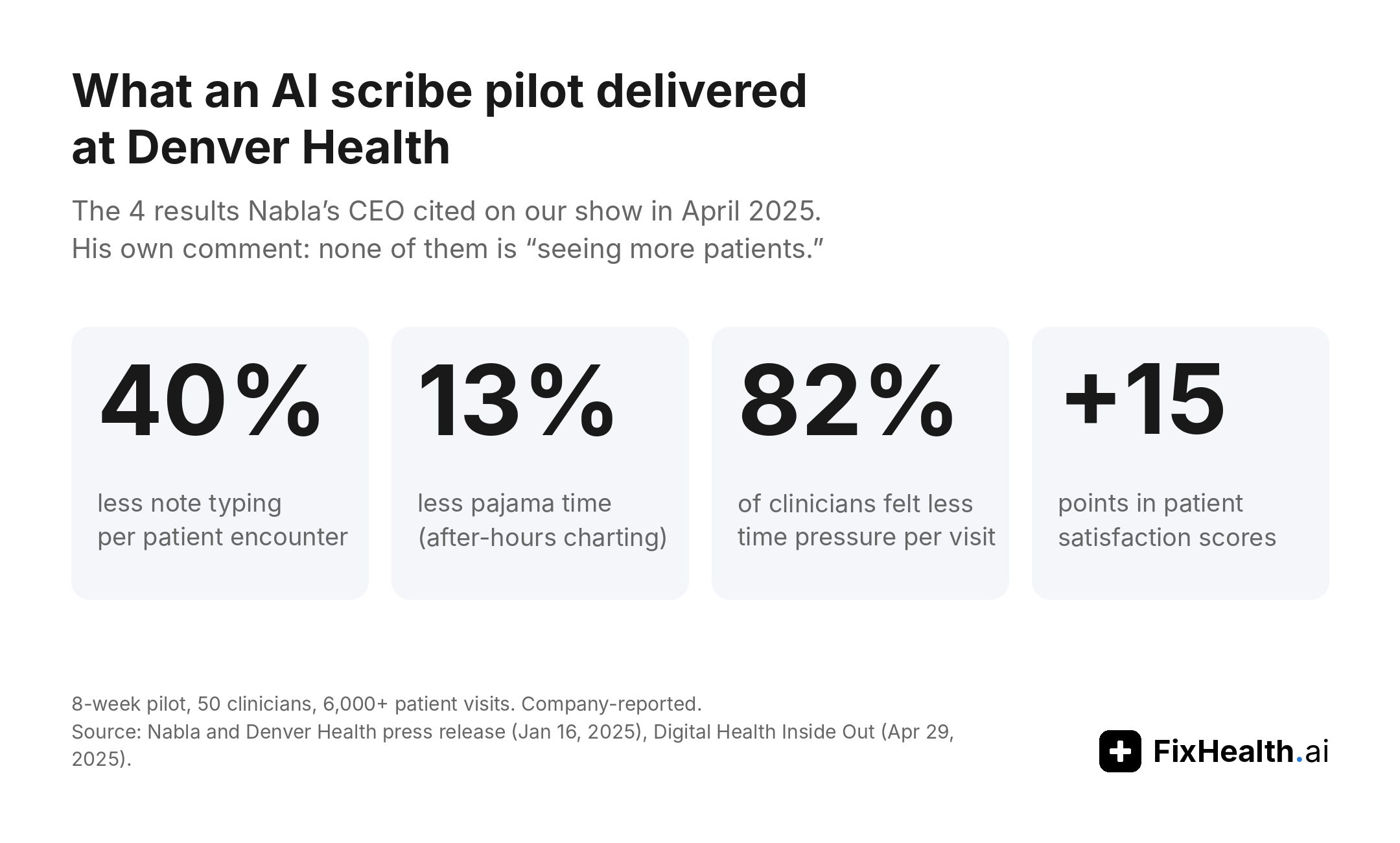
The ROI problem, in 2 quotes. LeBrun, on 100+ customer organizations: “nobody ever told me” they are seeing more patients. Brendan: when Dr. Bobby gets his pajama time back, he does not add 5 more patients. “He’s like, ‘I’m done.’” 😂 That may be the soft ROI Tom Kelly ran into 18 months later, when Heidi overestimated demand from large health systems.
LeBrun on the technology: custom models buy you an edge, and then “you get caught up by the LLM one year later.” That is exactly the disappearing moat I have been writing about since 2024.
Who was right? On timing, Brendan: a fragmented market, “some culling,” no die-off. That is what 2026 looks like. He was also right about the EHR threat and the land grab. LeBrun and I said it was not sustainable, and I have not changed my mind. But as I wrote in July 2025, “we often underestimate just how long parasites can stick around.” Ask me again in a year. 😉
7. Peter’s Bet: GLP-1s Over AI
Peter: “AI is commoditizing itself.” When “five smart people from MIT can recreate an LLM model,” the moat is channel partnerships, not technology. In 5 years, we will be overpaying for some other technology.
His bet: looking back, the most significant innovation of today “will not be AI, it will be GLP-1s,” because of what they can do to the cost curve. He admits “the jury is still out.”
What he’d back instead: a medical record the patient controls and authorizes, with no intermediary in between. “We are closer to that than we think.”
Stephanie: “How often has the personal health record been attempted and failed?” If Peter thinks it disrupts the EHRs, he “shouldn’t walk outside anywhere here.” Then she name-dropped Judy. 😂
Me: no argument on the moat. I’ve written since 2024 that frontier models beat fine-tuned wrappers, all day long. LeBrun put a number on it in April 2025: the LLM catches up in 1 year. See section 6.
8. Does Technology Make Healthcare Cheaper? No.
Stephanie’s question: is technology inflationary or deflationary in healthcare? Over the past 10 years, “it’s increased cost.”
Me: “Cost ain’t going down.” Healthcare does not behave like a consumer product.
Peter: in most industries, technology bends the cost curve quickly. In healthcare, costs go up first, because “technology moves at the speed of trust.” It is the one sector where “the more you create, the more people want.” It comes down to two questions: “How much healthcare do you want? And who’s going to pay for it?”
Stephanie: so technology is inflationary “kind of forever.” Better GLP-1s or cancer drugs from AI are “going to be expensive.” Not necessarily bad, she says, if the care gets better. My footnote: there is still no money in AI drug discovery.
Peter’s warning: one day the US has to balance its budget. Then healthcare gets rationed, or technology puts the consumer in charge.
We never got to CVS splitting into 2 companies. Next month.
👉🏼 Catch the full episode on YouTube, Spotify or Apple Podcasts, and don’t forget to subscribe. 😉
Happy Thanksgiving! 🦃 Daniel Nadler, the invitation still stands. 😉
Like what you’re reading in this newsletter? Want more in-depth investigations and research? Alright then, go tell your friends!
👉👉👉👉👉 Hi! My name is Sergei Polevikov. I’m an AI researcher and a healthcare AI startup founder. In my newsletter ‘AI Health Uncut,’ I combine my knowledge of AI models with my unique skills in analyzing the financial health of digital health companies. Why “Uncut”? Because I never sugarcoat or filter the hard truth. I don’t play games, I don’t work for anyone, and therefore, with your support, I produce the most original, the most unbiased, the most unapologetic research in AI, innovation, and healthcare. Thank you for your support of my work. You’re part of a vibrant community of healthcare AI enthusiasts! Your engagement matters. 🙏🙏🙏🙏🙏
I told you years ago that scribes are worthless. We need DATA, not more text. If you don't understand the difference, you don't get a vote or a seat at the deciding making table.
Text is why we need coders. Text is why we can't have automated orders (pharmacy, imaging, discharge, etc.) and a large reason that we get insurance denials and delays, due to the fact that someone miscoded the text a doctor spoke or typed in
I can show you how to get data from speech or typed notes, but scribes always were and always will be completely useless.